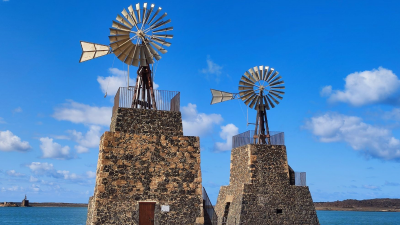
Inventories are a very useful tool in the management of cultural heritage. They allow to identify, describe and locate the heritage elements to record their existence, thus enabling the programming of actions based on this knowledge. Therefore, the General Directorate of Cultural Heritage has been promoting these works in all the islands by the expert and doctor in Art History, Amara Florido.
In the case of industrial heritage, these works contribute to define the assets that make up this unique heritage and constitute the first step on the road to protecting the most relevant elements that are part of our identity and the memory of work and place. Thanks to these investigations, important elements, ignored until now, that must be protected have been revealed.
The Inventory of Industrial Heritage of Lanzarote (2023-2024)
Continuing with the inventory work, between 2023 and 2024 the one on the island of Lanzarote was undertaken in two phases. In the first (2023), the one for the municipalities of San Bartolomé de Lanzarote, Tías and Yaiza was carried out, which was completed the following year with Haría, Teguise, Tinajo and Arrecife. In total, this inventory has the record of 239 elements of various kinds, among which mills and grinders, salt flats, lime kilns, lighthouses, workshops and ovens stand out.
By municipalities, San Bartolomé has 19 real estate assets and 40 furniture; Tías, with 14 real estate and 17 furniture, Yaiza, 16 and four, respectively; Haría has eight real estate and 22 furniture; Teguise, where a greater number of elements of interest have been registered, lists 33 real estate and eleven furniture; Tinajo, for its part, has an industrial heritage that adds up to four pieces of furniture and 14 real estate; finally, Arrecife adds 30 real estate assets and seven furniture.
With regard to movable property, the largest volume is concentrated in the Tanit Ethnographic Museum, inaugurated in 2000. Inside, a sample of the goods and belongings used by our ancestors is exhibited, which constitute a varied and rich manifestation of their social, work and religious life. It has a collection of more than three thousand pieces of various kinds: work and everyday utensils, clothing, idols, etc. The room dedicated to the wine industry stands out, where pieces of extraordinary interest are preserved: grape presses, corking machines, crushers, etc.
Another reference point is the Wine Museum, in the El Grifo wineries, inaugurated in 1982, currently located in one of the most visited in this area in Spain, with about 80,000 visitors per year. The public can see a review of the evolution of the traditional Lanzarote harvest through the machinery and utensils used since the late nineteenth and early twentieth centuries: presses, destemmers, corking machines, transfer pumps, corking machines, bottle fillers, and a wide and varied collection that has been duly registered in the inventory.
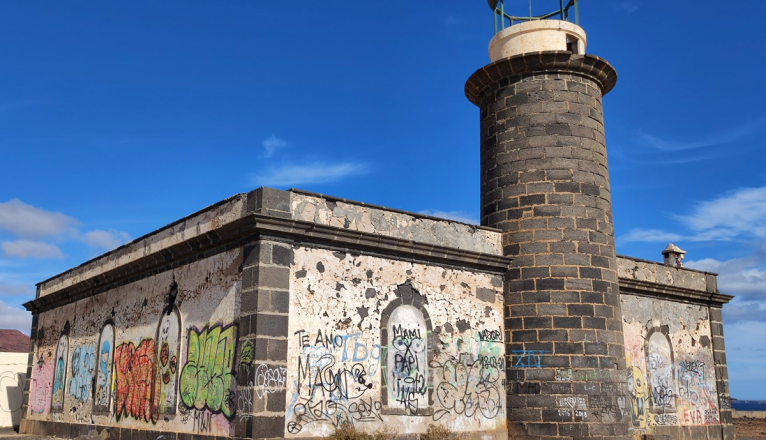
The municipality of Teguise is where the largest number of elements of interest have been registered. The gofio mills stand out, with a total of eight units, salt mills (6) and lime kilns (6). The rest is made up of: salt flats, wineries, carpentry, blacksmith shop, bakery, tahona and the Alegranza lighthouse. On the contrary, the capital of Lanzarote has lost a good part of its industrial heritage, especially that linked to the fish canning activity, which reached its maximum economic weight between 1950 and 1980.
As has happened in the other islands, it has been late on many occasions since the little or no sensitivity that has existed for decades towards the industrial material heritage has taken its toll. We generally find abandoned, semi-destroyed infrastructures. and the disappearance of relevant factory facilities on the island: fish canneries, gofio mills and grinders, tobacco factories, salt flats, etc. The movable heritage offers a worse situation since no alternatives are offered for its use once they have lost their original function.
However, we cannot forget isolated and specific initiatives that have allowed the recovery of some gofio mills and grinders in Teguise, salt mills, in Yaiza, Arrecife and Teguise; etc.



Add La Voz de Lanzarote as a preferred Google source.
Stay informed with the latest current news.