
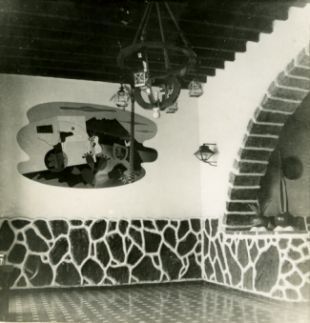
There are barely any sketches of paint left and they are imperceptible at first glance - one wonders how the worker who found them noticed them? - but the murals discovered during the rehabilitation works of the House of Culture of Agustín de la Hoz have a historical significance, since they will provide important data on César Manrique's way of working, during the first stage of his career, when he was studying at the School of Fine Arts of San Fernando in Madrid.
For this reason, the Ministry of Culture has proceeded to protect the paintings in order to continue the rehabilitation works of the House of Culture. Once finished, it will be possible to restore the murals, but not to reconstruct them, since, as the technician of the Spanish Historical Heritage Institute of the Ministry of Culture, Antonio Sánchez-Barriga, in charge of the project, has rightly warned, "we are not César Manrique". And the perspective of these works is "archaeological". "When you find ruins of a building, you don't feel like building it, but the remains provide data", illustrated the specialist technician in murals.
Now, the parts that remain have been covered by a special sheet of adhesive paper with a gel that "does not produce salts or mold" and therefore guarantees conservation until they can be restored. PLADUR walls, a kind of laminated plaster, will also be installed in front of the paintings, but without touching them, as a safeguard. When the building is inaugurated, the restoration can begin. According to the project technician, it will be possible to rescue some more parts that had been covered with paint and therefore, interpret the designs that Manrique applied and that show great influence from the "muralists of Madrid".
The discovery occurred last June by one of the workers of the works that were being carried out in the building. The absence of specialists in the Arrecife City Council, led the Councilor for Culture, Miguel Ángel Ferrer, and the César Manrique Foundation (FCM) to request the collaboration of the Ministry, which prepared a preliminary report in which it was advised to preserve the remains of paint, "even if they were very deteriorated", because they kept information about the painting techniques used, the polychromy and shapes that César used, etc. "The first study that has been carried out chemically provides data on how he worked", explains Sánchez-Barriga.
Two murals
When crossing the door of the House of Culture, one accesses what was the bar of the old Casino de Arrecife. Place where Manrique painted one of his first murals between 1947-1948, and that is photographically documented. Its remains remain today on the left side wall, but it is difficult to reconstruct the image that the photograph captures.
On the front wall, which belongs to the facade, are the remains of the other work. The only reference that exists about it is a news item from a local publication where it is reported on the arrival of "a young artist who was studying in Madrid and was going to come to Lanzarote to paint four murals in the Casino". It is thought that it could be one of them, but they are indications that will have to be investigated when the restoration is carried out.
The murals, which were made in oil on lime, have appeared covered by layers of paint that have been applied over these 60 years, which has caused the deterioration and disappearance of a large part of the work. "We have found almost four layers of paint and when you paint on lime, a concretion occurs that causes the paint to fall off", he argues about the damage to the murals.
Even so, it is expected to rescue more original drawing in the recovery phase. Regarding the study of the work, the Ministry of Culture will also carry out a diagnosis parallel to that of the FCM, which will be possible thanks to a finding, which already has its place in the artistic history of Manrique... and Lanzarote.


