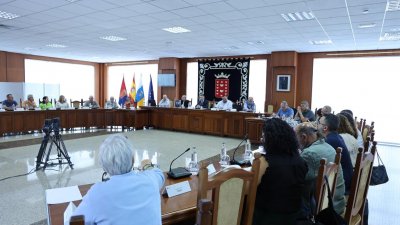
The members of the Governing Board of the Lanzarote Biosphere Reserve Council who participated in this Monday's session, have generally expressed not to consume new territory for roads. Although in some cases exceptions were raised, such as intervention in anthropized areas, the improvement of existing roads or the detection of situations of unquestionable demand, all words have been directed to preserve the island from more asphalt and to bet on public transport as a sustainable mobility alternative.
The conversation began after the presentation to the plenary of the report “Territory, mobility and roads. A new perspective for Lanzarote”, which was prepared by the César Manrique Foundation by the urban technician Alfonso Sanz, who was in charge of providing the main data.
The author of the diagnosis warned of the need to think about the territory first, think about mobility second, and finish addressing the roads, whose design “must be complete”, that is, that allows the different modalities of collective transport, the private vehicle, the bicycle and pedestrian use. He assured that Lanzarote “is hyper-motorized” and that the climatic challenge involves a change in travel habits.
After the different interventions in relation to this matter, the president of the Cabildo, Oswaldo Betancort, pointed out that “the Council of the Biosphere Reserve has pronounced itself around a majority feeling of not consuming territory on the island of Lanzarote for more roads, but to improve the existing ones, plan sustainable mobility and reduce the mobile fleet”. “As stated in the Foundation's report, we must reduce the use of private vehicles and then think about the roads”, he said.
He also announced that both the draft of the new Island Plan of Ordination of Lanzarote and any territorial intervention will pass for its knowledge and debate by the Council of the Biosphere Reserve.
The Minister of Environment and the Biosphere Reserve, Samuel Martín, announced that the Cabildo is working on a new specification for contracting the public transport service and linked the report of Alfonso Sanz with the BIOCRIT study, which also bets on roads integrated into the territory and that act as viewpoints of the landscape, of density and limited speed.
One of its managers, the architect Flora Pescador, was in charge of informing the Council of the main contents of the update of the document, which has incorporated novel epigraphs, such as swimming pools in rustic, tourist agglomerations in roferas, the appearance of unregulated parking lots or pontoons.
The president of the Cabildo also wanted to highlight the importance of the BIOCRIT project, promoted through an agreement with the Chamber of Commerce, “to reinforce the unique image and identity signs of the island, in all industrial areas”. In this sense, he announced that by 2025 the application of the BIOCRIT guidelines will also have the co-financing of the Centers of Art, Culture and Tourism (CACT) in order to strengthen the preservation of our image and landscape environment.
Add La Voz de Lanzarote as a preferred Google source.
Stay informed with the latest current news.