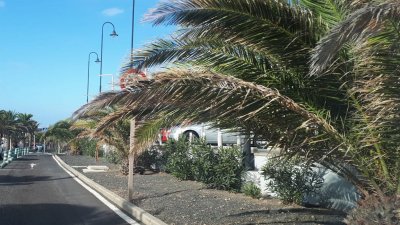
The Minister of Environment of the Cabildo of Lanzarote, Ariagona González, wanted to publicly remind the City Council of La Villa that “the maintenance of the palm trees of Costa Teguise is a municipal responsibility as they are considered urban gardening"
The councilor responded in this way to the recent complaints of the Police Councilor of Teguise, who blamed the Government of the Canary Islands and the Cabildo of Lanzarote for the deterioration of the Costa Teguise palm grove. “Other municipalities on the island have allocated their own resources to address the recovery of their palm trees instead of blaming other administrations in the media. Each one must assume the responsibilities that their status as a representative of an institution requires and seek solutions to the problems that arise in the management of public affairs,” he said.
In this regard, she cited as an example the case of the palm trees at the entrances to the airport. "It is AENA who must attend to the palm trees that welcome the island, as we know they are doing after a change in the company responsible for these works," she said. As for the Cabildo, she explains that "it is responsible for the state of palm groves with heritage classification, such as that of Haría, and those that are located on the margins of insular roads.”
In a statement, the councilor "encourages" the Consistory to "abandon the state of permanent victimhood and join the common front that the Government of the Canary Islands and the Cabildo of Lanzarote are trying to promote to face the plagues that are affecting the island's palm grove.”
In this sense, González points out that she is “waiting for an assessment report on the degree of affectation of the Diocalandra frumenti that technicians from the Government of the Canary Islands are carrying out to undertake a phytosanitary campaign aimed at ending this threat to an essential element of our landscape.” González hopes to present this material “shortly” at an Island Environment Board, “with the presence of specialized technicians and personnel from the Cabildo and the seven municipalities of the island.”


Add La Voz de Lanzarote as a preferred Google source.
Stay informed with the latest current news.