
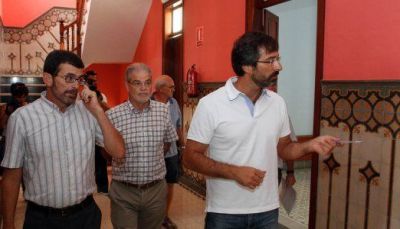
The president of the Cabildo of Lanzarote, Pedro San Ginés; and the vice president of the Island Corporation, Joaquín Caraballo; accompanied by the Councilor for Roads and Works, José Antonio Gutíerrez, and technicians from said Area, visited this Monday the old Cabildo house, once the rehabilitation works of this historic building dating from 1929 were completed. From now on, this building will house the Digital Memory of Lanzarote project, of the Data Center; as well as a tourist information point.
The authorities toured the different rooms and dependencies of the institutional building, "verifying how the different damaged surfaces have been recovered with the same materials or with others of better quality, respecting their original appearance." These works, which were received by the Cabildo on June 4, have been supervised by the Heritage department and have involved a final investment of 236,517.50 euros, "lower than the initially planned cost", charged to the Expansion Plan of the Strategy for Improvements of the Tourist Public Space, of the Government of the Canary Islands.
At the end of the visit, San Ginés stated that "after many years of magnificent work, which has been followed by the Area directed by José Antonio Gutiérrez, it is a satisfaction to be able to see this building completely restored." In addition, he announced that "this building, of great historical and architectural value, will house the Data Center project 'Digital Memory of Lanzarote'; a tourist information point, in addition to those in the Ramírez Cerdá Park and El Charco de San Ginés, and the building's own reception and information services."
For his part, Caraballo pointed out about the Data Center project that "it has a budget of about 60,000 euros and we understand that, due to its location and characteristics, the old headquarters of the Cabildo of Lanzarote is the ideal place to bring to citizens the important documentary capital that we already have, thanks to the assignments." The vice president also announced that "now it remains to provide this service with the necessary infrastructure, such as computers so that visitors who wish to do so can consult all the information, photos and videos that we have for themselves; and the space will also be prepared to house periodic exhibitions with this material." The Councilor for Roads and Works announced that the building is scheduled to open next September so that citizens can visit it.
Rehabilitation of the building
This building was the headquarters of the Presidency of the Island Council of Lanzarote until the beginning of 1997, when it moved to the current building. It closed its doors to the public in 2004, the year in which it was declared an Asset of Cultural Interest, with the category of Monument. On March 15, 2013, the rehabilitation works began, which concluded on April 12, after several delays "due to administrative causes and the difficulty of finding or recovering some materials."
The building, located on Calle Real de Arrecife, has a total area of 548.88 square meters, spread over three floors. The works basically consisted of the replacement of wooden floors (infected with xylophages) in ground floor offices, and sanitary chambers have been created under them, in order to improve the transpiration of moisture from the subsoil. In addition to the pavement, this damaged the walls, coverings and installations. For this, woods with the same characteristics as the originals were used. In addition, pavements have been replaced in the entrance hall and the ground floor distributor, deteriorated by moisture from the cistern, which has been eliminated.
The electricity and telecommunications installations have also been replaced, taking advantage of the existing conduits and the rest have been hidden behind the wooden frieze. New luminaires (low consumption) have been installed to improve the energy efficiency of the building. The sanitation and plumbing installation in the bathrooms has also been replaced and the evacuation of rainwater has been improved.
Coatings, carpentry and painting
On the other hand, the interior coverings and wooden carpentry have been renovated, eliminating and correcting deficiencies detected, with finishes of application of paints and open-pore varnishes. Likewise, the hydraulic tile pavements and the natural marble friezes were cleaned, repaired and polished in the central part. Likewise, the building has been equipped with a stairlift in one of the side doors to ensure the accessibility of people with reduced mobility (at least on the ground floor).
On the first floor, the pavements made of parquet tiles were repaired and the two-color wooden platform was replaced, the same as the original because it was completely affected by xylophages. On the facade, given that the beveled tile cladding presented bulges and loose pieces, these were replaced by new pieces with identical characteristics to the originals, as well as conduits and cables that were attached to the cornices and imposts were eliminated. The natural granite base of the facades was also replaced, rescuing the original material made in artificial granite pieces.


