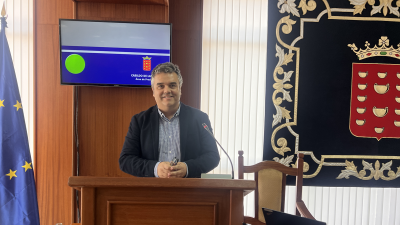
Armando Santana, councilor of the Cabildo de Lanzarote, has presented a series of initiatives aimed at improving the taxi service in Lanzarote, with the aim of guaranteeing efficient, sustainable and dignified mobility for citizens and visitors.
Santana emphasizes "the need to carry out a rigorous study on the current situation of the sector, addressing fundamental issues such as the number of licenses, the needs of the fixed and floating population, and mobility habits."
"The reality is that the Government of the Canary Islands itself has suspended the granting of new licenses for both taxis and VTCs for, at least, the next 12 months, until the councils present their new regulations for the sector," he highlights.
According to Santana, regarding VTCs, Uber operates only in the south of Tenerife, but "its expansion to our island may be a reality in a short time." “The arrival of these platforms generates debate among taxi drivers, who fear competition that could destabilize the sector.”
The absence of efficient collective transport worsens the situation, especially in key areas such as Arrecife or the airport itself, where serious problems of taxi availability have been recorded.
Santana points out that "on the island there are approximately 600 taxi licenses, a number that he considers insufficient to satisfy the growing demand for mobility." Therefore, he proposes carrying out a detailed analysis that contemplates:
-
Number of active licenses per municipality.
-
Labor conditions in the sector, including employees and owners.
-
Factors that affect availability, such as breakdowns or illnesses.
-
Distribution of shifts and effective working hours.
This study will also evaluate the moments of greatest demand, the specific needs of sensitive areas and the mobility habits of the population, to adjust the available resources effectively.
The councilor of the Mixed Group advocates for linking mobility and sustainability as fundamental pillars for the development of the sector. "Mobility is a right of citizens, and institutions have the obligation to guarantee a dignified and efficient service," he highlighted. In addition, he emphasizes "the importance of collective transport and taxis coexisting harmoniously, to offer comprehensive and sustainable solutions."
As part of his proposal, the councilor has proposed the creation of an Island Taxi Board, a space for dialogue in which professionals from the sector, public representatives and cooperatives participate. "This body would have the purpose of sharing information, coordinating efforts and simplifying resources. Although the initial agreements of the board would not be binding, they would serve as a roadmap to recover and optimize mobility on the island," he explains.
Santana has also drawn attention to "the need for municipalities to assume their responsibilities in the management of the sector." However, he emphasizes that "the Cabildo must act as guarantor to ensure that the right of citizens to effective mobility is fulfilled."
Among the proposals, the optimization of existing licenses stands out, promoting a system that allows work in minimum shifts of two daily periods, in order to maximize the operational capacity of the service.
The councilor concluded by highlighting that these initiatives seek not only to improve the current service, but also to lay the foundations for a more sustainable, efficient and oriented mobility to the real needs of Lanzarote. "It is time to act with seriousness and responsibility so that the taxi sector is an engine of development and well-being for our island," said Santana.



Add La Voz de Lanzarote as a preferred Google source.
Stay informed with the latest current news.