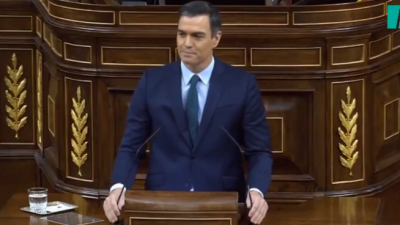
The President of the Government, Pedro Sánchez, defended this Wednesday that, despite the unanimous criticism of the parliamentary groups in Congress, Spain's position on the Sahara does not imply "a turn or a swerve", but only "one more step" in a position that Spain already maintained and that has allowed to "restart" relations with Morocco.
In a debate lasting more than eight hours on the European Council, the economic crisis and the Sahara, Sánchez has argued that his support for the self-determination proposal for the Sahara presented by Morocco in 2007 was already "welcomed" by the Governments of José Luis Rodríguez Zapatero and Mariano Rajoy, "adapts to international legality" and will serve to resolve a conflict of almost 50 years in a manner "mutually acceptable" to the parties.
According to the president, the support for the autonomy proposal for the Sahara is within the framework of the UN and the resolutions of the Security Council, places Spain in the same position as France, Germany and the United States, and must be adopted by mutual agreement by the parties.
Before the delegate of the Polisario Front in Spain, Abdula Arabi, and the delegate of the National Union of Sahrawi Women and Delegate of the Polisario Front in the Community of Madrid, Jadiyetu el Mokhtar, who were following the debate from the guest gallery, Sánchez stressed that, in the Spanish position "there is no disinterest, nor neglect of the Sahrawi people; what there is is determination to solve an entrenched problem without perspective of solution".
After Sánchez's explanations, one after another, the parliamentary spokespersons of all the groups have criticized the new Spanish position and the defense that the president has made of it.
Thus, they have reproached him for taking the decision to change a "State" position without consulting the Government or Parliament and without warning Algeria, and have criticized him for having "yielded to the blackmail" of Morocco without knowing what benefits Spain obtains in return. Canary Islands parties have also joined the reproaches, especially for the cession to Morocco that it implies.
"He who yields once always yields"
The spokesperson for the Canarian Coalition, Ana Oramas, has warned that "having a good relationship with Morocco is fundamental, but giving in to blackmail is a sign of weakness, because he who yields once always yields", while Pedro Quevedo, from Nueva Canarias, has expressed the concern that the archipelago has about the idea of having an enlarged Morocco off its coasts.
The letter that Sánchez sent to the King of Morocco defining the new Spanish position is "a mess", according to the head of the PP, Cuca Gamarra, and has been written in a "irresponsible, arbitrary and clandestine" manner, in the opinion of the president of Vox, Santiago Abascal.
"While other European countries are looking for reliable energy suppliers, you have weakened the relationship with Algeria. Does it seem absurd to you? It is," the popular spokesperson stressed.
Abascal has also reproached that Sánchez has decided the change on "his own account and risk", as an autocrat, without counting on his party or on Congress: "The letter is a damn insult to this parliament". The adjective has bothered Sánchez, who has asked him to withdraw it, something that Abascal has refused.
The opposition has also criticized the president for personally deciding on such a change of policy and then seeking the support of the chamber, arguing that it is a State policy, an argument to which the spokesperson for Ciudadanos, Edmundo Bal, has replied that Congress "is not a dispenser of guarantees where to come to ask for support for decisions already adopted in 24 hours and that give an absolute turn to an international position of Spain that has been unchanged for 50 years".


Add La Voz de Lanzarote as a preferred Google source.
Stay informed with the latest current news.