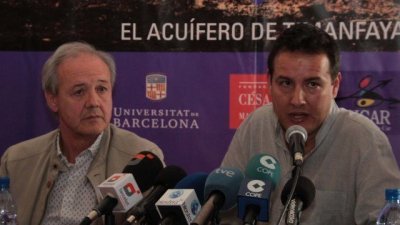
The Podemos group in the Cabildo of Lanzarote has organized an act of public presentation of the discovery of the Timanfaya aquifer for this Thursday, June 1, at 8:00 p.m., at the Civic Center of Arrecife. The formation, which announced to the media last Thursday the discovery of "a huge natural cistern", will now transfer the details of the project to the residents of Lanzarote.
The presentation of the discovery, which will be moderated by the spokesperson of the formation in the Cabildo, Carlos Meca, will feature the intervention of the engineer Carlos Soler, author of the theory about the existence of underground water under the badlands of the island and discoverer of this aquifer; and Albert Casas, doctor in Geological Sciences, professor of Prospecting and Mining Research and dean of the Faculty of Earth Sciences of the University of Barcelona.
"This public presentation of the discovery of the waters of Timanfaya has the objective of resolving any possible doubts that have arisen over the last few days in relation to this project," Podemos said in a statement.
Soler found the Fuente Santa of La Palma
The author of the discovery, Carlos Soler, is a civil engineer, channels and ports with a specialty in Hydraulics and Energy and professor of the subject of Hydraulic Works and Uses in the School of Technical Engineers of Public Works of the University of La Laguna. Soler has also been recognized for being the author of the discovery of the Fuente Santa of La Palma.
In 1987 Soler joined as an official of the body of engineers and architects in the Hydraulic Service of Santa Cruz de Tenerife and was appointed director of Works of the Ministry of Public Works and the corresponding Council of the Government of the Canary Islands. A year later he was appointed director of the Advancement of the Hydrological Plans of El Hierro, La Gomera and La Palma and from 1992 to today he has designed and directed the hydraulic works that he defined in those advances. In addition, he was appointed water expert by the European Union.
For his part, Alberto Casas Ponsati has a degree in Geological Sciences and a doctorate in Geological Sciences from the University of Barcelona, as well as a diploma in Underground Hydrology from the Polytechnic University of Catalonia. He has more than 45 years of teaching and research experience as a university professor and has been Professor of Prospecting and Mining Research since 1992. He has also been president of the Near Surface Division of the European Association of Geoscientist and Engineers, member of the Council for the Sustainable Use of Water of Catalonia and academic coordinator of the Thematic Network in Earth Sciences of the Ibero-American Program of Academic Mobility of the OEI, among other positions.


Add La Voz de Lanzarote as a preferred Google source.
Stay informed with the latest current news.