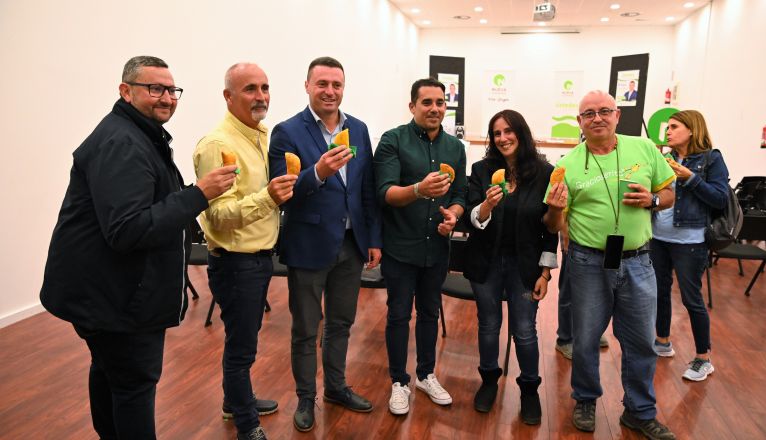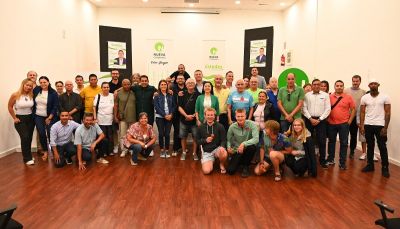
Óscar Noda has advocated this Tuesday, May 16, for the participation of the different national communities in the political life of Lanzarote. This was stated by the Canarian candidate who leads the 'Third Way' in the elections that will be held in a few days during the "Meeting of Nations of the World", an event organized during the afternoon by the Local Committee of Nueva Canarias in San Bartolomé in the Civic Center of Playa Honda.
In it, Noda held an enriching debate together with the candidate of Nueva Canarias for the Mayor of San Bartolomé, Pablo Yebra, and the candidate for Lanzarote and La Graciosa to the Parliament of the Canary Islands, Yoné Caraballo, with an audience and active participation of dozens of citizens of national communities with a large resident population on the island of Lanzarote.
The also candidate for re-election as mayor of Yaiza, has insisted on the need for "the integration of different cultures" in Lanzarote and has defended "the maintenance of its main values, which include plurality and coexistence."
Noda has stressed "the different and fruitful policies on Immigration and Social Welfare" carried out in the southern municipality that he has governed so far with Unidos por Yaiza (UPY), so also in terms of inclusion, immigration, education and cultural and social plurality he has again advocated for "extrapolating the management model of Yaiza to the island level." Not in vain, apart from Arrecife, where the Official School of Languages (EOI) has its headquarters, Yaiza is the only municipality that "has requested" and that "will soon have classrooms of this body" of the Government of the Canary Islands, which also includes Spanish for foreigners and different formulas to share days of coexistence between different nationalities.
During the meeting, despite the borders, the common spaces shared by the Canary Islands with other territories in the European, African and also Latin American environment and, specifically, with the Canarian culture were made. "The Canary Islands are a land of emigrants and we are a supportive and welcoming people." The Canarianism that we defend in Nueva Canarias defends that the "decisions about this land are made from here, by the people who live here," said Caraballo.
Thus, there were constant references to values such as "music, gastronomy and culture in general", but without a doubt, the message most reinforced by Óscar Noda, was based on the policies that, he assured, will be transferred to the First Corporation of Lanzarote after the next elections, policies "focused on advising and informing foreign residents of the Island about any procedure" and measures that encourage factors such as "coexistence, harmony and hospitality."
Both Noda and Pablo Yebra and Yoné Caraballo were interested in "the needs, problems and concerns of migrant groups" on an island that has, as in the case of the municipality of Yaiza, more than 40 different nationalities among its population of law.
Thus, several attendees activated with different contributions and proposals a debate in which the "housing difficulties of Lanzarote in Housing - even more for foreign citizens -, the processing of residence permits for community and non-community citizens, the ratios of economy and employment on the Island and factors such as the social integration of migrants" were addressed.
There was no shortage of criticisms and different proposals to the "shortcomings that Lanzarote suffers in terms of hosting foreign minors and adults."
In turn, "like other neighbors of this and other municipalities, which are part of this island and our society," the debate also gave rise to current problems that affect and concern the entire society of Lanzarote "whether they are Canarian or from wherever," such as "the serious interruptions of water supply and agricultural water that users of Canal Gestión and the Primary Sector continue to suffer, the various socio-health deficiencies of the Island or the need to improve mobility in many points of the Island."
Of course, the possibility of "exercising the right to vote" was another of the most debated aspects. In this sense, Óscar Noda, Pablo Yebra and Yoné Caraballo encouraged the attendees to participate in the public life of their municipality, their island and the Canary Islands and to get involved in political activity, either from citizen participation or more directly from a political formation such as Nueva Canarias.
This first "Meeting of Nations of the World", which featured live Caribbean music, concluded with a shared enyesque in which attendees could taste, among other typical products from other communities, Colombian empanadas.