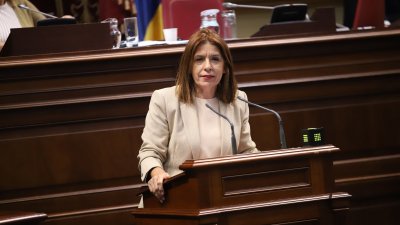
The deputy for Nueva Canarias-Bloque Canarista (NC-BC), Carmen Hernández, will argue this Wednesday in the extraordinary plenary session of Parliament that the new Canary Islands Radio and Television Law (RTVC) "places these two public Canary Islands media outlets at the service of the president of the right-wing government and head of Coalición Canaria, Fernando Clavijo".
The author of the amendment in its entirety from the progressive nationalist group will request the return of the Bill (PL) for the Regulation of the Public Service of Audiovisual Communication of the Autonomous Community of the Canary Islands for three fundamental reasons. Hernández denounced the "concentration of exceptional power in a single person, the director general". She also warned of the "weakening" of parliamentary control and the risk to "plural and independent information".
After finishing the analysis of, among other documents, the report from the Canary Islands Consultative Council (CCC), which severely questions the PL's suitability for the Constitution and European regulations, as well as the contributions from sector professionals, Carmen Hernández formally registered the amendment in its entirety to the PL.
The text promoted by Clavijo, according to NC-BC, "does not guarantee the functional independence" of the public audiovisual communication service "nor does it strengthen the democratic governance" of RTVC. Quite the contrary, Hernández maintained that it "normalizes exceptions, reduces institutional checks and balances, and concentrates disproportionate power in a single-person body, that of the General Directorate".
For Carmen Hernández, Clavijo's text aims to "hijack the radio and television of all Canary Islanders to put them at his service."
He maintained that the CCC warns of the violation of Article 20.3 of the Constitution, of the principle of legal certainty and of Regulation (EU) 2024/1083, which requires stable mandates, editorial independence, and protection against political interference in public media.
In this regard, Carmen Hernández criticized the linking of the mandates of the RTVC governing bodies to the political cycle of the legislature and the absence of guarantees against discretionary dismissals
Denounces that the law weakens parliamentary control
One of the most worrying aspects of the project, according to Hernández, is that "a collegiate model is de facto replaced by a personal system," by allowing the General Directorate to "indefinitely assume" the powers of the Control Board without establishing mandatory deadlines for its formation. "This does not correct the institutional deadlock," alleged by Clavijo to introduce this new regulation, but rather "perpetuates it," stated the Canary Islands deputy.
Nueva Canarias–BC considers it "especially serious" that the law "weakens parliamentary control, dilutes social and professional participation, and eliminates the guarantee of essential bodies such as the information councils, which are essential for safeguarding editorial independence and professional rights."
Carmen Hernández emphasized that her request for the return of the PL includes an express defense of the labor rights of RTVC workers, warning that the wording of the seventh additional provision opens the door to mandatory staff subrogation and outsourcing processes that jeopardize job stability and direct public management of the service.
A strong public media outlet, in his opinion, needs professionals with "rights, security, and autonomy. Precariousness or outsourcing of its staff weakens the quality of information and the independence of the service." He called for legislation to guarantee the integration of personnel as employees of the public entity and to shield employment from political or commercial decisions.
Hernández also warned of the “unjustified expansion” of the Directorate General's contracting powers, which will be able to authorize contracts of up to 1.5 million euros. A figure that is “disproportionate” in relation to the entity's budget, and much higher than that of other public media in other regions such as Madrid or RTVE. “This decision reveals a model of concentration of economic and political power incompatible with a democratic public service,” he reprimanded
A sweeping amendment
The amendment in its entirety also questions the lack of guarantees for Canarian audiovisual production, the high concentration of contracts with a single operator, and the possibility of outsourcing strategic services, including news, without sufficient safeguardsFor Hernández, RTVC "cannot function as an instrument of the government in power, but as a public service for the citizens, for political pluralism, and for territorial cohesion." Therefore, NC-BC advocates for the return of the bill to the Executive of CC and PP and the drafting of a new law based on "parliamentary consensus, constitutional and European law respect, and real participation" from society and sector professionals."Information is a fundamental right and cannot be subordinated to the logic of power or the market, nor to political urgency. Without independent public media, there is no quality democracy," the NC-BC parliamentarian concluded



Add La Voz de Lanzarote as a preferred Google source.
Stay informed with the latest current news.