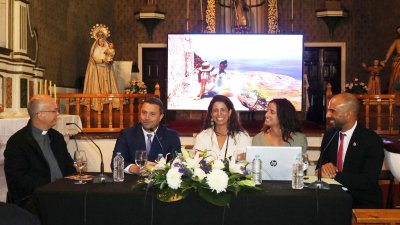
The counselor of the Mixed Group in the Island Council of Lanzarote, Óscar Noda, has presented a motion for the next plenary session in which he requests that the Cabildo of Lanzarote “financially support in its annual budgets, with the same allocation that it grants to the other great religious festival of the island, Los Dolores”.
At the same time, he requests that “a project be commissioned to write museum content and find a location, in coordination with the Yaiza City Council, to disseminate the historical importance of the events narrated to our new generations and to those who visit us” and, finally, that “the Government of the Canary Islands and the Parliament of the Canary Islands be urged to recognize San Marcial and Femés as the origin of Christianity in the Canary Islands, recognizing the creation of the first Bishopric in the archipelago”.
For Óscar Noda, “San Marcial del Rubicón is the area where the History of the Canary Islands begins and the place from which Christianity departs to each of the islands of the Archipelago”. In beautiful words of Agustín de la Hoz, “it transcends the interior with its defects and virtues, with its faith, its justice, its love, its fanaticism and its pain, also, to the extent that it is, its art, its adventure and its intelligence”.
Noda explains in defense of his proposal that “the history of San Marcial in the Canary Islands is closely linked to the founding of the city of San Marcial del Rubicón, originally located near the current beaches of Papagayo. The church of San Marcial, where the image of the saint was venerated, was later moved to the town of Femés, where the hermitage dedicated to the saint is currently located. That first construction will have the devotion of a saint, for whom the French conquerors had a predilection, San Marcial, who was bishop of Limoges in the 3rd century after Christ. Therefore, in 1404”, continues Noda, “Betancourt requests Pedro de Luna, Pope Benedict XIII, for a bull to distinguish that place; he grants it on July 7, 1404 in Marseille, erecting the Rubicense city and designating it as the diocese of a bishopric, declaring the small hermitage as a suffragan (dependent) cathedral of Seville. The cathedral of San Marcial del Rubicón remained between 1407 and 1485, when its seat was moved to Gran Canaria at the request of Bishop Frías, the last holder of San Marcial and the first of Las Palmas de Gran Canaria”.
Therefore, continues Óscar Noda, “the festival of San Marcial del Rubicón is celebrated every July 7 in Lanzarote, being the oldest in the Canary Islands. This religious festival commemorates the founding of the first city, castle and bishopric in the archipelago, San Marcial del Rubicón, by the Normans in 1404, with the support of Pope Luna and King Henry III of Castile", Noda indicated.
In this sense, he pointed out that "San Marcial, also known as Marcial de Limoges, as it was the place from which San Marcial was originally from and is currently popularly recognized as the patron saint of Lanzarote and one of the patron saints of the Diocese of the Canary Islands". Thus, he added that "San Marcial has its importance in the history of the Canary Islands, since it exemplifies the events that occurred in the periods of conquest and evangelization. The figure of San Marcial symbolizes the arrival of Christianity to the Canary Islands and the founding of the first religious institutions in the archipelago, therefore he is the maximum exponent of the union between history and faith. The festival of San Marcial is an example of how history and faith are intertwined in Canarian culture, remembering the events of the past and celebrating the identity of the island and, furthermore, the devotion to San Marcial in Lanzarote reflects the identity and traditions of the island, being an important part of its cultural heritage”.



Add La Voz de Lanzarote as a preferred Google source.
Stay informed with the latest current news.