
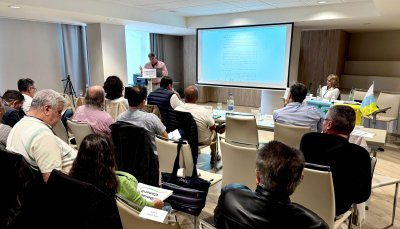
Liberación Canaria celebrated its I National Congress last Saturday, January 10, a meeting in which the organization approved a Political and Ideological Action Paper that defines a comprehensive national project for the Canary Islands based on real self-government and the expansion of the Archipelago's decision-making capacity.
According to the party, the document stems from a widely shared observation in Canarian society: the macroeconomic growth of the Islands does not translate into an improved standard of living for a significant portion of the population. In Liberación Canaria's opinion, this gap is due to a political, legal, and economic framework that prevents decisions from being made in the Canary Islands on key issues such as territory, taxation, economic planning, and strategic sectors.
The proposal places at its core the need to equip the Canary Islands with effective decision-making capacity to address its structural problems. In this regard, it proposes a Differential Legal Framework Canary Islands-State that allows for the maximum expansion of sectoral sovereignty quotas in areas that are decisive for the well-being, dignity, and opportunities for progress of the citizens.
One of the pillars of the project is the modification of the status of the Canary Islands in the European Union, changing from the current condition of an Outermost Region to that of an Overseas Country and Territory. This change, according to the organization, would allow for greater decision-making power in matters of trade, taxation, public aid, and foreign relations, adapting policies to the island reality.
The document also proposes a profound reform of the Economic and Fiscal Regime (REF) to orient it towards productive development, fiscal justice, and the strengthening of the Canarian business fabric. In parallel, it advocates for the creation of a full Canarian Treasury, with collection and tax planning capacity, so that all wealth generated in the Archipelago is taxed in the Islands.
Economic sovereignty over the Canary Sea constitutes another of the strategic axes of the proposal. Liberación Canaria proposes a status of Full Internal Autonomy that allows for the management of archipelagic waters, the exclusive economic zone, and the fishing, energy, and logistics resources linked to the maritime space.
In the fiscal sphere, the document includes the implementation of taxes for tourist overnight stays, access to natural spaces, and cruise ship calls, with the aim of making those who use the territory and public services co-responsible. Likewise, the creation of a Canary Sovereign Public Fund is proposed, intended to finance housing, energy transition, productive innovation, and social profitability projects.
Ports and airports are defined as strategic infrastructures of logistical sovereignty. The proposal suggests the creation of a Canary Islands Strategic Management Authority that guarantees the coordination, planning, and control of these infrastructures, orienting them towards a national strategy.
The protection of territory is established as a cross-cutting theme of political action, linked to the planning of tourist flows, housing policy, and social balance. In this context, the paper incorporates the regulation of residences, migratory flows, and foreign residency as key competencies to guarantee social cohesion and demographic balance.
The project approved in Congress places Canarian national identity as a unifying element, along with its own educational model and the reinforcement of public social rights, healthcare, and education.
With this Congress, Liberación Canaria begins a new political phase and presents itself as an organization with a roadmap and a vocation for government. The party believes that the paper opens a fundamental debate on the country's model and on who should have the power to decide the future of the Canary Islands, inviting Canarian society to participate in that process.


