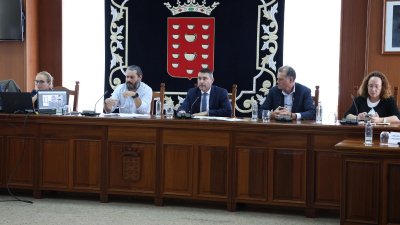
The Lanzarote Island Water Council is driving a global investment exceeding 6.4 million euros aimed at improving urban drainage, reducing losses in the supply network, and strengthening hydraulic security across the island, in the context of the current water emergency situation, recently extended.
Furthermore, as stated in the files included in the agenda of the General Meeting held this morning at the Cabildo de Lanzarote, all approved actions have already passed their administrative phase and are ready to go out to tender through the Public Sector Contracting Platform, after the approval of the projects, technical and administrative specifications, and the authorization of the corresponding expenditure by the Intervention Department.
The president of the Cabildo and of the Island Water Council, Oswaldo Betancort, described the agreements as “historic” and pointed out that “the objective is clear: to ensure that the integral water cycle, which covers sanitation, supply, and the primary sector, becomes increasingly competitive and efficient.” Betancort conveyed his gratitude to the Island Water Council for its support, as well as to the professionals of the Cabildo for the work carried out.
“The future is faced with optimism, with the foresight of being able to announce new positive news soon,” added the president of the Cabildo who also wanted to highlight the actions that will be developed in Haría, although he regretted that its mayor did not attend the Council Meeting.
Stormwater works in Argana, network renovation and drainage of more than thirty ravines
Among the adopted agreements, the approval of the project for the improvement of rainwater drainage in the Argana neighborhood, in the municipality of Arrecife, stands out, with a total investment of 964,892.11 euros and an execution period of eight months. This action is mostly financed by the Government of the Canary Islands, which contributes 959,152.48 euros, while the Insular Water Council assumes 5,739.63 euros. It will allow correcting flooding problems during rain episodes through the installation of new storm drains, the improvement of collectors, and the adaptation of different critical points in the neighborhood.
The General Board has also approved two framework agreements that will allow agile action throughout the island to improve the efficiency of the hydraulic system. The first, endowed with 3 million euros, is allocated to the renovation of supply networks to help reduce losses, currently standing at 55% of uncontrolled water, while the second framework agreement of 2 million will allow the execution of cleaning and drainage improvement actions in about thirty ravines of the insular hydrographic demarcation. These agreements are financed by the Cabildo de Lanzarote and will be executed progressively through specific interventions.
In the section on network renovation, and in view of the criticism from the Socialist Party, it was clarified by the technicians attending the General Meeting that the works to be carried out within the framework agreement are within the competencies of the Insular Water Council, which also acts in cooperation with the Lanzarote Water Consortium, without these works being confused with the location of leaks and repair, which are the responsibility of the concessionaire Canal Gestión.
Improvements in Haría
In the scope of specific actions, the General Board has also authorized the execution of cleaning and adaptation works of several sections of ravines in the municipality of Haría, with an investment of 461,779.02 euros fully financed with own funds from the Insular Water Council and an execution period of four months. The interventions will be carried out in the ravines of Trujillo, Tenesía, Elvira-Sánchez, Curbelo-Chafariz and La Negra, and will include the removal of debris and vegetation, the recovery of traditional structures and the improvement of the natural water course to favor runoff.
For his part, the Water Councillor of the Cabildo de Lanzarote, Domingo Cejas, has focused on operational management, pointing out that “these agreements allow us to intervene quickly throughout the island, optimizing resources and responding to both structural problems and specific incidents.” Furthermore, he highlighted that “the combination of direct works and framework agreements gives us an effective tool to continue developing this year the roadmap planned for hydraulic matters.”
Likewise, the General Board took note of the continuity of the water emergency situation on the island, extended until August 4, 2026, which allows continuing to activate extraordinary measures, expedite investments and prioritize key actions to guarantee the supply and efficiency of the island's hydraulic system.


Add La Voz de Lanzarote as a preferred Google source.
Stay informed with the latest current news.