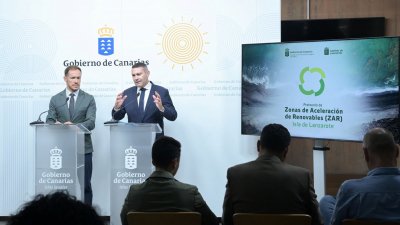
The Government of the Canary Islands and the Lanzarote Island Council have signed the first collaboration protocol in history for the development of Renewable Acceleration Zones (ZAR) in the archipelago, a pioneering measure born from the modification of the Canary Law on Climate Change and Energy Transition.
This protocol, which makes Lanzarote the first island to formally join this process, lays the foundations for defining in a consensual manner the areas suitable for the development of renewable energies on land, that is, wind power on land and photovoltaic, with technical, environmental and territorial criteria, with the aim of accelerating decarbonization and providing legal certainty to promoters and investors.
The Minister of Ecological Transition and Energy, Mariano H. Zapata, explained that "these ZAR zones are a novel figure in the Canary regulatory framework, which arises from the initiative of this Government" and that they seek nothing more than "consensus with society and administrations to continue betting to achieve a decarbonized Canary Islands without renouncing the necessary environmental protection".
Zapata also thanked the Island Council and its president for their willingness and work, trusting that the rest of the island councils will join as soon as possible, as they are working intensively with each one. "They are the true connoisseurs of the territory and a very important active part for the definition and delimitation of the same and to provide the entire archipelago with an orderly, responsible and transparent territorial planning in energy matters." He also highlights that also in this and the rest of the protocols "the business sector and others of relevance such as the Biosphere Reserve have been involved." He also wanted to thank the commitment and leadership of the Deputy Minister, Julieta Schallenberg, and her entire technical team in the area of Climate Change, as well as the General Directorate of Biodiversity and Energy, who have done an important job to be able to have this document today.
For his part, the president of the Lanzarote Island Council, Oswaldo Betancort, stated that with the signing of this protocol "we are taking a decisive step towards our own, orderly and sustainable energy model for Lanzarote and La Graciosa, as we will be the first island in the archipelago to have specific regulations that define our Acceleration Zones for Renewables (ZAR)"; the result of rigorous planning that respects our environment, he said. "This not only guarantees that clean energies are implemented with territorial criteria and consensus," he commented, "but also reinforces our island sovereignty in strategic decision-making." Oswaldo Betancort also thanked the Government of the Canary Islands for the technical support and sensitivity shown to "walk together towards a green future."
Regarding this signing, the Councilor for Territorial Policy of the Lanzarote Island Council, Jesús Machín Tavío, also spoke, who stressed that "Lanzarote must work to continue being an environmental benchmark, and an example of how to advance towards renewable energies without renouncing the landscape identity or the protection of the territory," he said.
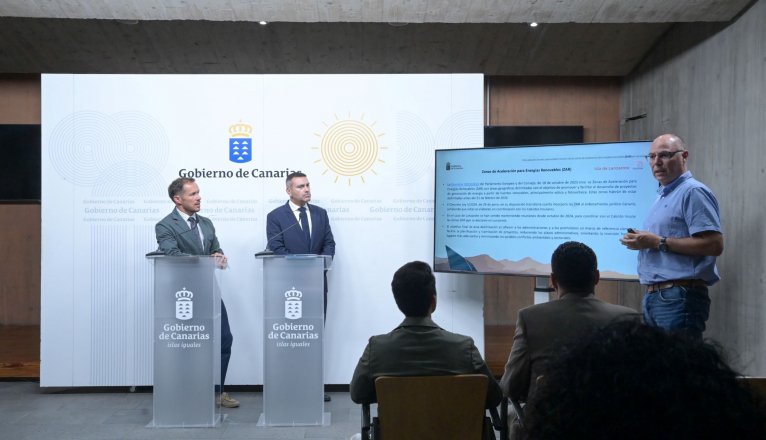
The ZAR zones, in detail
The Renewable Acceleration Zones (ZAR) seek to identify large and suitable spaces to locate new renewable projects on land (wind and photovoltaic).
These zones will be the result of a rigorous and coordinated analysis between the Ministry of Ecological Transition and Energy, the island councils and other areas of the Government of the Canary Islands such as Agriculture and Biodiversity.
The delimitation of the ZAR starts from a technical and transparent approach that excludes protected natural spaces such as National Parks or areas of the Natura 2000 Network, and incorporates variables such as island and municipal urban planning.
Thanks to this protocol with the Lanzarote Island Council, the areas that could host wind or photovoltaic energy projects on the island have already been determined, based on its Provisional Island Ordinance (OPI) and the regulations already in force regarding renewables. The result is a consensual proposal that combines development, sustainability and territorial planning.
The area qualified as suitable as ZAR will be a bag of 3,163.89 hectares, which is equivalent to 3.75% of the total area of the island. Of which, to achieve the decarbonization objectives by 2030, the actual occupation area is estimated to be 0.23% of the island's surface.
This is because the ZAR protocol differentiates between suitable zones, where renewables could be added, and conditioned zones, which could also be suitable if some aspects of the area related to Agriculture, Biodiversity or other issues such as aeronautical easements are reviewed.
With this model, any promoter who starts a project within a ZAR zone will have a more agile and secure framework for its processing. In this sense, the Government undertakes not to voluntarily apply the figure of article 6 bis of the Law of the Electricity Sector, which until now was used as an extraordinary way to make renewable installations viable in areas without specific planning.
The Lanzarote protocol and these zones can be consulted from this Wednesday on the Energy website of the Government of the Canary Islands.
Add La Voz de Lanzarote as a preferred Google source.
Stay informed with the latest current news.