
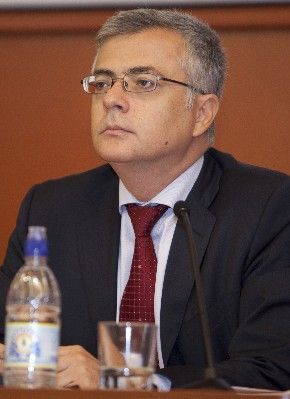
"Society can trust the work that is being carried out by the Prosecutor's Office in the area of environmental and urban crime." This was stated by Guillermo García-Panasco, chief prosecutor of the province of Las Palmas, who will participate in the Conference on the Reform of the Penal Code on the day of its inauguration, this Wednesday, January 19, at 4:15 p.m. This meeting between professionals of the Judiciary has been organized by the Lanzarote Bar Association and is directed by Ignacio Stampa, prosecutor of Lanzarote assigned to the Environment and Urban Planning section of Las Palmas.
In his conference, García-Panasco will discuss the "General aspects of the reform of the Penal Code". "It is very difficult for me to make an overall assessment of the reform, due to its extension and the variety of topics addressed. According to the preamble or statement of reasons of L.O. 5/2010, the reasons or motives for the reform are three: compliance with international commitments embodied in Framework Decisions of the Council of the European Union; existence of "shortcomings or deviations" that needed to be corrected and the "emergence of new issues that must be addressed". As will be seen, the last two reasons are considerably vague," he says.
On the other hand, regarding the situation of Justice in the Canary Islands, he believes that "there is a significant workload that is supplemented by a significant effort by the professionals involved. In recent years, there has been a significant improvement in terms of facilities and resources, although they are still insufficient in some places." In particular, he highlighted, "the computer system is one of the most advanced (if not the most) in the Administration of Justice at the national level, trusting that the logical problems of implementing a new version of a complex system like this can be solved as soon as possible. The dispersion of headquarters (the case of Las Palmas de Gran Canaria is notorious) and the great interim nature (with training deficits) of the staff continue to be almost structural problems."
In García-Panasco's opinion, "the most important thing is the need to reform, not only in the Canary Islands but at the national level, the organizational structures, which involves modifying the judicial structure, implementing the new judicial office and reassigning functions to the different bodies, such as, for example, attributing the function of investigating crimes to the Public Prosecutor's Office, with a real judicial police force at its service, as well as a reasonable number of qualified technicians and experts who collaborate in the exercise of their functions."
Focusing on the volume of work caused by the reform of the Code, García-Panasco asserts that "it has required an organizational and work overload, in which we are still immersed."
85 percent of conforming sentences
Despite this workload, García-Panasco assures that "the work done has been very intense. The general lines are: organization and unification of criteria through collegiate bodies; and deepening the principle of specialization. The results are being positive." According to data provided by García-Panasco himself, in 2009, 60 prosecutors and a smaller number of officials managed a total of 9,000 accusations. 6,000 of them were in the field of fast trials, with 90 percent conformity in the guard service itself. Until September 2010, there were 85 percent of sentences in agreement (to a greater or lesser extent) with the prosecutor's requests in the Criminal Courts and in the Provincial Court.
"We have specialized services in areas such as the fight against drugs, immigration, international legal cooperation, economic crimes, computer crime, environment and urban planning, road safety, occupational accidents, violence against women, victim protection, criminal enforcement, or prison surveillance. And this without forgetting our functions in matters of reform and protection of minors, civil jurisdiction, protection of people with disabilities, contentious-administrative and social jurisdiction. This is the reality of the Prosecutor's Office," he details.
Excarcerated
In Lanzarote alone, almost a dozen prisoners from the Tahíche prison benefited from the reform of the Penal Code. One of them was able to choose to serve his sentence outside the prison, and of his own free will he decided not to do so. With respect to this, he argues that "all those cases that involved prison releases as a consequence of the entry into force of the reform of the Penal Code were reviewed with sufficient anticipation. Now we are in a second phase of reviewing sentences that did not require so much urgency, as well as preparing new liquidations of sentences of the reviewed sentences that did not involve immediate prison releases."
Urban prevarication and corruption
Regarding the crimes of urban prevarication, against land management or bribery, Vicente Garrido, Senior Prosecutor of the Canary Islands, has said that it is the most relevant of the new code. "I don't know if it is the most relevant, but it is one of the most important. In any case, everything that serves to avoid the impunity of behaviors that deserve criminal reproach seems positive to me, and the reform undoubtedly goes in that line," García-Panasco said for his part.
Regarding the new figure of "corruption between individuals", the prosecutor argues that it aims to protect the free market. "Consequently, all those gifts that exceed what can be considered as courtesy, and that have the purpose of offering an advantage or benefit to a company to the detriment of others that compete in the same economic sector, will be punished. It is difficult to be more precise without considering the circumstances of the specific case," he points out.
Some questions
García-Panasco has publicly stated that the introduction of the criminal responsibility of legal entities in this reform of the Penal Code has been a "revolution", but "this does not mean that it is a mistake. "It is a revolution (in quotation marks) because it involves overcoming concepts known up to this moment in the field of criminal law, such as that responsibility is personal and that companies or corporations could not commit crimes. This changes from now on. Apart from that, the specific regulation raises some questions that only practical experience will clear up."
"Prudence and rigor"
The Chief Prosecutor of the Province of Las Palmas is concerned about the confusing atmosphere we are witnessing in recent days in the judiciary in the Islands "with truculent episodes of espionage, illegitimate manipulation of computer equipment and obvious media campaigns," among other matters.
"I believe that it is necessary not to lose sight of principles such as respect and responsibility. Respect implies acceptance of the decisions that are made from each and every one of the estates, without interference, and that criticism (necessary in a democratic state) does not call into question the very functioning of the institutions. Responsibility implies that we must all make a special effort to carry out our work with determination and firmness, but also with prudence and rigor."


