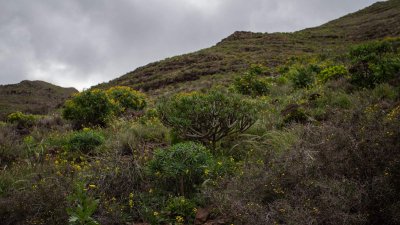
The Consejería de Transición Ecológica y Energía del Gobierno de Canarias has published on its website the good practices manual to promote the use of native flora in gardening, a document that establishes certain technical criteria for the design, execution, and maintenance of landscaped areas. Its objective is to reinforce biodiversity conservation and promote a more efficient use of natural resources in the islands.
The Minister of Ecological Transition and Energy, Mariano Hernández Zapata, assured that “this guide reflects the commitment of the Government of the Canary Islands to the protection of our natural heritage and to the promotion of a more sustainable development model”. Likewise, he highlighted that “betting on native flora not only helps preserve the Archipelago's ecosystems, but also allows optimizing water consumption and achieving better landscape integration of public and private spaces”.
Along these lines, he/she added that “we offer practical solutions to advance towards more responsible gardening, which actively contributes to the conservation of biodiversity and to the creation of green infrastructures that improve ecological connectivity”, while also emphasizing that the guide “facilitates decision-making for public administrations as well as for professionals in the sector and for citizens”.
Information in detail
The manual responds to the need to address the environmental impacts derived from the widespread use of exotic plant species, whose proliferation has favored the expansion of invasive species in the Canary natural environment. These can displace native flora, alter habitats and generate significant environmental and economic damage.
Furthermore, the accidental introduction of invertebrates, fungi or pathogens poses a risk to crops and island biodiversity, while many tropical species require high water consumption, a particularly relevant factor in a context of water scarcity and recurrent drought episodes.
Faced with this scenario, the guide highlights the use of native species, naturally adapted to the climatic and soil conditions of the islands, with lower water and phytosanitary needs and a high capacity for integration into the landscape. Their incorporation into gardens also contributes to creating refuges for fauna, serving as a source of seeds and promoting ecological connectivity.
The document establishes clear criteria for the selection of species —taking into account their functionality, the risk of hybridization and current regulations— and includes technical recommendations for the design of gardens capable of reducing erosion, stabilizing soils, generating shade, acting as screens against wind and noise or functioning as ecological corridors.
Among its tools, a highlight is a cartographic viewer that allows knowing the recommended percentage of Canarian flora according to the project's location, as well as indicative lists of species depending on the island, the altitude or the functionality of the space. Likewise, it incorporates 90 datasheets with detailed information about native species, including images, distribution, identification keys and techniques for their production in nursery.
All the information and resources associated with the manual can be consulted on the following link.


Add La Voz de Lanzarote as a preferred Google source.
Stay informed with the latest current news.