
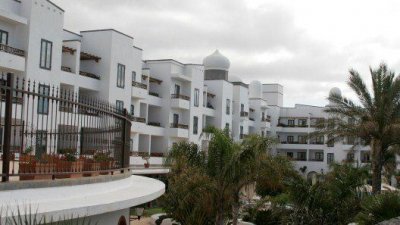
The Yaiza City Council has ordered the "total or partial" demolition of the Son Bou hotel, owned by businessman Juan Francisco Rosa. The decision, adopted last Friday at the Municipal Government Board, was notified this Wednesday to the Court, within the framework of the execution of the judgment that declared the license of this establishment illegal.
To avoid the demolition, the promoter had to try to legalize the hotel by obtaining a new license. However, the City Council has concluded that it is impossible to legalize the establishment and grant it a new permit, since what was built "triples" the permitted building volume. "It failed to comply with the regulations for granting the license and it fails to comply now," they specify from the City Council, clarifying that not even with the "incentives" contemplated in the new Yaiza General Plan, which allows expanding the building volume in certain cases, could this hotel be legalized.
For this reason, the City Council orders the demolition of all or most of the establishment, until "restoring the altered physical reality." In the event that Rosa opts for a partial demolition, she would have to demolish "the part incompatible with the ordinance", which could mean the demolition of two-thirds of the hotel. "It is not a matter of floors," the mayor of Yaiza, Gladys Acuña, explained to La Voz, who affirms that the non-compliance is not due to the height, but to the total volume of the construction.
Therefore, it will be the promoter who has to propose a demolition plan, leaving only a third of what is currently built, which is what the regulations would allow. In its resolution, the City Council gives the property one month to present a demolition project and one more month to carry it out. Afterwards, in the event that the promoter opts for the demolition of most of the hotel, she would have to request a new license to legalize the part that remains standing.
They didn't even submit the documentation
The mayor affirms that the City Council itself initiated this procedure ex officio, both with the Son Bou hotel and with all the illegal hotels in Playa Blanca. "We require all establishments to submit the corresponding projects," she explains, clarifying that in the case of this hotel, it had not even initiated the procedure to try to legalize it by requesting a new license.
After the City Council's request, the Son Bou property initially submitted "some plans", but the documentation provided "was not complete". The City Council then required them to send the rest of the documents necessary to verify if the hotel complied with current regulations, but "they never completed it." For this reason, the City Council intervened by carrying out its own measurements. And the conclusion was that they had built three times more than they could.
Thus, the establishment was not only built with an illegal license (which was already annulled by the courts), but it also far exceeded what it had actually been allowed to build on that plot. And it would not fit in the new Yaiza General Plan either. It should be remembered that this new Plan allows increasing the building volume of hotels by up to 50 percent, provided that this increase is used for common areas. However, even applying these parameters, the Son Bou could not legalize its excess construction.
The City Council has already notified its resolution to the Court that annulled the license, which in turn is responsible for ensuring the execution of the judgment. It should be noted that with this notification, the Court is simply informed of the City Council's decision, since the City Council has the power to order this demolition. Thus, no judicial pronouncement is required to carry it out, beyond the measures that the property may try to take to avoid it.
Another hotel can be legalized and the rest are under study
Regarding the rest of the illegal hotels in Playa Blanca, the mayor has specified that so far only the analysis of two establishments is "advanced", while the rest remains "under study". In addition to the Son Bou, the Yaiza technicians have also issued their conclusions regarding the Rubicón hotel, located in the Montaña Roja Partial Plan. In this case, the City Council concludes that the establishment does comply with what the regulations allow, so it could obtain a new license. "It is not even necessary to apply the incentivized regulations on building volume," the mayor specifies.
Although the situation of this establishment was also debated at the Government Board last Friday, what the City Council has not yet done is grant it the new permit. To do this, the property must still comply with some procedures, such as establishing a guarantee that guarantees the completion of the urbanization works that corresponded to it. "But urbanistically, it complies," Acuña insists.
As for the rest of the hotels, there are still no definitive conclusions or deadlines to know them. "There is only one architect reporting, with the help of the Plan's drafter," the mayor explains. It should be remembered that together with the Son Bou, one of the hotels that incurred the greatest non-compliance was the Papagayo Arena hotel, which, among other things, was built by eliminating access to the beach. In addition, another hotel owned by Juan Francisco Rosa, the Princesa Yaiza, also incurred various non-compliance, especially in terms of height, since it had two more floors than allowed when it was built. Now, what the technicians must evaluate is whether it conforms to the new approved General Plan.



Add La Voz de Lanzarote as a preferred Google source.
Stay informed with the latest current news.