
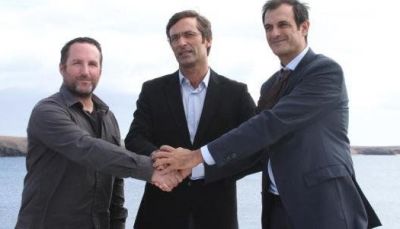
Jason DeCayres Taylor, who arrived in Lanzarote with the German swindler Helge Achenbach, had not sold a single work on the market when in 2016 he tried to get the Tourist Centers to buy the sculptures of the riders for 200,000 euros. This is reflected in the "economic valuation report" requested at the time by the CACT, when Coalición Canaria managed the Centers and took the proposal to the Board of Directors to make that purchase, after having already installed the horses next to the Castillo de San José.
The report, prepared by the Integral Art Consultancy Consultarte, also warned that De Caires lacked "exhibitions in contemporary art centers of international prestige" and had not participated "in art fairs of international reputation". Regarding his quotation, he pointed out that "the presence of the artist's work is non-existent" in international auctions, "there being no record of any transaction through this medium". And as for the art galleries, he specified that there was "a single gallery" that represented DeCaires, the Johathan LeVine Gallery, of which he pointed out that "it presents a low profile in the art market".
"Since its origin and given the profile of its owner, the gallery has catered to counterculture aesthetics of punk and rock," the report detailed. "Currently the gallery represents 42 artists, mostly born in the 70s. In general we can say that these artists have discreet curriculum vitae, with little presence in collections and exhibitions in relevant centers. The average price of these is low, with average parameters of between 1,000 and 2,500 euros per work. The gallery does not have a regular presence at art fairs," he added when describing the only gallery with which Jason DeCaires worked, who when he arrived in Lanzarote had only charged for commissioned works, almost all underwater museums in other tourist destinations.
The third copy of the horses, for sale in a graffiti gallery
The Johathan LeVine gallery, known for promoting "graffiti art" and exhibitions of "street art", was where DeCaires put the third edition of his horses on sale, since he made three copies of the same work: the first for a temporary exhibition commissioned in London, the second that was the one he wanted to sell in Lanzarote and a third that he announced would go to another large European city, but which he then put on sale without finding a buyer.
To make its report, the consultant hired by the Centers explained that it contacted that gallery, which only offered this work by DeCaires. The artist asked for 683,050 euros for it, but he had not found anyone willing to pay them either. "The fact that only this piece is offered indicates that the artist does not have work produced and that his work is usually done by commission", the report specified, insisting that there is also "no record of any transaction through auctions".
Thus, the valuation was carried out without having a previous data with which to compare what the price of his works was, since he had not sold any. The only economic reference included in the report is the underwater museum itself, also commissioned to DeCaires under the mandate of Pedro San Ginés. In this case, in total there are about 300 sculptures and the institution paid about 700,000 euros, although the consultant hired by the Centers ruled out considering this comparison (and the average price that it would leave per sculpture), pointing out that "being a global project of musealization of a marine space, the economic quantification is not comparable to the average price for a single work and therefore, it cannot be considered".
DeCaires, "substantially inferior at an artistic level"
In this way, the only prices that were compared in that report were those of the sales of other artists, who at that time were "in the first positions of the classification in the market". Specifically, it focused on four, who had sold sculptures for prices ranging between 165,000 and 800,000 euros, and all of them appeared on the platforms and databases that measure the price of artists.
"In the case of Jason de Caires, he is outside the artfacts ranking due to the characteristics of his career, associated more with the environmental field than with the artistic one. Similarly, he is not present in the artprice database because he has not had any transaction through auction rooms," the report acknowledged below.
"These data allow us to place the artist in a substantially inferior position at an artistic level, which will be directly related to his quotation", he added. However, he then added that "the characteristics of his creations, of an original and unique nature, his involvement in the defense of nature and the realization of creations as a vehicle for the preservation and conservation of the marine environment that make his production innovative and highly committed to the environment" should be considered.
Thus, based on subjective criteria about DeCaires' environmental commitment -who in Lanzarote worked in an illegal marina, in two premises rented and paid for by the Tourist Centers to Marina Rubicón-, the report set the price of the work between 200,000 and 300,000 euros. And for this, he used as the only reference the price that he himself asked for that third copy of the horses, in a gallery of "low profile in the art market", pointing out that between 40 and 50% of that starting price could be offered for them.
"He trained as a diving instructor"
However, in the conclusions of that opinion, Consultarte returned to insist that DeCaires "stands out for his involvement in the defense of nature", but added that "less remarkable is his career in contemporary art circles, lacking exhibitions in contemporary art centers of international prestige or participation in art fairs of international reputation".
As for the rest of the report, it began by reviewing the biography of DeCaires, explaining among other things that he studied art and then began his activity as a sculptor, although later "he trained as a diving instructor". In addition, he linked this to the fact that almost all of his known works are precisely the underwater museums that he created by commission between 2006 and 2014 on the Caribbean coast of Granada, in Cancun and in the Bahamas.
Then, he brought that same model to Lanzarote, when he arrived on the island with Helge Achenbach, who was later convicted of fraud and who presented the Atlantic Museum project to Pedro San Ginés, together with Achenbach's friend and secretary of his Foundation, Juan Gopar, and the former president of Aetur Gerardo Fontes.
Sculptures designed for London
As for the sculptures of the horses, the report pointed out that they were made thinking about where they were going to be placed, in the Thames River in London, and that is why they "allude to work in the British capital and the dependence on fossil fuels".
In addition, he recalled that those riders were commissioned for a festival that was held in this London river, "to raise awareness about the preservation of nature, in which multiple cultural activities were developed along the course of the Thames during the month of September 2015".
Afterwards, DeCaires made two copies of those sculptures and one of them was the one he tried to sell to the Tourist Centers. Finally, the controversy unleashed stopped this claim that Coalición Canaria took to the Board of Directors of the Centers, but what did end up prospering with the vote against the entire opposition was to accept a supposedly "free" transfer for ten years. In return, the Centers committed to pay 15,000 euros for the expenses of "materials" and "assembly" of some sculptures that, in reality, had already been assembled and installed next to the Castillo de San José.


