
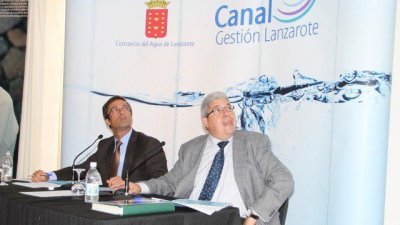
"Canal Gestión Lanzarote will have executed and certified works worth more than 35 million euros before the end of 2015." That is what the then president of the Cabildo, Pedro San Ginés, assured that year, when Gerardo Díaz was still the manager of the company on the island, before being arrested and transferred to another destination. However, the minutes of the contract monitoring committee that San Ginés had kept hidden, and to which La Voz has now had access, show that the reality of what was happening had nothing to do with what the president was publicly conveying.
In fact, not only were 35 million euros not certified until 2015, but eight months later, in August 2016, Canal had only presented works worth 15.9 million euros. And of that amount, the Consortium had only approved 800,000 euros. The rest had been rejected or were still under study, either because they did not consider them real investments or because there were discrepancies with the calculations made by Canal, which attributed sums to the Investment Plan above the value for which the works had been awarded.
However, despite these breaches that occurred from the beginning, San Ginés publicly praised the work carried out by Canal and especially that of its then manager, Gerardo Díaz. In fact, he defended him both after his arrest for the alleged rigging of contracts, and when eight months later, in October 2015, the company decided to remove him from this position. Then San Ginés even asked Canal to reconsider this decision and keep him "at least for a reasonable time", or allow him to remain "linked to the coordination and development of the Strategic and Investment Plan". And all this when at that time, the contract had already been in force for two and a half years and the company had accredited little more than 1% of the works it was to execute in the first five years.
"The investments are being executed at full capacity"
"The investments are being executed at full capacity at this time," San Ginés defended in the letter he sent to Canal asking for the continuity of Gerardo Díaz, and which he attached to another signed by the workers. However, the company maintained its decision to transfer Díaz to another position and it was from then on that the tension between the Consortium and Canal began to grow in the meetings of the contract monitoring committee.
These meetings were held behind closed doors and the only politician who participated was Pedro San Ginés, although later the mayor of Haría, Marci Acuña, also from Coalición Canaria, joined this body, and since 2018 San Ginés was replaced by Echedey Eugenio, when he assumed the presidency of the Water Consortium. However, the minutes also show that in the first two years there were issues that were not addressed in that committee. And it is that among other things, there is not a single mention of the moment in which San Ginés ordered the seizure of the desalination plant and the treatment plant of Club Lanzarote in Montaña Roja in September 2014 and handed it over to Canal, which with that increased its revenues by billing until the Justice annulled this illegal measure.
It was from 2016, after the departure of Gerardo Díaz, when the frequency of meetings and also the discrepancies increased. In addition to making constant references to the investments that were not being justified, the Consortium also began to accuse Canal of other breaches. Even, already at the beginning of 2019, it proposed up to six sanctions, but none of them linked to the investments that are still not accredited today, when the deadline for completing that investment plan has been more than met.
Economic sanctions
As for the sanctions that the Consortium did promote, one of them was because Canal refused to pay 50% of the works corresponding to the promoters of four partial plans of Playa Blanca -with whom San Ginés had signed agreements- and to assume Juan Francisco Rosa's treatment plant, as La Voz reported last week. Among other things, Canal argued that this treatment plant presented "serious deficiencies" and risks to the safety of workers and the environment. However, although the Consortium itself had reports that accredited these deficiencies, it demanded that Canal assume these facilities and complete the works that the businessmen had not completed. And in the face of its refusal, the manager of the Consortium, Domingo Pérez, proposed to penalize it with 640,000 euros.
To this were added another five proposals for penalties, all between April and May 2019, shortly before the change of government. The first was for "unjustified delay in the execution of the actions aimed at improving the meter park", and a sanction of 31,000 euros was proposed; the second for not notifying the Consortium of staff dismissals at the Janubio plant; the third, for "failure to comply with the obligation to supply information to the Consortium"; the fourth, of 10,000 euros, "for the lack of maintenance of the intermediate wastewater pumping station of Playa Blanca"; and finally there was talk of a last one "for failure to comply with the obligations of supplying information to the Consortium, failure to comply with the service operation plan and the organization and management plan of the service offered, failure to comply with the request for authorization to the Consortium in personnel matters and for not complying with the orders issued by the Consortium".
In addition, at the meeting of the monitoring committee held last May, they also warned Canal with opening another sanctioning file for not having paid the corresponding to the fees A and C provided for in the contract for the first quarter of the year and neither the extraordinary fee "despite the requirements", and gave them a period of five days to make the payments, warning that otherwise they would face another economic sanction.
"These breaches may open the door to rescinding the contract with Canal", warned two weeks ago the former spokesman of Podemos in the Cabildo, Carlos Meca, who had just gained access to these minutes that San Ginés had been hiding from him for three years, as confirmed by the Transparency Commissioner when estimating a complaint from the former councilor.
Reckless bids and unsupervised awards
The minutes also reflect that it was from the third year when the Consortium began to raise in the monitoring committee basic questions about the awards of works carried out by Canal. Specifically, at the meeting in December 2016 they talked about the participation that the Consortium could have "to supervise the specifications" and "the procedure". A few months earlier, they had warned of an award with "a reckless bid" in a tender for works on the network, and the Consortium asked Canal to stop the award, but it refused.
As for the investments that Canal claims to have made, which since 2018 assures that it has already executed all the committed investment, the Consortium continued to disagree until the last meetings held before the end of the last term. In fact, they continued to leave out alleged investments, because they considered that they were actually maintenance expenses of the service itself, and also questioning the amounts that Canal attributed to certain works.
In May 2019, the lawyer appointed by San Ginés to be part of this body, Eugenia Torres, warned that in almost all the lots of works presented by the company there were contracts that had been modified without the files being recorded. As an example, she pointed out that the work on the Zonzamas reservoir had been awarded for 2.7 million euros, but Canal had presented 3 million euros as justification for the investment plan.
"The contract cannot be awarded for two million and justify three. That difference should be regulated by means of an amendment and said amendment file has not been presented to the Consortium for its review and subsequent verification with what is justified," she warned.
10% for Canal
Despite the serious discrepancies on the accreditation of the investment made, at the same time the Consortium continued to propose entrusting Canal with the execution of works financed directly by the Consortium. For this, the company claimed to keep 10 percent of the total value of each contract, which is the same percentage that it has been applying to the works charged to its investment plan. That is to say, that of the 54 million that it was to execute and that are still not accredited, 5.4 would remain in the hands of Canal as expenses.
One of the occasions in which it was proposed to entrust other works to Canal was in September 2018. In that meeting, the manager of the Consortium, Domingo Pérez, pointed out that he did not see "the direct execution by Canal of the works not included in the investment plan as viable", although he added that "in operability" it was "faster". Afterwards, the issue was discussed in other meetings, proposing to entrust other works to Canal, despite the fact that the Consortium continued to question the justification of those that were part of its investment plan committed in the contract.
Add La Voz de Lanzarote as a preferred Google source.
Stay informed with the latest current news.