
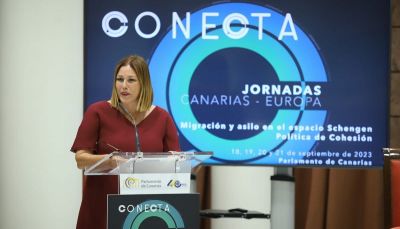
The president of the Parliament of the Canary Islands, Astrid Pérez, closed the first 'Conecta Canarias-Europa Conference' with a speech in which she advocated for a common front, "together with the Spanish and Canarian governments", to "adjust European priorities to the reality of this Archipelago". In order to respond to the "migration emergency" and apply the "European funds in a more flexible way and adapted to our islands".
“We share the conviction that local and regional realities must be taken into account in the reform of the EU's migration and integration policy." Regional governments are best placed to offer "a coherent vision of the situation and its needs, so they should receive more governmental and economic support to face the task of reception and integration,” said Astrid Pérez.
In her opinion, “it is vital to launch an EU search and rescue service that coordinates all efforts”, as well as the development of the concepts of “shared responsibility and binding solidarity in crisis situations”. The president of the Chamber underlined, among the Canarian priorities, the need for an "adequate reception network, referral procedures that meet regional demands and needs, more efficiency in border control, or the increase of the endowments of security forces and bodies, Maritime Rescue or Frontex". In addition, she advocated for "the creation of a single command in the State, which would simplify the relationship of the Canary Islands with the different ministries participating in migration management".
“Activating an agile, transparent and non-discriminatory transfer policy, from the Canary Islands to the peninsula and also to the rest of Europe”, is another basic issue for Astrid Pérez, who stated that “our islands cannot become permanent detention centers”. “It is urgent to guarantee a rapid and common reaction to migration crises. That the European and Spanish authorities make it possible for the Canary Islands to function as a humanitarian platform, with sufficient resources to face this great global challenge,” she concluded regarding the migration section.
Regarding Cohesion Policies in Europe, Astrid Pérez considered it necessary to “guarantee and consolidate the status of the Canary Islands as an outermost region of the European Union, also beyond 2027”. She defended an EU Cohesion Policy “with more attention to the regions”, and recalled that the peculiarities of the outermost territories are not duly reflected in European regulations.
The opening of the fourth session of the Conecta Canarias-Europa Conference was in charge of the deputy and president of the Committee on European Affairs and Foreign Action of the Parliament of the Canary Islands, Alicia Vanoostende, who valued “the importance of this Chamber disseminating all those European policies and initiatives in the field of migration and cohesion that affect the daily lives of people living in the Canary Islands. We must defend the singularities of these islands in Europe and there the Parliament has a fundamental role”.
The MEP of the European Popular Party Gabriel Mato stressed, through videoconference, that “the European Union has a profound impact on our lives, even more so in the Canary Islands. Our condition as an outermost region provides us with opportunities that we must take advantage of, and consolidate, in order to compete on equal terms with the rest of Europe”. He predicted a “very flattering future” for the Canary Islands “if the set of European funds to which it has access is used effectively and quickly”.
Mato stressed that cohesion "is not just funds" and recalled that “cohesion is also that our farmers can remain competitive or that food has reasonable prices. "Cohesion is that you can travel from the Canary Islands and the mainland at affordable prices, or that border regions do not have to bear alone the adverse effects of irregular migration.”
The panel discussion Priorities for the Canary Islands, moderated by the journalist Moisés Álvarez Montero, featured Dunnia Rosa Rodríguez Viera, director of the Canarian Employment Service; Marisol Izquierdo López, director of Innovation University of Las Palmas de Gran Canaria, and Enrique Rodríguez de Azero, president of the Canarian Association of Renewable Energies.
The debate table of deputies on Cohesion Policy in the Canary Islands, moderated by the journalist Marta Modino, served for the representatives of PSOE, CC, PP, NC, ASG and AHI to expose their diagnosis regarding the situation of this European policy in the islands, as well as their demands and proposals for the future. Vox excused his attendance.
These conferences have been developed during more than fourteen hours of training, information and debate on migration and cohesion policy, with more than 50 speakers, experts and protagonists of the humanitarian drama of migration.
Conclusions
The parliamentary groups will work in the coming days to agree on shared conclusions on migration and cohesion policy within the framework of the interventions and debates of the Conecta-Canarias Europa Conference. These conclusions will be sent to the European Committee of the Regions and to the Conference of Regional Legislative Assemblies of Europe to contribute to establishing new European priorities in the Canary Islands.


