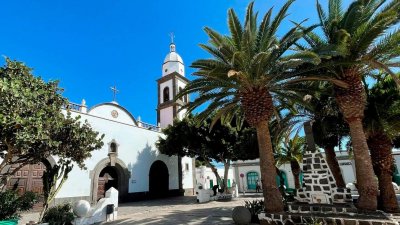
The Cabildo of Lanzarote has received a formal request from the Arrecife City Council within the framework of the file relating to the Basic Restoration Project of the Plaza de Las Palmas and Reorganization of Accesses. In said letter, sent by the Department of Urban Planning, the capital's Consistory requests the island institution to remove the architectural ensemble known as "Cruz de los Caídos" (Cross of the Fallen), located in the center of the square.
The municipal request is based on the legal obligation to eliminate symbols contrary to Law 20/2022, on Democratic Memory, and Law 5/2018, on Historical Memory of the Canary Islands. The group to be removed includes the cross-shaped monolith, the commemorative plaques, the pedestal, the steps, and the ornamental spheres of basalt stone. The president and Heritage councillor of the Cabildo of Lanzarote, Oswaldo Betancort, stressed that the Island Corporation "will act in accordance with the provisions of current legislation, guaranteeing compliance with the Democratic Memory Law and the preservation of the island's historical heritage."
Likewise, Betancort highlighted that this action "is part of a broader process of recovering the heritage and artistic value of the Plaza de Las Palmas, an emblematic space in the capital that is part of the island's collective memory."
The Cabildo of Lanzarote, as the competent administration in matters of Historical Heritage, will proceed to adjust the actions of the restoration project of the Plaza de Las Palmas to the provisions of state and regional regulations, complying with the provisions of the Democratic Memory Law and the Historical Memory Law of the Canary Islands.This requirement, however, contrasts with the recent statements of the mayor of Arrecife, issued on the program Buenos Días Lanzarote, where he expressed his intention to return the cross to public space, albeit with another name or meaning. The divergence of positions between the City Council and the Island Council highlights the open debate regarding the treatment of Francoist symbols and their reinterpretation in the context of democratic memory legislation and the conservation of historical heritage.


Add La Voz de Lanzarote as a preferred Google source.
Stay informed with the latest current news.