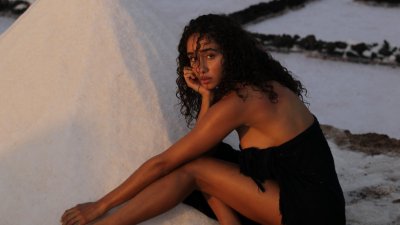
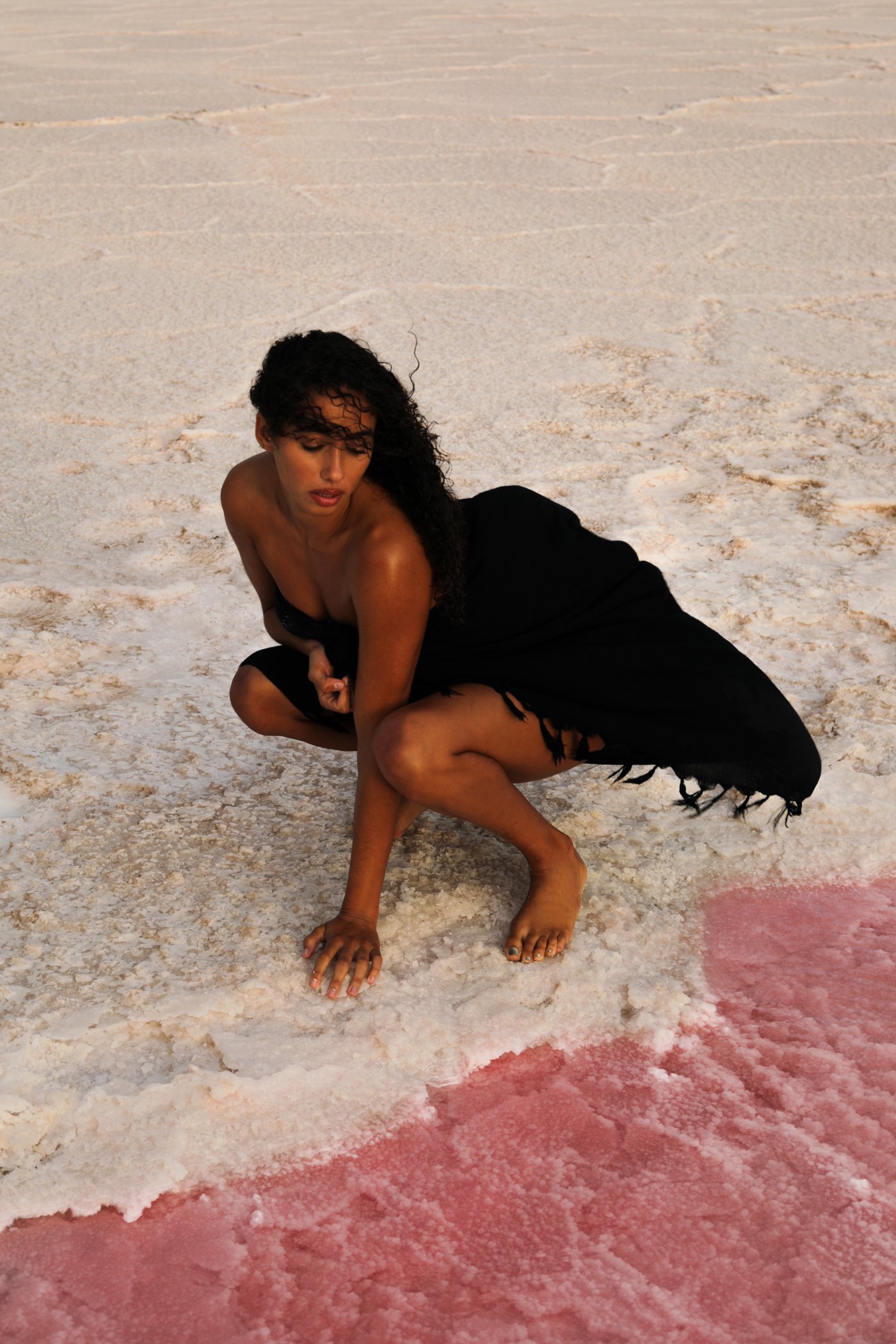
Walking barefoot on the rofe of Lanzarote, dressed with a mantle on her head, a bodice and embracing a kid goat. This is how two years ago Eva Ruiz (Lanzarote, 1998) presented the single Papá Dónde Estás, an appetizer of her new album Agua Salada (2026), which completely saw the light this past March.
"Lanzarote is what you want it to be for you and, in my case, it is my house, my home", confesses the Canarian artist during an interview with La Voz. Currently, immersed in her musical project, which she combines with her work as actress, lives halfway between the island where she was born, the city of Madrid and the United States.
"Without a doubt, they have probably been the best years of my career so far," confesses Ruiz. Currently, the Lanzarote native has a distribution contract with Sony Music and is one of the faces of the successful saga of Culpables (2023-2025), from Prime Video, which reached one hundred million reproductions, where she plays the character of Jenna and gives voice to the soundtrack of the trilogy.
"I had always been superfocused on music because I feel it is very demanding, it requires a lot from you and because I am very involved, I like to produce, write and direct videos", she explains. When she auditioned for Culpa mía (2023), the first film in the saga, Eva Ruiz did not imagine the magnitude the project would reach: "I have put everything I have in me into that project and for an artist to feel fulfilled is one of the most beautiful things".
The island roots and the Canarian identity
Her new album, which she presented just over a month ago at a special event in Salinas del Janubio, opens the door to discover the binomial between Eva Ruiz and Lanzarote and how the former could not be understood without her island roots.
"My blood is made of lava", she recounts in Sahara, another song from the album. This nod to Western Sahara narrates the experiences that her grandparents, both Andalusians, transmitted to her during her childhood about the time they lived in the African country. "My grandmother's house is like a Sahrawi museum", she recounts during the interview, recalling how they used the chilaba on special occasions and that they learned some words in Arabic.
In the midst of the maelstrom unleashed by the success of these three films, the Lanzarote native has presented her second studio album, a profound work that speaks of the Lanzarote identity as a border island, but also lets slip pieces of her intimacy, of her family's history, of her wounds, of her musical culture and of her roots. "I needed to tell my truth and my truth is that I am a Canarian woman, from Lanzarote, and these are the landscapes that inspire me. Lanzarote is like a work of art," she adds.
In this work, which comes to light eleven years after her first album, the artist reveals that at this stage of her life she feels involved "on another level" with her roots. "I believe that art has to transcend into something that has a social impact, in helping on a larger scale".
From her grandmother's flamenco to her grandfather's Afro-descendant music
Her passion for music began when she was just a child, inspired by her grandmother, who was a flamenco singer in Algeciras and who came to share tablaos with the Andalusian musician Paco de Lucía. Her life has always been surrounded by melodies, inspired by flamenco, copla, Spanish pop, R&B and the music of Afro-descendant artists that her grandfather played for her and by her father, who also sings.
Those coplas resonated alongside unmistakable voices like that of Whitney Houston or Michael Jackson. "It was lucky that my grandfather also had that musical culture and that he introduced me to that," recalls. Those songs led him/her to also encounter Destiny's Child, the musical group of which Beyoncé was a part.
Driven by the dream of living from music, the multidisciplinary artist presented herself at sixteen years old to the program La Voz Kids, where she managed to reach the final. "I wanted to seek inspirations, get to know the world, fly, travel," explains Ruiz, who defines herself as a person who loves to discover. "I have always believed that one must live to be able to tell and write," she continues, and "I have always said that I could leave Canarias, but Canarias never left me".
Ruiz left the island in search of those stories, but her roots always bring her back home. "I feel that in my project, my music, which is linked to my truth, the message I tell in my songs and basically who I am as an artist, is connected here, to my home, to Lanzarote".
The American dream and the Canarian talent
After the pandemic, Eva Ruiz left for United States, pursuing the dream of working that she grew up listening to. In the North American country, she lived for four years. "I was lucky enough to work with the best producers and I realized that really in a session with Lupión, without going any further, my friend who is from here in Tenerife, who is wonderful, and also other guys from Canarias, have nothing to envy in terms of the type of production or how they work there," explains the artist during an interview with La Voz. "Every brilliant mind is a brilliant mind, no matter where it comes from," she adds.
The example of Eva Ruiz exposes the buoyant situation of the urban music genre in Canarias, where artists who propose songs framed within hip-hop, reggaeton, trap and R&B, among others, have made a niche for themselves in the international music charts.
Following the success of the island of Puerto Rico, from which artists as successful as Don Omar, Ricky Martin, Olga Tañón, Marc Anthony or Bad Bunny have emerged to the world, Eva Ruiz dreamed of replicating the model in Canarias. "Ten years ago I told Maikel [Delacalle] at a festival, how amazing that the artists from Puerto Rico, are expanding their genre, their culture, to the world. Hopefully we Canarians can achieve that too."
The Canarian woman dreamed more than a decade ago what today seems to be consolidating, the possibility that the world knows "our culture, who we are, that what makes us rich is the mix and all the influences we have".
In the success of the music scene in Canarias, Eva Ruiz has already collaborated with other artists from the islands such as the Tenerife natives Cruz Cafuné, with whom she shares the song Lento, one of her favorite songs, or with Maikel Delacalle, with whom she collaborated on his latest album with the single Quiero contarte. "In the end, we all know each other and have a great relationship," she relates, while not ruling out that new collaborations with other Canarian musicians like Quevedo or Las Knarias may arise in the future.
The artist narrates that soon the cities in which she will perform to present Agua Salada will be announced, while she confesses that she would love to be able to do it also on her island. She states that it is difficult for her to choose a place on the island where she can present it, because all its corners inspire her but she reveals that the auditorium of the Cueva de Los Verdes has always fascinated her.
Set has to dream, as she already did when she left the island for the first time when she was only a teenager, the Lanzarotean confesses that her dreamed collaboration is with Lauryn Hill, Sade or Beyoncé.

Add La Voz de Lanzarote as a preferred Google source.
Stay informed with the latest current news.