
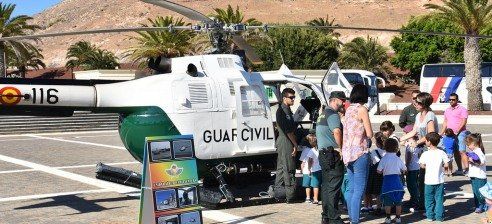
'Police' dogs in search of illicit substances, mock-ups of bomb disposal experts deactivating explosive devices and even helicopter flights. These are some of the activities that the students from five Infant and Primary education centers in the municipality of Yaiza enjoyed this Wednesday, during a demonstration organized by the Civil Guard.
Officers from the Helicopter Unit of Fuerteventura, the Seprona detachment in Timanfaya, the Explosives Deactivation Group of Lanzarote, which has its base at the Guacimeta airport, the Rapid Intervention Group that the body has on the island, the Cynological Service, which groups together these dogs capable of detecting narcotics or explosives, and also the Traffic Group, all met in the Plaza de la Alameda de Yaiza. In total, about 16 Civil Guard officers showed the children from the schools of Femés, Yaiza, Uga, Las Breñas and Playa Blanca what their work consists of.
This exhibition was part of the informative activities of the Director Plan for Coexistence and Improvement of School Safety carried out by the Benemérita. The objective, explain from the Civil Guard, is to "bring the daily work" of this police force closer to the citizen and the school community.
9 informative talks in centers of Lanzarote
Within this Plan, which arose in 2013 from a proposal by the Ministry of the Interior, the agents also carry out "more specific" talks in educational centers, with students, associations of teachers and also of parents. These talks, they point out, are intended to "specify and inform about possible crimes or dangers that the school community will face." In this sense, from the Benemérita they list aspects such as the risks of drugs, violent gangs, gender violence or cases of 'grooming' or harassment through the Internet and mobile applications. Between 2015 and these first months of 2016, the Civil Guard has carried out 9 of these talks in Lanzarote, in different schools and also in institutes, where these problems become more evident.
The initiatives contemplated in this Plan, adds the Benemérita, work "quite well", given that they allow the police force not only to "inform", but also to "prevent" and that there is a "contact between the teaching community and the state security forces and bodies".


