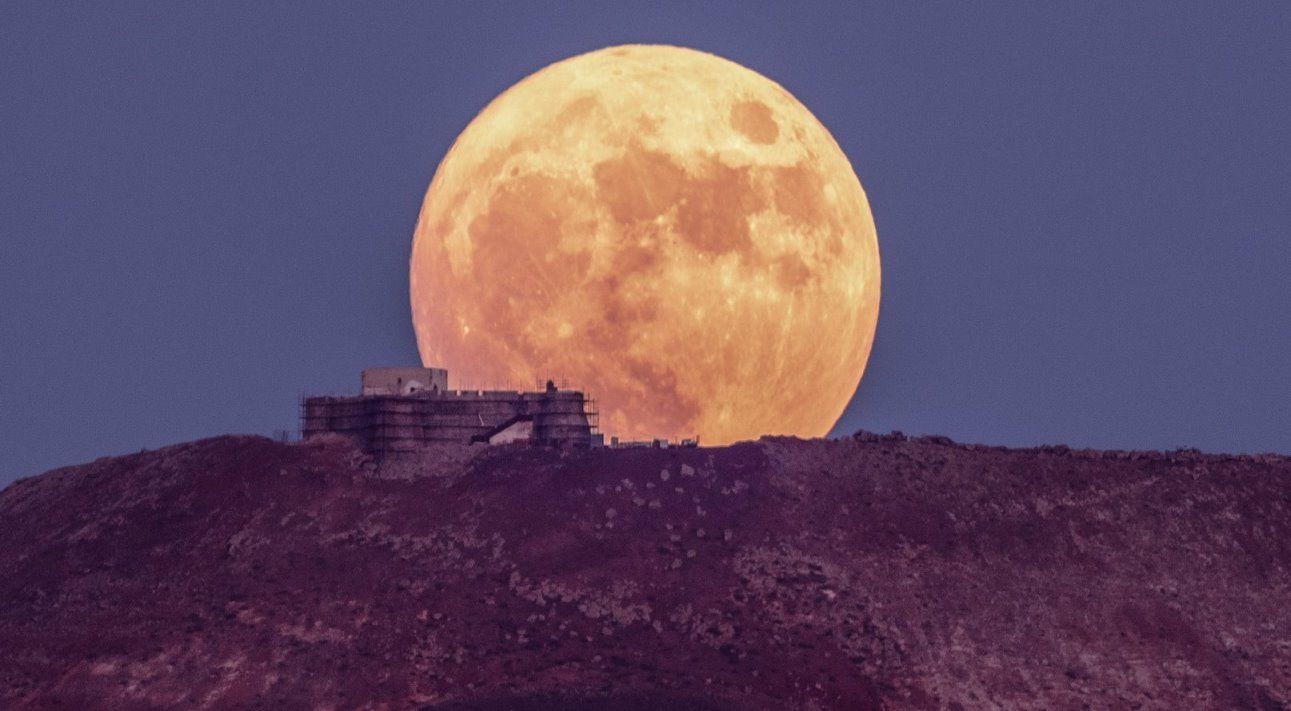
On the night of this Wednesday, August 30, and during the early hours of this Thursday, August 31, you can enjoy an unusual phenomenon in astronomy that will say goodbye to the month of August: the blue supermoon.
The name Blue Moon refers to an astronomical phenomenon that occurs when there are two Full Moons in the same month. Since the Sturgeon Moon could already be enjoyed on August 1, this second Full Moon is called the Blue Moon.
But then you will ask yourself, where does the name blue supermoon come from? In this case, it is known as a supermoon because the Moon is closer to the Earth's orbit and looks larger and brighter than usual.
A total of four supermoons are usually seen per year, but it is not common for a supermoon to coincide with the blue moon phenomenon, giving rise to the blue supermoon. Therefore, to experience the same circumstance we will have to wait until January 2037.
Why are there two full moons in a month?
The answer to why there are two full moons in a month is simpler than it seems. The lunar cycle develops in 28 days, while the months of the year range between 28 and 31 days. So if there has been a full moon in the first days of a month, it is more likely that there will be a second full moon at the end of the month, as is the case here.
Where and how to see the blue supermoon?
The peak time to observe the Earth's satellite from the Canary Islands will be at 2.36 am. However, for those who do not want to wait until dawn, it is expected to be seen from dusk until dawn.
The best way to enjoy this astronomical phenomenon is to look for a clear sky with little light pollution.
The State Meteorological Agency (Aemet) forecast for this Wednesday predicts slightly cloudy skies in Haría, Arrecife and Teguise, clear skies in Tías, San Bartolomé and Yaiza; while it predicts very cloudy skies in Tinajo.
In the case of Arrecife, Yaiza or Teguise, from 11:00 p.m. this Wednesday until dawn the few clouds expected will disappear.
While in Tías and San Bartolomé the skies will be clear from nightfall. It will be more difficult to see the moon in Tinajo, where very cloudy skies are expected. Something similar will occur in Haría, with the presence of some clouds in most of the night, but with clear skies between 2 and 3 in the morning.


Add La Voz de Lanzarote as a preferred Google source.
Stay informed with the latest current news.