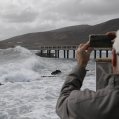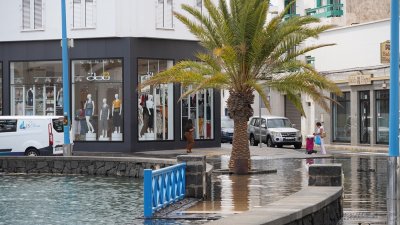
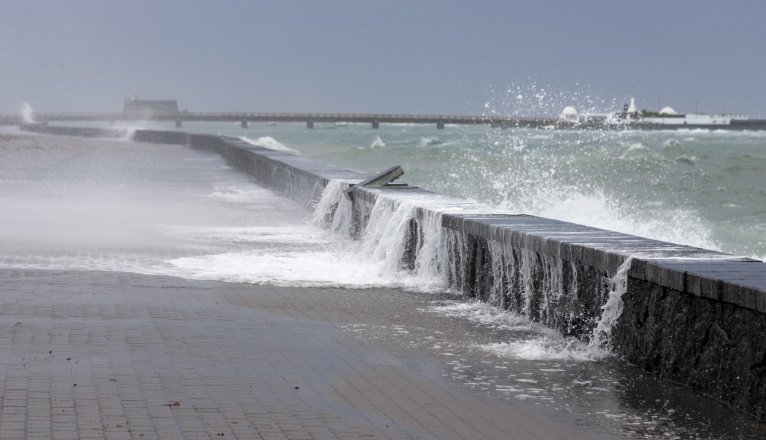
An international investigation warns that the Canary Islands' population will be the most exposed of all European island territories to coastal flooding caused by rising sea levels as a consequence of climate change. Climate forecasts warn that this situation will aggravate the coastal erosion of the Canary Islands and generate social, economic, and environmental losses.
The project, developed by Nature Communications and recently published, warns that the "substantial impact" of rising sea levels will disproportionately affect island coastal communities, which have a more fragile economy and territory separated from the mainland.
This work highlights the paradox that islands, despite being the territories that contribute least to greenhouse gas emissions, are the main ones affected by their effects. In this regard, it studies the nine outermost regions of Europe (ORs), among which the Canary Islands are included, as well as thirteen overseas countries and territories (OCTs), which are under the sovereignty of the United Kingdom, the Netherlands, and France.
A third of the population affected by rising sea levels is in the Canary Islands
Currently, the work shows that among the island territories analyzed, at least one-third of the population affected by sea-level rise is in the Canary Islands (a total of 4,797), as in the Spanish archipelago, part of the urban centers, its population, and its economic activities are located on the coast.
This study considers four different climate scenarios, depending on whether greenhouse gas emissions are contained or increased: low emissions (a scenario with net-zero emissions by 2050), moderate, high, and very high (with fossil fuel burning throughout the 21st century).
In addition to the population exposed each year to these floods (EAPE), this study analyzes the expected annual damage (EAD), the annual flood area (EAFA), and the losses of ecosystem services in each region. To do this, they use climate projections through a tool that quantifies coastal risks using physical models and socioeconomic data from the islands exposed to different climate scenarios, depending on emissions.In the Canary Islands, the population at risk of flooding will grow by 1,150%
If forecasts are met, by the end of the century, the population of the Canary Islands will be the most exposed of the overseas territories to coastal flooding, regardless of the climate scenario. By then, nearly four out of ten Canary Islanders will be at risk of suffering flooding due to rising sea levels
By 2100, the exposed population is projected to have multiplied between 15 and 28 times. The research estimates that in the most optimistic scenario, a total of 60,000 people will be exposed to sea-level rise in the archipelago, far exceeding other territories analyzed, such as the neighboring Azores and Madeira, and only closely followed by the island of Réunion, located east of Madagascar.
If the worst-case climate scenario is reached and the burning of fossil fuels continues throughout the 21st century, the affected population in the Canary Islands could reach 90,000 people. If greenhouse gas emissions are not contained or even increase, the worst climate scenarios could occur sooner than expected.
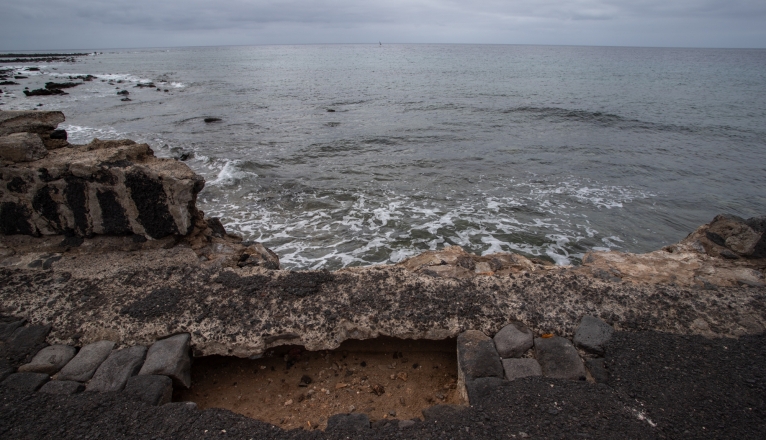
Canary Islands, among the territories suffering the most economic damage
In terms of economic damage, currently half of the damage is divided between **New Caledonia**, a group of French islands in the Pacific, and the **Canary Islands archipelago**, with 24 and 40 million euros per year respectivelyThe sea level is rising at an "accelerated pace" and climate projections estimate that by 2150 it will increase by at least 50 centimeters. This rise will translate into more coastal flooding across the globe, but research warns that it will be more concerning for island territoriesThus, it emphasizes that the Canarian economy, dependent on tourism, as is the case with French Polynesia or territories like French Guiana and Saint Pierre, more linked to agriculture and fishing, depend on sectors "deeply impacted by rising sea levels".
In the case of the Canary archipelago, it states that its coastal infrastructure, settlements, beaches, and agricultural land are under increasing pressure. In the Canary Islands, several urban areas are located in low-lying zones. In Lanzarote, the capital city of Arrecife is also situated in a coastal area. Furthermore, the island's main economic drivers are also located along the coast.
Climate scenarios show that damage to the population and economy of the Canary Islands will go hand in hand with flooded areas. Specifically, for the 2100 and 2150 forecasts, the Canary Islands are expected to bear between 14.4% and 15.8% of the expected annual damage (EAD) due to sea-level rise.
Four climate scenarios: 550 million euros
Currently, the expected annual damage from sea-level rise on the archipelago is the highest among the territories analyzed, although it translates to an impact of 0.1% on its Gross Domestic Product (GDP). In 74 years, the Canary Islands will remain among the regions with the highest annual damage from sea-level rise, but it is estimated that other territories such as Reunion Island or Guadeloupe will overtake it in the rankings.Regarding the expectations for the annual area that could be flooded, in the low-emissions scenario, it is expected that, given its geographical location in the Canary Islands, at least 20 square kilometers will be flooded, which could increase to 30 in the case of the worst climate scenariosMeanwhile, the economic cost in the Canary Islands in the worst climate scenario could rise above 550 million euros and up to 350 million in the scenario with fewer emissions.Finally, the economic cost due to the loss of ecosystem services, such as natural coastal protection or biodiversity, is around 10 million euros
Loss of biodiversity
Coastal ecosystem services will suffer losses valued at almost 148 billion euros. The majority will occur between New Caledonia, French Guiana, and French Polynesia.However, the research warns that the retreat of the coastline will mean the loss of ecosystem services in all territories
The research warns that the effects of climate change mitigation are "limited" and the impacts of the high-emissions scenario for 2050 are "slightly worse" than if strict mitigation policies are implemented. However, in the long term, these benefits would increase over time if such strict policies were applied.
In the worst-case scenario, it is estimated that among the analyzed islands, 139 square kilometers more of land will be lost due to sea erosion, 102,774 more people will be exposed to flooding, and an additional 1.542 billion euros in losses will be incurred


Add La Voz de Lanzarote as a preferred Google source.
Stay informed with the latest current news.