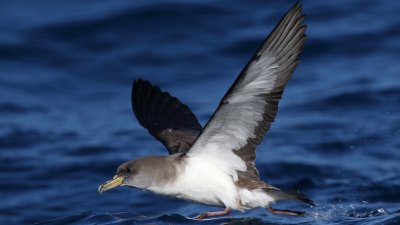
The Civil Guard of the Maritime Detachment of Fuerteventura, proceeded to the arrest last September, of two people for capturing and killing seven specimens of Atlantic Cory's Shearwater within the Jandía Natural Park (Fuerteventura).
The events took place when the Civil Guard of the Fuerteventura Maritime Detachment was carrying out coastal patrol within the Jandía Natural Park, specifically at the Punta Pesebre Lighthouse, also coinciding with agents of the fish and game warden service for the monitoring and environmental surveillance of the LIC and the marine ZECs of the Canary Islands belonging to the Ministry of Ecological Transition and Energy of the Government of the Canary Islands. From there, they observed some lights halfway up the mountains located between Junquillo beach and Punta de Barlovento (Aguacabras area, Pájara), so they suspected that, being that time of year, when the chicks of the Cory's shearwater (calonectris borealis) reach their greatest weight, and therefore are more susceptible to being hunted furtively, said activity could be taking place.
At that moment, the Civil Guard proceeded to identify two people approaching a vehicle carrying a raffia sack and a wooden stick with a hook, which is habitually used to extract shearwaters from their caves, and it was verified that inside the sack there were seven dead specimens of, supposedly, Cory's Shearwater (Calonectris Borealis). This species is subject to Special Protection determined in Royal Decree 139/2011. It is also included in the Spanish Catalogue of Threatened Species with the category of vulnerable, it is also considered vulnerable in the red book of birds of Spain, and also protected by the convention for the Conservation of Wildlife and Natural Environment of Europe, Bern Convention, annex II, strictly protected fauna species.
From the very moment of the seizure of the birds, a chain of custody was established for the seized shearwater specimens, these specimens being transferred to the Maritime Detachment of the Civil Guard in Corralejo and handed over at that same location to environmental agents of the Cabildo de Fuerteventura, for their transfer to the University Institute of Animal Health and Food Safety (IUSA), where they certify that it is the Cory's Shearwater Species (Calonectris Borealis), and that they have died from asphyxia and cranial trauma. Given these circumstances, the Civil Guards have indications that what happened could constitute a crime against flora and fauna typified in Article 334 of the Penal Code, for which the corresponding proceedings were initiated.
The trial regarding these events took place in Puerto Rosario at the end of February, for an alleged environmental crime for the capture and death of seven Cory's shearwaters on the island of Fuerteventura. They have also been imposed a financial penalty of more than 3,200 euros each of the responsible parties and disqualification from hunting for three years.
Description of the Cory's shearwater
The Atlantic Cory's Shearwater (Calonectris borealis) is a seabird with long, slender wings. It flies at a low height over the water, in long gliding sequences combined with active flight sequences flapping its wings. It lives in the open sea, coming to dry land only during the breeding period.
They form their breeding colonies on islands, islets, and coastal cliffs, placing the nests in tunnels, crevices, caves, or in small galleries excavated by themselves. Arrival at the breeding areas begins in late February and early March, copulations occur in April, and laying, of a single egg without replacement, happens in May. Incubation spans about 53 days, while chick care from hatching until nest abandonment lasts about 90-99 days. The young return to the same colony or a nearby one at five years of age, although many of them do not breed for the first time until six to nine years of age.
The captive breeding of this species is very difficult due to the fact that it is a highly specialized seabird, adapted to large oceanic displacements and natural breeding colonies, having very specific requirements such as long-distance flight, open-sea feeding, orientation, and colonial behavior.
The hunting of shearwaters in some corners of the islands has always had a traditional component that even gave rise to the profession of shearwater hunter and its sale through the streets of some towns. Shearwater oil was used in Canarian folk medicine.
The hunting of shearwaters in the Canary Islands is prohibited since 1981
The capture or death of shearwaters in the Canary Islands does not constitute a recently prohibited conduct, but rather has been forbidden for decades. Specifically, the prohibition dates back to March 26, 1981, the date of entry into force of Royal Decree 3181/1980, a regulation that established the protection of certain species of wild fauna throughout the national territory, including the Cory's shearwater.
Since then, this species has maintained its protection through different state and autonomous provisions, which have reinforced its conservation and have consolidated the prohibition of its hunting, capture, possession or trade.
Shearwaters are part of the natural heritage of the archipelago and play a relevant role in the marine ecosystems of the Canary Islands, so their protection responds not only to a legal obligation, but also to the need to preserve biodiversity and ecological balance.
With this, it must be remembered that the hunting of shearwaters in the Canary Islands has been prohibited for more than forty years, being a conduct contrary to the framework for the protection of wild fauna in force in Spain.
Possible sanctions
They may be punished with the penalty of imprisonment from six months to two years or a fine of eight to twenty-four months and, in any case, special disqualification for profession or trade and special disqualification for exercising the right to hunt or fish for a period of two to four years. In addition, a penalty for damages to the natural environment may be imposed.


Add La Voz de Lanzarote as a preferred Google source.
Stay informed with the latest current news.