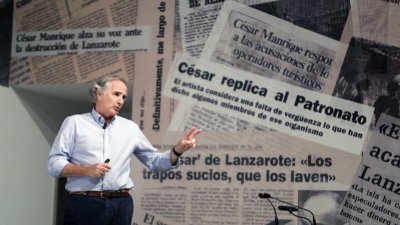
The increasing frequency of heat waves, the rise in sea level, and how climate change will shape the global landscape in the coming years were the focus of the presentation given by the expert in coastal engineering, climate change, and offshore energy, Íñigo Losada, during his conference at the César Manrique Foundation in Lanzarote this past Thursday.
Losada is one of the world's leading specialists in the analysis of the impact of climate change on Earth and has visited the island to give a conference on Risks and adaptation to climate change on the Canary coast. He also holds a doctorate in Civil Engineering and has directed studies of risks and adaptation to climate change in about thirty countries. He has also done so in the Canary Islands. During his conference in Lanzarote, he stressed the importance of understanding the coast "as a set of systems" that do not understand municipal divisions and are not only composed of a beach, a fishing village, or a dune system.
"A very important part of our GDP is closely linked to the coast and that means that I am accumulating vulnerabilities in that area, so the probability of having great risks is greater," the expert began at the start of his speech. In this space, "all the worst" is accumulated, due to its location between the sea and the land. It assumes the rise in sea level, the warming of the water, but also the runoff or the rains.
Danger, vulnerability and exposure
In order to act against the imminent climate change and its impact on the Canary coasts, we must first understand what are the risks facing the Islands. Among them, three essential factors are analyzed: danger, exposure and vulnerability.
This expert explains that danger involves how the natural situation of the sea changes, but also how the rise in sea level, the warming of the water or the acidification of the oceans affects it. "It is not the same to cross a street where nobody passes than to cross one where people pass by bicycle, cars or trucks," Losada exemplified. Thus, he adds that another factor comes into play: exposure. "It is not the same to cross a street of five meters than a highway of five lanes, because I am going to be exposed longer," he continued with the simile. The engineer assured that the more that is built on the coast, the more risk there is of suffering losses or damages.
To conclude, this expert spoke of vulnerability. "Depending on how I build, what are the risk reduction elements or the state of health of an ecosystem, its vulnerability may be greater or lesser," Losada testified. In this sense, he differentiated between natural systems, such as dunes, cliffs or corals, from human systems such as settlements or tourism. "If I increase the sea level, if I increase my exposure or if I increase my vulnerability, there will be more risk," reveals Íñigo Losada.
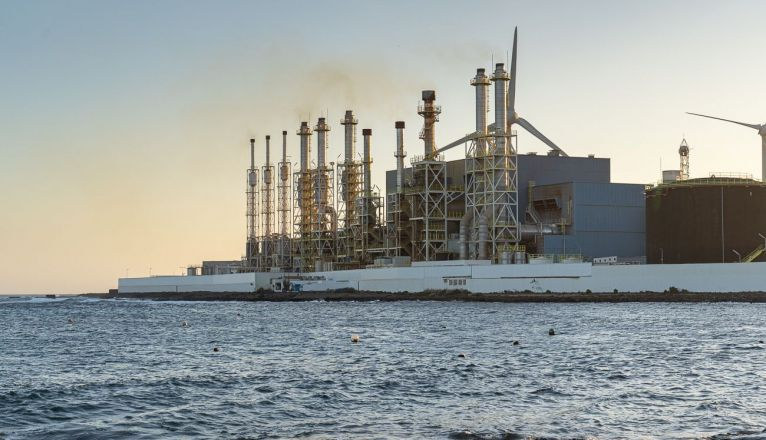
For example, in Lanzarote, the power plant that supplies electricity to the island is located next to the sea in Las Caletas, the Airport is located very close to the coast, and the tourist accommodations are mostly next to the sea.
The rise in sea level
Faced with this reality that seems inevitable, the world's leading experts are considering the possible scenarios in which the planet will find itself depending on how the emission of greenhouse gases is reduced or not. To tackle this problem, there are two formulas: mitigation and adaptation.
The decarbonization of the planet is the only way found by researchers to mitigate the effects of climate change. So, the only thing that could stop this advance and prevent us from placing ourselves in the worst of scenarios is to try to reduce greenhouse gas emissions as much as possible and improve the sinks to fight against the warming of the oceans and the rise in sea level.
As they are not optimistic about this scenario, a second option has been raised: adaptation. "The coast is not going to disappear, it is going to change as we know it. It will be unthinkable to rebuild the promenades or replace the beaches five times a year," said the expert in coastal engineering, climate change and offshore energy during the conference. In the worst climate scenarios, atmospheric phenomena such as floods will be repeated more and more frequently, so it will not be sustainable to rehabilitate spaces prone to suffer these damages.
For example, in scenarios of large emissions, the sea level will rise a lot, up to 1.10 meters more in 2100. In the most unfavorable case, we would be talking about rates of up to 20 millimeters per year, according to the expert.
"There is no one who can stand that. The coast as we have it until now we could not adapt it," Losada foresaw.
"We are not going to be able to reduce CO2, we are going to continue suffering impacts, so we are going to reduce the impact of that risk or see how we can live in a world with more risk," he added. To face this reality, the Canary Islands already carried out in collaboration with the Ministry of Ecological Transition and under the direction of Grafcan a specific plan to locate vulnerabilities and find a way to safeguard the structures located in coastal spaces. For example, the Canary Islands has an adaptation plan for all regional ports.
The real adaptation objectives are carried out for specific points and not for an entire area. "If we do not know the risk, we will never be able to know where or when to adapt," he revealed. During these works, Grafcan was able to identify what will be the coastline of the Canary Islands during the next decades in order to tackle which elements will be in danger and be able to try to safeguard them. In that objective, the Archipelago studied the danger, erosion, and flooding on the population, infrastructures, productive fabric, heritage and ecosystems. Despite there being other elements, only these three points were studied because they were the most unknown in the Islands.
The case of Lanzarote
The expert in coastal engineering, climate change and offshore energy, revealed that the ocean absorbs part of the heat that is produced by the increase of the greenhouse effect and captures a large part of the CO2. "If it were not for the ocean, the situation on Earth would be catastrophic," he said.
"More and more extreme events. The sea level is affecting everywhere. In the Canary Islands we are in the environment of four millimeters per year, which is very important in the retreat of the beaches," he advanced.
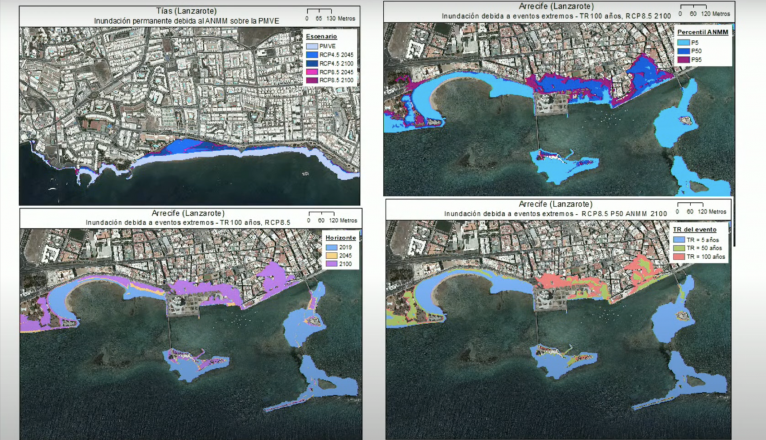
During his presentation he exposed the particular case of Arrecife, where in the worst future scenarios, with greater frequency of extreme episodes, part of the center of the capital would sink. Among them, the area of the Plazuela.
The erosion of the beaches is another of the problems faced by the Archipelago. The loss of these coastal spaces has two negative points: the waves have nowhere to break and the risk of flooding increases and affects the tourism industry of the islands. In some areas of Lanzarote, for example in Famara, 25 to 40 meters of beach will be lost.
This research serves to alert political leaders where they should adapt and work to avoid damage from rising sea levels. This work collects the indices by spaces and shows the areas where these damages can be suffered the most.
All this situation will cause in the world the increase of the losses of goods near the coasts and rivers, but also will bring with it the increase of the climatic refugees.


Add La Voz de Lanzarote as a preferred Google source.
Stay informed with the latest current news.