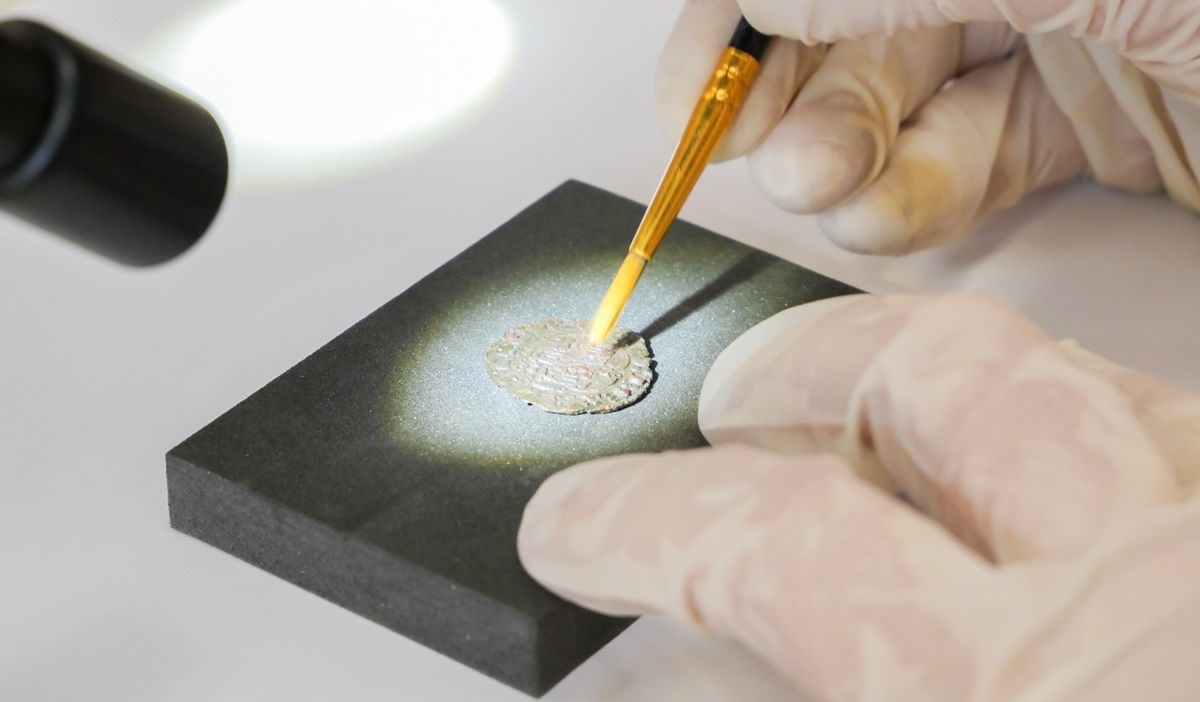
The latest campaign of archaeological excavations at the San Marcial de Rubicón site is providing "really new" material information about the first years of the conquest of the Canary Islands. Among the pieces that have been exhumed, those responsible highlight the "large quantity" of both aboriginal and colonial ceramics, as it allows dating certain areas of the site, but, without a doubt, the "most exceptional" discovery of this last campaign has been the set of coins found in two of the excavated areas, the so-called factory area and European habitat area.
On the morning of this Thursday, the results of the latest excavation campaign in this area of the south of the island were presented at a press conference with the participation of the general director of Cultural Heritage, Nona Perera; the mayor of the Yaiza City Council, Óscar Noda; and Esther Chávez and María del Cristo González, co-directors of the research project and professors at the ULL and the ULPGC, respectively.
In her speech to the media, Nona Perera announced that at this time "a new agreement is being processed, which with a validity of 2 years will guarantee the continuity of research in San Marcial de Rubicón." The head of the Government area explained that "the second campaign developed is proving very fruitful and extraordinary due to the amount of new information that is contributed to the knowledge about the first moments of the conquest and the subjugation of the native population of the island."
"The results of the current archaeological intervention in San Marcial de Rubicón are a great step towards the objective of creating a visitable park that helps to disseminate the history of the Canary Islands, while allowing the conservation of the site. Yaiza is committed to signing a new agreement with Cultural Heritage and the two public universities of the Canary Islands to continue advancing in this exciting research," said the mayor, Óscar Noda.
"Eight of the nine coins have been attributed to the coins of Enrique II or Enrique III, called 'crowned dinars' or 'cornados', because they represent the crowned bust of the king in profile and looking to the left, although the numismatic study is still in the discussion phase by Manuel Mozo and Ana Serrano. Even so, this is an unprecedented finding as it is the oldest monetary elements discovered in an archaeological context on the island," explains María del Cristo González.
What really makes this finding a unique discovery is that all the coins bear a countermark that represents a Gothic letter "B". "It is well known, as it appears in the chronicle Le Canarien and is ratified by the administrative documentation, that the king granted Jean de Bethencourt the power to mint coins and also that the absence of metals in the islands prevented the first conqueror and lord of the Canary Islands from making this prerogative a reality, always reserved for royalty," they point out from the Government of the Canary Islands.
The team made up of the two public universities of the Canary Islands wonders if this seal is not "the proof that Jean de Bethencourt managed to make that royalty a reality", printing the initial of his last name on the coins in circulation. As María del Cristo González explains, "we are facing a monetary find that, as of today, is unique and relevant, not only for the islands, but also for the peninsular numismatics, where there do not seem to be such old examples of this practice", all this if this theory were to be confirmed.
The pieces rescued in the months of September and October 2021 have been studied by research staff and students in the Archeology and Prehistory Laboratory of the ULL. In the case of the coins, due to their fragile state of conservation, they had to be cleaned and consolidated by a specialized restorer before their study. Patricia Prieto, restorer of the Cueva Pintada de Gáldar, was in charge of carrying out these interventions.
With this project, attached to the collaboration agreement between the Government of the Canary Islands, the Yaiza City Council, the University of Las Palmas de Gran Canaria and the University of La Laguna, it has been possible to locate, among other findings of interest, the oldest coins in the archipelago within an archaeological context, with the exception of the vellón money of Jaime II exhumed in the Cueva Pintada de Gáldar.
Other findings
The field work also allowed documenting the vestiges of domestic enclosures associated with the people who were part of the hosts commanded by the Franco-Norman conquerors, Gadifer de la Salle and Jean de Bethancourt, as well as by some women who accompanied them.
In this sense, the archaeological activity confirmed the use of rammed earth, a technique consisting of raising walls through the use of a wooden formwork inside which moist clay soil was poured, which was compacted by blows with a rammer. "This technique, used profusely according to the administrative documentation during the period of colonial transition and definitive conquest of the Canary Islands, had not been archaeologically recorded until now," says archaeologist Esther Chávez.
The interior of these walls housed that coexistence of indigenous and colonial ceramics, the latter dated in the second half of the 14th century and the first half of the 15th century in the peninsula. These findings help to define spaces, since there are some areas where the presence of ceramics of aboriginal origin is 95% while in others, the percentage of colonial ceramics is higher, which means that there are areas where the aboriginal society lives and others where the European society lives almost independently.
Premiere of the short documentary
On the other hand, from the Government of the Canary Islands they point out that one of the objectives of the project is dissemination, so on the afternoon of this Thursday, at 6:00 p.m., a short documentary about the field work with interviews with specialized personnel involved in the latest excavation campaigns will be screened at the Casa de la Cultura Benito Pérez Armas, in Yaiza.
After the screening of the audiovisual, there will be a colloquium with the co-directors of the archaeological research project together with the director of the film, Pablo Rodríguez, from the production company Desenfoque Producciones. In addition, the General Directorate of Cultural Heritage will publish the short documentary on its YouTube channel soon for all those interested in the work being carried out at the San Marcial de Rubicón site.

Add La Voz de Lanzarote as a preferred Google source.
Stay informed with the latest current news.