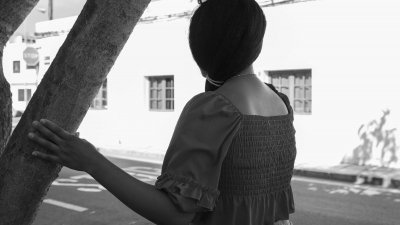
María (fictitious name) arrived in Lanzarote two years ago seeking a better future. She was born in Colombia, but the economic situation in her country led her to first try her luck in Argentina. "The devaluation of the currency in Argentina and everything made me return to Colombia," she explains during an interview granted to La Voz and then led her to cross the pond and come to live on the island of volcanoes.
After deciding to leave her native country again, she chose Lanzarote because it is "a very safe place, it is a very quiet island." María's situation in Colombia was marked by the kidnapping and disappearance of her mother twenty years ago by an armed group. During her childhood, it was her grandmother who struggled to raise her along with her brother and cousins.
María arrived in Lanzarote as an asylum seeker. However, the delay in the process, which according to the Spanish Commission for Refugee Aid is between four months and a year to get the first appointment and which is delayed over the years, led her to encounter labor exploitation in Lanzarote. "I worked in several restaurants and worked between 10 and 12 hours a day for 900 euros," she reveals during an interview.
María entered the support networks of the Mararía Association fleeing from the gender violence that her ex-partner exerted on her. Through this entity, she obtained psychological support and also access to the food bank for her and her baby, the son of her abuser. Currently, her baby does not have to make visits with his father because he has a restraining order and cannot approach María.
"To be with someone like that, it's better to put a limit on the situation once and for all because if you let it happen once, it comes back and happens and I didn't want that for my life," she laments at one point in the interview.
According to data from the Government Delegation of Spain against Gender Violence, a total of 1,284 women have been murdered by their partners or ex-partners since the official count began in January 2003 until this November.
Taking the step of moving away from her abuser was very difficult. "It was a very sad, very painful process, because he is the father of my baby and I didn't think that was going to happen," she says.
Under these circumstances, she has been relying on the food bank and the help of the Active Reintegration Income, intended to reincorporate women victims of gender violence into the labor market. "With the help, the truth is that I have been able to survive, because all the savings reach a point where they are scarce," she confesses.
Currently, she lives in the house that she had rented with her ex-partner. However, the bank took the house from the owner and it has been acquired by another person. "The man came two months ago and told me that he had bought that house. All he wants is the house and he doesn't want to leave it to me for rent," she tells this newsroom.
However, the young woman states that "there is a contract involved" and that she is waiting for some notification from the Court to be able to reach a rental agreement. "It is very difficult to get a rental and the judge could be more flexible and give me one more year of rent, while I save a little now that I start working and have money to go to another island where there may be more housing," she adds.
The first three months of 2024 concluded with 114 women victims of gender violence in Lanzarote. Of these, 63 are Spanish and 51 are of foreign origin. Foreign citizens, in proportion, continue to suffer more from the consequences of physical, psychological, social and economic aggressions of violence against women.
Although foreigners only represent 24% of the women of Lanzarote, according to the INE, they account for 44.7% of the victims of gender violence. This is reflected in the data from the General Council of the Judiciary in Arrecife.
Labor exploitation
In addition to gender violence, there are the months she spent living in Lanzarote without an employment contract. "I stayed close to work because I worked part-time, I didn't even come home, I stayed around there. On top of that, if there was something to clean, organize, I had to stay and give more time," she narrates her experience in a well-known bar in Arrecife. "It was something very hard, very complicated, because I was like that for four months. It happened to many of us with the previous owner of the place," María continues.
María waited a long time for her former boss to pay her the money he owed her, but he didn't. "Most of us were from Colombia and we didn't dare to report it so they wouldn't think we were doing it for the papers, even though we all had papers already. So they wouldn't say. 'Oh, Colombians always want to report it so they can get papers!' and in reality we didn't do it for that," she confesses.
At that time she was pregnant with her baby and feared losing it with the hustle and bustle of work, "so much work and so little staff, we were running from one place to another and I fell."
Currently, she has a work permit that has allowed her to access decent working conditions, with eight-hour contracts for 1,300 euros. María obtained temporary residence authorization after the birth of her baby and has since renounced her asylum application.
Hope in the future
"For me it is a privilege to be here and, above all, I am very grateful to Spain and to the people here because they are very humanitarian," she says on the other side of the phone. "The people who are here, each in their own way, want to get ahead," she adds. María is processing the documentation to start studying Law through the internet and has been taking out the books from the library little by little.
"I would like to help many people in the field of gender violence. I am very grateful to the Bar Association, to the Justice system, which granted me a free lawyer, but also to many people. I would like to be one of those people who are going to help those who have few resources and do not have the means to pay a lawyer," María confesses.
Currently she is going to start her new job and has already planned to renounce the aid from the food bank because she wants to "give the opportunity to other people who are not working."



Add La Voz de Lanzarote as a preferred Google source.
Stay informed with the latest current news.