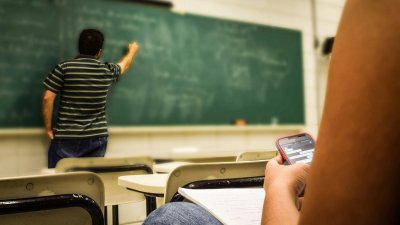
Using mobile phones in the middle of class, using artificial intelligence to do homework, the increase in verbal aggressions or the lack of motivation and attention in class are some of the problems that teachers are facing in recent years in Lanzarote and the rest of Spain. This situation of deterioration in education is reflected in a survey carried out by the STEs-Intersindical union and whose results, published last January, reveal that 82.62% of teachers describe the work environment in classrooms as "conflictive and complicated".
After the covid pandemic that led us to lock ourselves at home for months, in recent years the situation in classrooms is "strange and with a generalized apathy regarding learning or following the rules that teachers want to transmit to students," explains Silvia Álvarez, a Spanish Language and Literature teacher at IES Tías in an interview with La Voz. The general trend of behavior and ways of acting in class comes, according to her, from "the idea of being freer" and of "managing my time but with the things I want to do, not with the ones you impose on me."
This situation leads teachers to seek strategies to motivate students and for them to be aware of the importance of classroom teaching. This problem, coupled with the excessive use of mobile phones and social media makes the situation even more complicated. "We procrastinate a lot, we waste a lot of time and we don't know how to manage it for what our responsibility really should be, which is to do homework and study for exams," he assures.
And it is that social networks like TikTok in which immediacy is the protagonist, students transfer this speed to the classroom. "Everything is images, immediacy and sitting down and having a study habit is a world to them," although the teacher points out that "one cannot generalize because there are also very good students who still have interest and desire to learn, but they are fewer and fewer in the classrooms."
In this sense, the intervention of families is paramount for the student to do their work in class and at home. "I'm not going to generalize, but we see that some are with us and others disengage from their children's educational process because they come to ask for explanations when the results are what they are," he/she points out.
To lay a foundation to avoid disrespect towards teachers
Currently, 83.15% of the teaching staff nationwide has noticed an increase in verbal and physical aggressions from students. However, regarding disrespect, Álvarez emphasizes that the teacher "must establish a foundation from the beginning because disruptive behaviors can happen once a week or a month, but if you lay a foundation at the beginning, this does not happen".
Families once again play a very important role in this aspect. "If you issue a disciplinary report or a sanction and that family responds by giving you the reason, everything runs smoothly and works, but if the family goes against you, no matter how many reports you issue, the student will continue to behave the same way," indicates the teacher.
Based on his experience, he assures that the teaching staff has lost a lot of authority, which makes it possible to observe this type of disruptive behavior. "As a teacher, each one of us must put order within the class and if I have to leave you without recess I do it, but families and the management team have to support us to prevent everything from going to waste and we have to make that not happen", he says.
In addition, it also exposes the sexist conception extended in society in which "the man imposes more than the woman". "The students know how far they can push the limit", he declares.
For Silvia Álvarez, these lack of education and verbal aggressions "are a consequence of spending a lot of time in front of a screen, like violent video games, all this generates verbal and physical violence that can make the conditions not be adequate". And it is that, according to warns the teacher, activities as simple as reading that "imply being yourself with your person are not done, each time there is less capacity to be still".
However, one of the aspects that teachers are observing in students who arrive from Primary school to high school is the lack of maturity because "they arrive more and more childish," something that perhaps influences "the protection by families." The frustration that many suffer may also be derived from the student not correctly assimilating the content given in class, which makes them bored. "This impacts teachers, as many of the anxiety attacks occur because they don't know how to manage the situation and it also affects students who do want to learn," he explains.
The danger of fragmented information and the immediacy of social networks
The teacher always advises her students to read newspapers, listen to the radio or watch the news on television, not only so that they are informed, but so that they know the reality of the world that may appear to them in the form of an exercise in exams such as the University Entrance Exam (PAU). However, most inform themselves on social media like TikTok with immediacy as their main asset.
"The news reaches them fragmented and they keep that part, so the use of the mobile must be controlled because there are students who are hooked on them and the only time they are without using it is during the six hours they are in class," he points out.
Mobile phone and social media addiction among the youngest makes them feel exposed to racist, sexist, and homophobic hate speech about which they do not reflect. "With feminist and equality messages, boys often feel attacked and what we want to make clear is that statistics are what they are," she reveals. "They should not feel attacked; what we have to learn are appropriate behaviors," she continues.
And it is that, according to the professor explains, when topics such as feminism are discussed in class, the boys verbally attack. However, Álvarez highlights that this trend also occurs with other far-right discourses. "I have even heard in class that life was better with Franco," she assures. "What we must do is listen to each other and not believe the first thing I see on social media without verifying it... it is something that is due to information arriving in a fragmented and immediate way," she continues.
The use of artificial intelligence, another of the challenges
The irruption of artificial intelligence in work, universities and institutes is a reality for a few years now. Despite being a very useful tool to optimize time, many of the students use it improperly to complete entire assignments, which means they do not reflect, think or learn about the content of the exercise.
Álvarez, like many other teachers, emphasizes that "artificial intelligence is here to stay and we have to accept it," so "we must adapt and use it in the best way possible." During her Spanish Language and Literature classes, the teacher points out that she does not assign evaluable tasks to be done at home, but in class. "If I send it home, the student will put what I ask into the AI and this tool will create it," she comments.
To force the student to carry out those guided exercises by themselves, the teacher asks that this task involve a creation process. An example of this is a project about women in the students' lives that she has carried out with 1st year of Bachillerato, in which she asks them to conduct an audio-recorded interview with the chosen person and with which the student will explain in class the process and the information. In addition, they must also write a literary text in the classroom, which avoids the use of artificial intelligence.
"Artificial intelligence is a tool that can be very positive if the student uses it appropriately because it can help them understand things that I explain in the classroom and that perhaps it can explain them in a clearer way with examples", he concludes.



Add La Voz de Lanzarote as a preferred Google source.
Stay informed with the latest current news.