
"Many times to survive, memory forgets things, but the body is there remembering everything. Even though it happened a long time ago, it's still there," says the founder and director of the Teatro que cura association, Susana Martín Cuezva, during an interview with La Voz.
Teatro que cura is a non-profit association that was founded in 2017 and seeks, through the performing arts, to raise awareness among young people about gender violence, while trying to educate in respect and promote healthy relationships. To represent it, they use the toxic love story of Ali and Edu, two fictional characters who maintain an adolescent relationship and are represented for two hours by actors from the project.
"Sometimes we find spaces in classrooms with a lot of normalized violence and that's what we want to focus on," she adds. For its founder, the initiative goes beyond staging a relationship, but is a way to intervene, prevent and tackle it. "What we do, above all, is reflect on the way we relate in an affective and intimate relationship, which can also be between friends," she says on the other end of the phone.
During these interventions with students, on several occasions they have seen how students begin to tremble involuntarily when remembering "a scene they experienced as children, which they did not remember and which comes to their memory." At this point, the session serves to "detect situations among the students of which the educational center was not aware." After encountering them, they refer the student who has been "touched or moved" by these scenes to the appropriate institutional spaces, with professionals in psychology who can follow up on the cases, such as the Island Council for Equality and Attention to Women (CIAM).
The therapist, also trained in Gestalt and systemic psychotherapy, explains that "realizing, remembering or bringing it back to consciousness and being able to work on it is one of the most important things to recover that creature that was shocked, paralyzed and had to encapsulate that, so that that young person or adult can really trust, establish healthy relationships and restore their affections, so that patterns are not repeated."
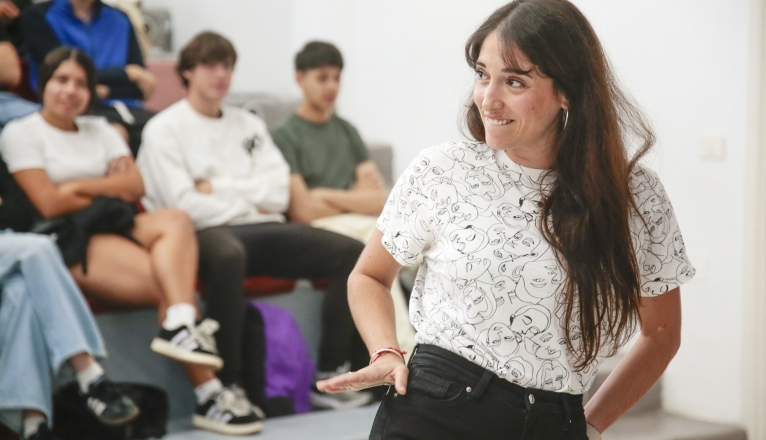
This work is totally interactive and allows minors to detect situations of violence, but also to name realities that some of them live in their homes or with their partners. "We show signs so that they can identify, connect and contact with their emotions and with what they feel and can resolve conflicts," adds the therapist. In many moments, students are invited to go on stage and rethink how to tackle situations "from a different place" and move away from violence.
The representations of Teatro que cura have encountered different realities, from young people who do not know how to explain how they feel, to others who are very clear about what the limits are in relationships.
Vicarious violence
Martín Cuezva narrates that during the theatrical plays, which they represent throughout the country and which in Lanzarote have reached a thousand students this year, the attendees usually react and identify situations similar to those they have experienced.
"A few weeks ago, a student explicitly shared directly that she was a victim of gender violence, that her father hit and mistreated her mother and that she was also mistreated for defending her," narrates the founder of Teatro que cura, "then with her first partner the same thing happened to her." At this point, the gestalt therapist explains that "it is very important to realize, to become aware and to do a personal process, to put yourself in the hands of a professional" and to rely on the institutional structure that exists to support victims of gender violence. "30 years ago that structure did not exist, it is very important to realize that we need help," says the theater director as well.
Faced with situations of family violence, Cuezva highlights the importance of adding family or friendship support networks to psychological and institutional support. "When there is a person suffering or living a relationship of gender violence, friends who do not get tired, who are there accompanying and understanding the dimension of the problem so that that person does not isolate themselves, which is what usually happens," she exemplifies. In this line, she points out that support networks are crucial for survivors of gender violence to make the decision to break the relationship.
Teatro que cura also seeks that minors who are victims of vicarious violence, a form of gender violence where the children of women victims are used to mistreat and cause pain to their mothers, can be understood by other classmates, opening "spaces for reflection so that they realize the dimension of the problem" and exemplify what are the phases of gender violence.
Thus, she also explains that during one of the interventions in Lanzarote, an adult man said "we are very focused on Ali, but the character of Edu has a problem. He knew very well what he was talking about," she says, at that moment he addressed the character of Edu and said "you have a problem, you can go to a professional who can help you process how to channel that aggressiveness and those outbreaks of violence."
Cuezva explains that the examples that she finds while representing the story of Ali and Edu is "the magic of theater and art, when you see a painting, listen to a poem or a song, something that has no words suddenly transforms." Cuezva adds that the initiative aims to convey the message that "everyone can do something" in the face of gender violence.
Helpline for gender violence 016


Add La Voz de Lanzarote as a preferred Google source.
Stay informed with the latest current news.