
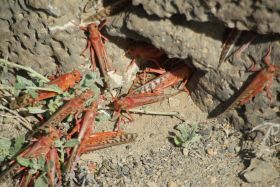
Official reports, especially in Mauritania, confirm that large waves of locusts are approaching the green areas of the north of the country, in search of plants and herbs. In this context, a recent report by the Food and Agriculture Organization of the United Nations (FAO) warned of the danger of this plague on the area.
This organization called on Algeria, Morocco, Mali, Senegal and Mauritania to take the necessary precautionary measures to deal with the waves of locusts. The Moroccan authorities confirm that the lack of rain in the Sahara rules out the danger for now, but once it rains the locusts can invade the Atlantic coasts of the Sahara in search of grass.
Although the locusts would reach the Atlantic coasts, it would be difficult for them to reach the Canary Islands, because at the moment the situation is not nearly as strong as it was in 2004, when these insects did reach the islands. In 2004, the governments of Morocco, Mauritania, Senegal, Algeria and Mali spent 400 million euros to control this plague.
Locust plagues in West Africa are always synonymous with problems and natural and social catastrophes, as they destroy agricultural fields and cause unemployment and misery, ending one of the few options that young people have to work and thus discard the possibility of emigrating to Europe.
ACN Press


