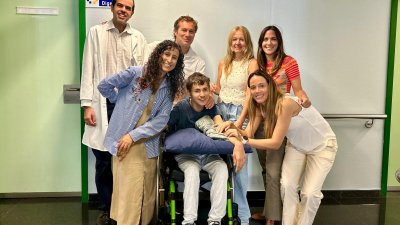
The story of Juanito Corchero Palczarski (Lanzarote, 2002) is full of exceptionalities. When he was only nine months old, his parents Juan and Marta saw how their only son almost died due to an ultra-rare disease known as Menkes disease.
Babies in his situation suffer from decreased muscle tone, deterioration of the mind, and developmental delays. In addition, they die before they turn two years old. However, science has allowed this young "conejero" (from Lanzarote) to become the longest-living Menkes disease patient in the world and to have already celebrated twenty-two birthdays.
At birth, Juanito was like any other child, but in less than a year he began to lose weight and his body became a "ball of jelly." This young man was diagnosed with a pathology linked to copper deficiency, which only 78 children in Spain suffer from and which has no cure, only palliative treatment to relieve the pain.
His diagnosis was located by a young dermatologist from Molina Orosa, who, upon seeing the baby's hair, remembered a disease he had studied at the University. "We spent a year with the child losing him, losing him every day," recalls his father, Juan Corchero, visibly moved, during an interview with La Voz. "He was losing mobility to the point where he could no longer hold his head up, he couldn't move his hands, and his feet would fall off."
At that time, his family contacted different doctors and found a palliative treatment by searching the internet. "These are treatments that, although not official, are authorized because they are people who have no other alternative," his father explains. Juanito receives daily copper supplements that are applied subcutaneously and have allowed him to have a better quality of life.
This young "conejero" has managed to exceed all expectations thanks to the fact that he suffers from a partial genetic mutation that allows him to absorb part of the copper and to the dedication of his family. Juan describes Marta, his ex-wife and Juanito's mother, as "a very sacrificial, incredible person who has been able to maintain her life, her work, and take care of the child in very high conditions."
However, although the treatment has allowed him to exceed the life expectancy of the disease, he cannot speak, walk, or eat without the help of his parents. "It is not 100% effective, it is a help, but with that product we have been maintaining Juanito, with the hope that in the future, with time and technology, something more effective would come out," he adds.
In these two decades looking for a cure for Juanito, his parents have advised other families with babies in the same situation. "Everyone talks to us, asks us, and since we have more experience and information, we have collaborated with many parents. What happens is that all the children have been dying and ours continues. It gives us the confidence that the child is giving us time to find a solution."
"She told me I'm not going to let my son die, I'm going to do everything possible, I'll find the solution. And the circumstances arose and it appeared," explains Juanito's father.
Juanito's hope
The life of Marta, Juan and their son Juanito and other families affected by Menkes has taken a radical turn thanks to an experimental and pioneering treatment that manages to cope with copper deficiencies. After the struggle of the families and a large medical team, Lanzarote is one of the first five places in the world that administers it exceptionally.
"One of the last mothers who had a child with Menkes dedicated a lot of enthusiasm, energy, time and sacrifice to it. She told me I'm not going to let my son die, I'm going to do everything possible, I'll find the solution. And the circumstances arose and it appeared," explains Juanito's father.
"That mother moved heaven and earth, managed and organized things that I have never seen done, nor did I think could be done," he continues. The woman Juan is talking about is Aurora Mateos, Doctor of Law and a UN worker and mother of Marco, a four-year-old Spanish boy with Menkes disease.
In an act of desperation, Marco's mother found a publication on copper in the journal Science, conducted by the University of Texas in the United States. The research showed a new therapy, a transporter that, when attached to copper, managed to cross the brain membrane and that, when tested in mice, gave good results.
The miracle of science
What happened next can only be explained by the unconditional love of a mother who would do anything to save her baby's life. "Marco was very bad, the conditions were bad and Aurora had a very bad time. Aurora was able to get what was happening in a Texas laboratory to Spain," he explains. In these years, Aurora Mateos founded the International Menkes Project, of which Juanito's family is a part.
Aurora Mateos reached an international agreement, got the American pharmaceutical company that had the rights to the research to collaborate, even though the treatment was not yet certified in the United States, and contacted the second largest pharmaceutical company in India, which was in charge of manufacturing the product. In addition, she managed to get "both the American laboratory and the Indian laboratory, the manufacturer of the product, to want to supply it free of charge to all the children," reveals this father.
This Andalusian mother managed in less than a year to "manage the authorizations, permits and certifications from the European Commission so that the product could enter Europe, be legal and reach Spain. She also obtained permission from the Spanish Medicines Agency for its exceptional use."
The Sant Joan de Déu Hospital in Barcelona is in charge of coordinating this experimental treatment, which does not have previous clinical trials in humans. "I've been in this from the beginning, I know them all and even they are surprised that this could have happened," he confesses. Marco, at four years old, was the first child in the world to receive the elesclomol-copper treatment three years ago. Now he can walk, run and play with other children and his recovery has opened the door for other families of children with Menkes to dream of seeing their children grow up.
The family of this twenty-two-year-old Lanzarote native is full of praise for the medical team that has made it possible for their son Juanito to dream of a better life. On the recommendation of the head of Pediatrics at Molina Orosa, Concepción Pérez, they reached the endocrinologist Eduardo García, who managed to coordinate with the rest of the centers involved in the treatment and that Juanito could receive the treatment. Also, without moving from Lanzarote.
"The doctor told us that he was an exceptional person, with an exaggerated dedication and concern for patients, but when we met him we were surprised because he was exactly like that," Juan says about the doctor who directs his son's treatment after spending six months developing the project to obtain permission from the Government, the Hospital of Lanzarote, the Pharmacy and the manager.
"It is not usual for this type of thing to be done in a secondary hospital like Lanzarote. Normally they go to Madrid, Barcelona or Las Palmas, but we did everything, we fought for it. In Lanzarote they gave us all the support and with their authorization we went to Negrín and got the support of the Research Ethics Committee," he indicates.
Juanito has already received the first two injections of the experimental treatment, which is administered once a week, while the palliative copper treatment is maintained the rest of the days.
On November 25, he received the first injection, under the coordination of the health personnel of Lanzarote and the head of Chronic Diseases in Pediatrics of the Maternal and Child Hospital of Malaga and part of the research team of the Menkes International Foundation (MIA) team, Elena María Godoy; also of the physiotherapist responsible for the evaluation and analysis studies of the evolution of the children of the Foundation, Rosa María Marqués Pérez-Bryan of Malaga; and Stephanie Lotz, expert in Genetics of the Sant Joan de Déu Hospital and Menkes researcher.
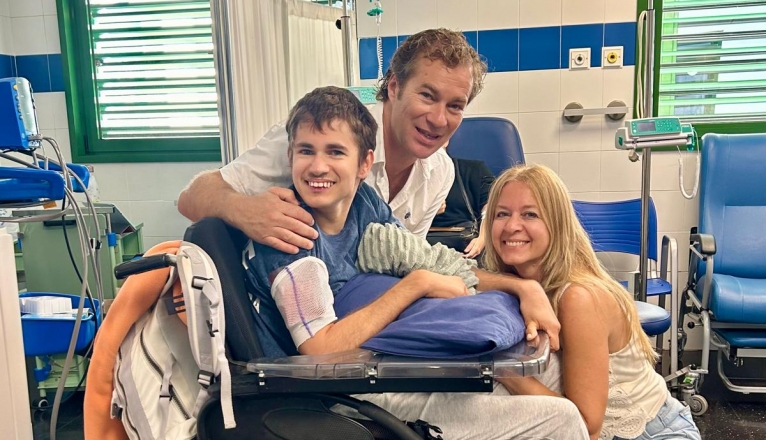
"When something like this happens in life, your life expectations and future plans disappear, you focus more on the day to day. Now my main concern is to see my son smile every day," concludes this resident of Lanzarote.



Add La Voz de Lanzarote as a preferred Google source.
Stay informed with the latest current news.