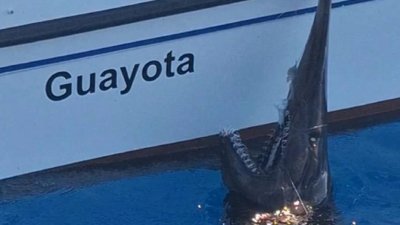
A team of researchers, including Alberto Brito Hernández, a retired professor from the Department of Animal Biology, Soil Science, and Geology at the University of La Laguna, has documented for the first time the presence of a live specimen of goblin shark (Mitsukurina owstoni) in the waters of the Canary Islands.
The specimen analyzed, **approximately 2.5 meters in length**, was accidentally caught on May 4, 2024, during a **recreational fishing** trip off the coast of San Cristóbal (Gran Canaria) at a depth of 900 meters and 9.5 kilometers from the coast.
After capture and handling, the shark was released alive and documented through photography and video, allowing for the recording of the species' diagnostic morphological characteristics.
Among the observed characteristics of the shark are its flattened and elongated snout, protrusible jaws with long, sharp teeth, small eyes without a nictitating membrane, a flaccid body, and two rounded, flexible dorsal fins, along with a long caudal fin devoid of a ventral lobe. Furthermore, the provisional identification as female was based on the absence of copulatory organs.
A significant advance in its geographical location
This record, detailed in the international journal Thalassas, represents a significant advance in understanding the geographical distribution of the species Mitsukurina owstoni, as it is the first confirmed sighting in the Canary Islands and the second occurrence in the Macaronesian region.
Detail of the head of Mitsukurina owstoni captured in the Canary archipelago, showing the diagnostic morphological features: elongated, flat, and leaf-shaped snout, with long, slender teeth, and tiny eyes without nictitating membranes.
Tropical and temperate waters
To date, fewer than 250 individuals of this unusual-looking shark have been documented worldwide. The goblin shark has a scattered but widespread distribution across most of the planet in tropical and temperate waters, at depths ranging from 250 to 1,500 meters. Its presence has been occasionally recorded in the northeast Atlantic in Galicia, Madeira, Moroccan waters, and near Portugal.
On the other hand, the finding also underscores the ecological importance of deep-water habitats in the Canary Islands, which act as a refuge for sharks and other elasmobranch species. The absence of bottom trawling since the 1980s and limited fishing activity targeting deep-sea sharks contribute to the preservation of these populations, although incidental catches through passive gear persist
This documentation provides evidence of geographic segregation by size observed in the species. Records from the eastern Atlantic mostly correspond to juvenile or subadult individuals, while adults (>300 cm. TL) predominate in the western Atlantic. This differential distribution could reflect ecological or reproductive factors not yet fully understood.
The research team points out that this record constitutes a notable expansion of the species' known distribution range in the Eastern Central Atlantic and highlights the need to continue exploration and monitoring of these understudied environments.



Add La Voz de Lanzarote as a preferred Google source.
Stay informed with the latest current news.