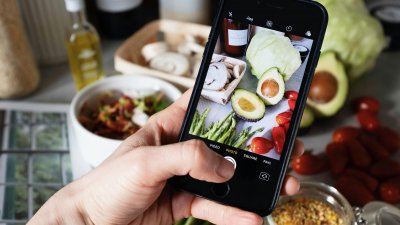
Healthy recipes, recreation of desserts in their "healthy" version, ideas for losing weight, defined bodies, influencers who pose as fake nutritionists to advise their followers on diet and a algorithm that becomes a double-edged sword. This is what many people, especially young people, encounter on social media platforms like TikTok or Instagram and which, in some cases, leads to the development or exacerbation of Eating Disorders (TCA). The person who suffers from them shows a strong concern in relation to their weight, their body mass and presents alterations with eating.
In a society where physique and the idea of a healthy lifestyle have taken over daily life, social media often promotes this content in an extreme way which can generate eating disorders. But, first of all, what types of ED exist? Specifically, we can list three of these serious psychological disorders: bulimia, anorexia nervosa, and binge eating disorder which, in Spain, affect around 400,000 people, according to the Spanish Society of Family Physicians (SEMG).
According to Alicia López, a general health psychologist specializing in therapeutic work with minors and their families, bulimia is a disorder in which the patient's physical alteration is not as striking, but there are more binge-eating episodes. "They eat uncontrollably for a period of time and, due to guilt, engage in compensatory behaviors that can range from vomiting, excessive physical activity, fasting, or laxatives, and there is also a great concern about weight, but they do not necessarily have to have a low weight," she points out.
The anorexia nervosa is presented as "a restriction and reduction of nutritional intake, with an intense fear of gaining weight and, above all, a great dissatisfaction with your body and there can be a false perception of the physique, seeing themselves fatter than they are".
Regarding binge eating disorder, there is also excessive food intake as in bulimia, but in this case there is no compensatory behavior itself. "These people usually experience a significant weight gain and it generates deep discomfort for them to remember the binges and it is usually linked to depressive symptoms," she details.
Indications that can surface from nine years old
Despite many people thinking that eating disorders appear from adolescence, the truth is that indications are manifesting in children from nine years of age. "Some warning signs appear that if not treated could develop an eating disorder," explains the psychologist.
Families must be alert to certain behaviors such as girls being concerned about weight, the compulsive use of the scale, that they avoid some meals or foods, dissatisfaction with their body, crying when they look in the mirror or dressing in a wider way so that their silhouette is not seen. "Above all, dissatisfaction with weight because it is not typical of that age," indicates Alicia López.
Despite this, according to the professional explains, EDs "do not have a cause or factor in themselves, but rather they have genetic, psychological factors (trauma, bullying situation or family problem), personality traits or difficulty in emotional regulation because sometimes we use food as a strategy to manage difficult situations".
In the education of children and adolescents, the family is fundamental, as well as when it comes to the relationship with food. "Many times the awareness of satiety or physiological needs is not worked on as much," she points out, which sometimes leads to parents forcing their children to eat whole plates instead of "connecting the child with their feeling of hunger and having them stop when they don't want to keep eating more."

The impact of networks and the algorithm on a brain in full development
In children and adolescents, when the brain is still in full development, social media and its content can be detrimental to the cognitive growth of the minor. "The prefrontal cortex is immature because it is the part that develops later and entails those cognitive functions such as judgment, self-control, or decision-making," López points out.
This influences functions such as attention, which causes a lack of it. "An example is the consumption of YouTube and very short videos, which influence attention," he details. However, it also affects the correct development of emotional reactivity, of "how it responds to criticism, comparisons, or dependence on social validation through likes or comments on networks."
"All this does is decrease self-esteem, generate anxiety and make the person continuously seek that external validation", continues the expert. Likewise, there also appear the changes in emotional regulation, which leads to them "having fewer resources to manage intense emotions and, above all, constant comparison because there is a normative model of body and image that minors pursue and compare themselves to."
The algorithm, the system that filters our tastes or hobbies and makes the content of our social networks a clear reflection of what we want to see, becomes a very powerful and dangerous tool in people with eating disorders. "Overexposure to content related to the body ideal increases the feeling of discomfort and, what could be healthy behaviors, become risk behaviors," comments the psychologist.
In people suffering from an eating disorder, this algorithm "ends up showing them content related to strict diets, perfect bodies, and behaviors that encourage these disorders", which ends up being a loop from which it is very complicated to exit.
And it is that when a minor has a mobile phone, parents must take into account more than just the child's age. "What I always recommend is not to be abrupt, not to go from having nothing to having an iPhone, but rather to accompany the child with one of your phones first, supervised social networks and, depending on how you see your child's preparation, give them their own device," advises Alicia López. In addition, "viewing social networks with the child, criticizing them and seeing what is real and what is not to gradually give them autonomy," she continues.
Only 2.1% of the nutritional content on TikTok is truthful
According to a study conducted in 2024 by the University of Dublin and the mobile application MyFitnessPal, only 2.1% of the content in the form of videos published on the social network TikTok is truthful. The study reached this conclusion after analyzing 67,000 videos, which reveals that the overwhelming majority of content about food and nutrition is inaccurate and does not conform to reality.
This can have an impact on health, especially that of young people, who turn to TikTok with the aim of learning healthy recipes for free and informing themselves about the nutritional values of foods when many of the videos are not made by professionals. "This means that the vast majority of what people are consuming is not backed by science," points out Flavia Baridón, nutritionist and dietitian.
The consequences derived from this involve, according to Baridón, "adopting unbalanced diets or generating problematic relationships with food, something that can be very difficult to resolve." "Platforms reward what goes viral and we know that this is normally not the most rigorous," the expert continues.
On the other hand, the bombardment of videos about healthy recipes or healthy variations of desserts and meals on social media spreads the message that everything we eat must always be sugar-free and low in calories. However, the reality is that it's okay to lead a healthy lifestyle and occasionally eat something more caloric or not as healthy, such as a slice of cake or a hamburger. "I am in favor of flexibility and it's okay if you feel like eating a sweet once, healthy eating is very good, but without obsessing," assures the nutritionist.
However, these healthy recipes are a very good option when, on a daily basis or more often, we want to eat deliciously but eliminating ultra-processed foods and that it be nutritious. The quid of the matter of the matter lies in eating healthy in general, but being able to enjoy other not-so-healthy foods from time to time. Otherwise, it is possible for a person to develop orthorexia, an eating disorder characterized by an obsession with eating pure, healthy, and "clean" food.
"Talking to a person with orthorexia about being flexible in their diet for a day is unfeasible, they cannot allow themselves to do it because they feel guilt and frustration," explains Flavia Baridón.
Recovery of a person with an eating disorder
People with eating disorders face a great struggle after becoming aware of their illness and starting recovery. In this process, several healthcare professionals come into play, forming a multidisciplinary tandem to accompany the patient during this journey.
In this sense, there may be cases in which the person recovers completely, but there are also many others in which they never fully recover and have small relapses. "The possibility of total recovery exists, but always with good treatment at a nutritional, pharmacological, psychological, psychiatric and, even, sometimes involves internment in Eating Disorder units, in addition to very specific monitoring," details the psychologist.
This process can be prolonged a lot over time, always depending on each person's capacity and the severity of the disorder they suffer from. "It's not about eating well again, it's about dismantling beliefs, losing fears, rebuilding trust with one's own body and losing the fear of eating to have that flexibility," asserts nutritionist Flavia Baridón for her part.
For a correct recovery, the healthcare professionals must be continuously training and updating themselves, as new eating disorders emerge more and more. Of course, all of this with "empathy, respect, and without judgment because they are people who feel a lot of guilt and anxiety" to enjoy food again without remorse.



Add La Voz de Lanzarote as a preferred Google source.
Stay informed with the latest current news.