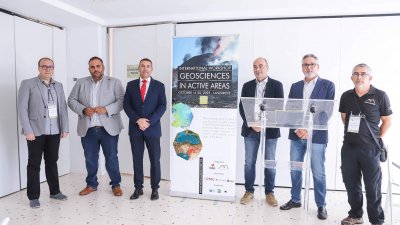
The international scientific meeting International Workshop on Geosciences in Active Areas, which will bring together researchers from different disciplines of Earth Sciences to share research results in geodynamically active areas of the planet, began this Monday in Lanzarote. This multidisciplinary group, which includes researchers from geodesy, geophysics and volcanology, places special emphasis on seismic and volcanic areas and will meet until October 20.
Research in this field studies phenomena associated with terrestrial dynamics, such as plate movement, earthquakes, volcanic eruptions or variations in sea level. These investigations must be carried out in suitable places, areas of the planet where in situ studies can be carried out with the purpose of learning more about the genesis, state, development and possible evolution of the phenomenon under study.
The president of the Cabildo, Oswaldo Betancort, inaugurated this new meeting on Monday morning at the Islote de Fermina, from where he thanked the organizers, sponsors and participants for making the event possible. "Activities such as those that begin today promote not only research, but also help us to foresee and protect ourselves against future geological phenomena, something crucial and of enormous interest to the island, since it will undoubtedly be a great opportunity to discuss multidisciplinary issues in the field of Earth sciences that have so marked our history and which is, without a doubt, a place that has a unique scientific interest due to its volcanic origin and its important historical eruptions, its geographical location and its involvement in the protection and knowledge of the environment," said Betancort during his speech.
"The latest volcanic eruptions in the Canary Islands have highlighted the importance and need to maintain and develop scientific facilities such as the Lanzarote Geosciences Laboratory, a model of multidisciplinary research laboratory from which to promote scientific collaboration based on long-term instrumental monitoring and the development of methodology and models for the knowledge of phenomena of volcanic origin," explains the Area Councilor, Samuel Martín, recalling that, currently, there are more than 40 sensors installed in iconic spaces on the island such as the Cueva de los Verdes, the Jameos de Agua and Timanfaya, which continuously record geodynamic parameters of the island.
Precisely, the international workshop includes visits to the scientific facilities of the Lanzarote Geosciences Laboratory, in the Cueva de los Verdes and inside the perimeter of the Timanfaya National Park.
In addition to the purely technical sessions, on Friday, October 20, a conference open to the public will take place on the islet of Fermina, on the research implemented by the Lanzarote Geosciences Laboratory in areas of active volcanism.
As a result of the collaboration between the Geosciences Institute, a joint center of the Higher Council for Scientific Research, the Complutense University of Madrid (IGEO, CSIC-UCM) and the Cabildo de Lanzarote, through the Casa de los Volcanes, the initiative also has the sponsorship of the International Union of Geodesy and Geophysics (IUGG), the International Association of Geodesy (IAG) and the International Association of Volcanology and Chemistry of the Earth's Interior (IAVCEI).
Add La Voz de Lanzarote as a preferred Google source.
Stay informed with the latest current news.