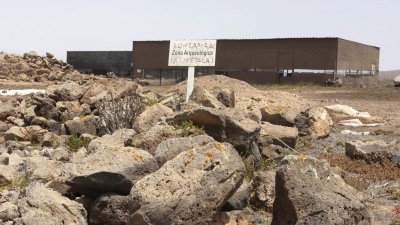
The town of Zonzamas became one of the most well-known and important archaeological sites in Lanzarote after the first works of the archaeologist Inés Dug Godoy in 1971 and 1985, who promoted the recognition of this place and shed light on the way of life of the island's aborigines, the Majos.
During these years, it was possible to recover a large quantity of archaeological materials, among which stands out an idol carved in gray volcanic sandstone known as the Idol of Zonzamas.
After some small interventions carried out in this space between 1994 and 1995 by the two Canary Islands universities, the site was abandoned until 2015, when the Cabildo of Lanzarote decided to resume work continuously until today.
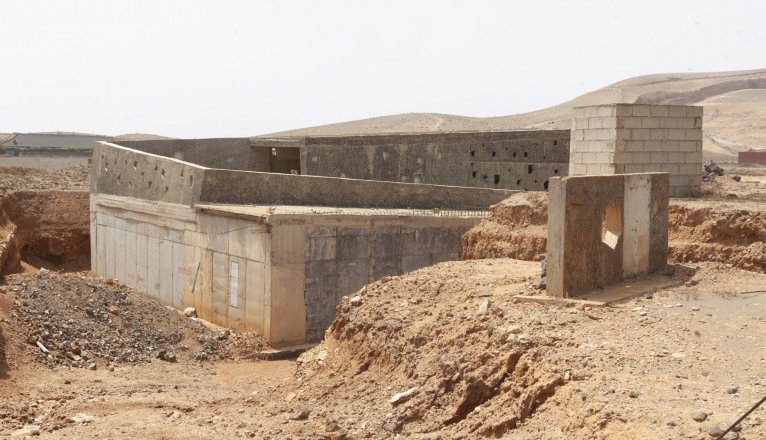
During the course of the following thirty years, the only action that was carried out was that of the concrete building that can be seen today, all due to the heritage policy that Lanzarote has had over the last three decades.
Due to the scarce research that has been carried out on the ground in Zonzamas, knowledge about the infrastructures and the way of life of the Majos is limited. Faced with this, Patrimonio will sign "immediately" and for the first time, a research grant on the archaeological heritage of the island for those people who want to do their doctoral thesis through the study of the materials that Inés Dug excavated at the time.
Likewise, the Area also intends to create a agreement of three to four years with the University of Las Palmas de Gran Canaria to carry out a series of research actions on the site. This will generate knowledge that, until now, is residual.
Characteristics of Zonzamas
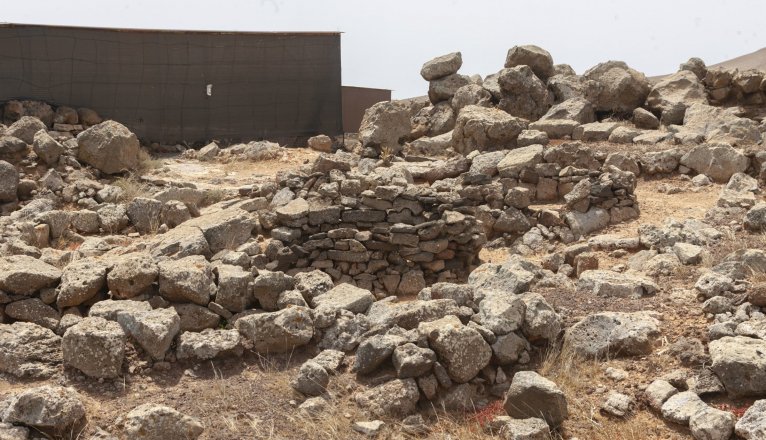
Zonzamas is one of the most unique sites in the Canary Islands, since it is the only one that has a wall made with large stones of up to three tons, which reflects that the aborigines had a very consolidated social and economic system.
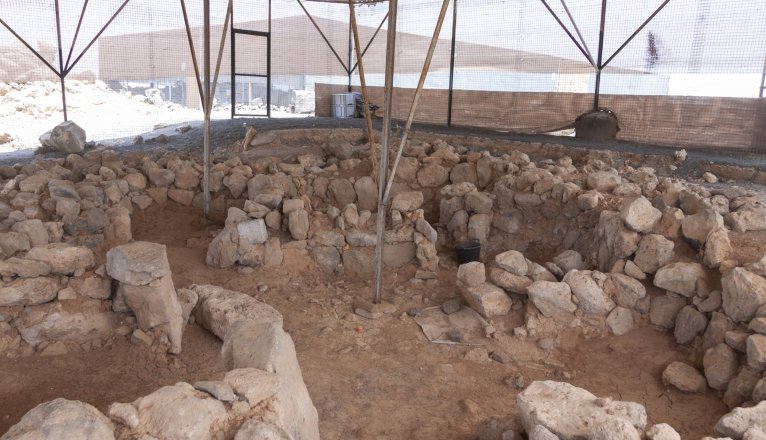
One of the characteristics of the archaeological sites of Lanzarote and, specifically, of Zonzamas, is that the houses were called "casas hondas" because they were semi-buried as a matter of protection against weather conditions such as wind or temperatures. In addition, the archaeological structures here are covered with tegue that acted as a waterproofing agent.
Regarding human remains, bones of two perinatal children dated around the 7th century were discovered at the site, which was a milestone, since it was the first time that remains of that nature had been discovered in a residential site such as Zonzamas. In another of the surveys that were carried out, the fossilized footprints of a camel were found and in a deep house that was abandoned by the volcanic eruptions of Timanfaya, two ceramics appeared on the ash bed, probably from Tenerife.
According to Ricardo Cabrera, insular inspector of Historical Heritage, currently the team "is sifting sediments from the remains of the construction of the concrete building of the site that were left aside and many very important archaeological remains have appeared."
Turning the site into a museum
One of the objectives pursued by the Historical Heritage Area of the Island Council is for Zonzamas to become a large museum where anyone who wants to can visit it, learn about aboriginal history and understand how they lived. However, Cabrera explains that "to musealize a place you must know what you have", so one of the first steps since the works were resumed was to know the extent of the site.
"Since 2015 and up to the present we have been carrying out surveys to see the extent of the site", declares Cabrera, who highlights that in the adjoining plots there are still remains, so "the site is quite large". However, there are approximately more than 4,000 meters of surface area.
In this sense, he emphasizes that "it is very difficult to recover lost time in such a short time" and, although in the last ten years work has been carried out from Historical Heritage uninterruptedly, "the issues in this area are very subject to political issues, so there have been stoppages."
The amount of work and research that remains to be done in Zonzamas is enormous, so "a museum cannot be made until we know the extent of the site." For this reason, a few years ago, Patrimonio sectorized the space and launched a first multi-year contract to carry out surveys and check whether or not there were more archaeological structures that were not known. These works revealed new remains and currently these actions are practically finished.
Since the works that began ten years ago, the ultimate goal was to rescue Zonzamas from the abandonment of almost thirty years and turn it into an archaeological museum. To this end, conservation, maintenance, dissemination, outreach and museum-related tasks have been carried out. For this part, the inspector explains that "a team of architects was hired to take advantage of the concrete building built in 2002 so as not to cause more damage to the site, so a musealization project was proposed from that structure."
The Area indicates that this project was started, but it is not supervised by the Cabildo, but by the Government of the Canary Islands. "When a musealization project is carried out, the ideal is for the team of architects and the team of museography to work hand in hand because a very beautiful building can be made, but there are needs that derive from the specific use that the building has", he points out. As a result of this, the museology team realized that improvements had to be made, something that was carried out.
Currently, the works are paralyzed because these modifications have to be incorporated so that "the building works better". According to what they reveal from Patrimonio, if everything goes well, "in a few weeks the new project will be available to start the bidding process and, possibly, the museum works will start again this year." From now on, the itineraries of the future museum will be designed and, in addition, next September the perimeter where the archaeological infrastructures are located will be marked with a wooden fence and a dissuasive rope. At the same time, paths and content tables will be established.
Maintenance and conservation
A large part of the work in Zonzamas has focused on maintaining and conserving the archaeological remains of the space after three decades of neglect. "With regard to archaeological structures, conservation work has been done practically up to date", assures Cabrera.
One of the first steps that is taken is a diagnosis of the pathological agents that are affecting the remains, that is, those factors that influence their deterioration such as pathogens, fungi or the climate. "We try to put in place palliative measures to correct it and prevent an effect from being generated, and in the case of the quite harsh climate we have, these works must be continuous", he details. In this aspect, the company responsible delivers a report to the Cabildo every three months where the works are explained in detail so that, if necessary, measures can be taken.
On the other hand, from the Area they indicate that "when Inés Dug carried out the archaeological works in Zonzamas, she excavated several houses, but due to a series of problems in the nineties they were buried with rofe, and what we did was unearth them again and provide them with temporary covering structures to protect them until the definitive project is executed."
This same week the attack against the Piedra del Majo was known, a podomorphic engraving that someone broke with blows and that years ago was already vandalized. The piece that remained and that was damaged has been guarded by Patrimonio for its "possible future reconstruction". "In Zonzamas there is an alarm surveillance system that has sensors and that are connected to the central, in addition to having guards who make rounds during the day and night", he recalls, but social networks, for example, spread spaces like these and make them known very quickly, something that endangers the site.
Outreach and dissemination
Although the museum is not yet a reality, there are guided tours that are organized from time to time to learn more about the site and see it in person. After discovering the structures that Inés Dug excavated, the Historical Heritage Department promoted guided tours, especially with schoolchildren.
According to the Area, since this initiative began, more than 10,000 students have passed through the site. "I think this number is a success despite the fact that the museum is not open", says the inspector.
In addition to the visits for schoolchildren, there are also those aimed at the rest of the public and are held once every 15 days, usually on Saturdays. Also, three times a year themed visits are organized.
According to Marco Moreno, archaeologist, director and manager of Tibicena who organizes these visits, in them "they tell from the death of the aborigines of Lanzarote, the construction systems of the houses to the history of the site itself about the excavations and the works."


Add La Voz de Lanzarote as a preferred Google source.
Stay informed with the latest current news.