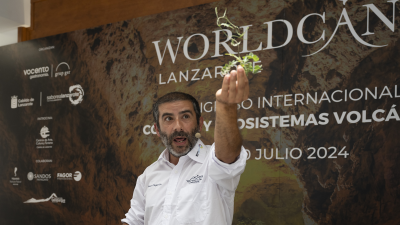
The island of La Graciosa has been the chosen setting to carry out the second day of the Worldcanic 2024 Congress this Tuesday. The round table that was held featured the wild herbs and flowers that grow on volcanic soils and the wide possibilities they offer in gastronomy.
The discussion included Kike Gallardo, biologist and chef co-responsible for the El Herbario Comestible project, Juan Carlos Godoy, technician at the Biosphere Reserve Office of the Cabildo de Lanzarote, and Montserrat Rodríguez Mesa, biologist at the Geopark of Lanzarote.
The three have highlighted the exceptional characteristics of volcanic soils, very fertile due to the abundant presence of minerals and with a high presence of rofe and jable that reduce water evaporation and facilitate filtration. Plants grow in these soils that "we sometimes call weeds out of pure ignorance," explains Kike Gallardo.
This biologist and cook encouraged chefs "to get to know them and use them in their dishes to achieve not only the use of natural resources, but also greater awareness of the environment." For his part, Juan Cazorla reinforced the message by listing the multiple varieties of species, native and exotic, that can be found, for example, on the island of Lanzarote. This is the case of purslane, with a high content of Omega 3; sow thistle, very similar to thistle; the burnet, whose pods taste like mustard with a spicy touch; the sorrels, with their acidic and vinegary point; or the prickly pear, a truly multipurpose plant.
Cuisine with volcanic awareness
That use of natural resources offered by volcanic areas that has been proclaimed by the round table of the day is already practiced by the chefs who have participated in this session. This is the case of Fina Puigdevall and Martina Puigvert, mother and daughter in charge of the kitchens of Les Cols (Olot), in the heart of the volcanic region of La Garrotxa. The passion of both for their territory also derives in the utmost care and respect for native varieties, such as buckwheat, which they grind in their own mill and serve in all its forms, from grain for false rice, in flour, in flower or in drink.
Also the Santa Pau bean, with which they make "a very volcanic dish that also includes pork knuckles, turnip and vegetable bacon", or the native onion "sweeter because it is volcanic", with which they make a delicate onion royale that they accompany with roscón de Olot, bread crumbs and licorice. Another important stop, the elderflower, with which they enrich many dishes, and even make a soft sparkling wine.
On the other hand, another of the standard-bearers of local and nearby products is the chef Miguel Ángel Expósito, who makes a proposal based on traditional recipes in his Retama restaurant (Ciudad Real) that shakes with passion and modernity. The chef now knows, and has explained it to the attendees of the congress, that although ancient and extinct, the volcanic soil of Ciudad Real offers numerous benefits to its crops, such as the singularity of wines and oils that the recent Designation of Origin Campo de Calatrava collects. "They are a total of 16 municipalities spread over about 5,000m2 of extension, populated by about 240 volcanic buildings, surrounded by lagoons and with extreme temperatures, which conditions its fauna and flora." Land of Iberian lynx, and wild boar, the golden eagle, black stork, black vulture, red partridge, duck, and plant varieties such as black garlic, large gladiolus, mauve geranium or yellow saffron abound.
The scientific note of the day was given by the geologist and official at the OASP Earthquake Planning and Protection Organization (Athens, Greece) Maria Manousaki. The Greek researcher, who has reviewed the 40 million years of activity of the Greek volcanic arc, wanted to highlight during her speech the importance of prevention. "It is convenient to be prepared," warned Manousaki while recounting that for this reason, and after a large increase in seismic activity was detected in 2011 after an eruption in the Santorini area, a scientific committee was created in her country whose main function is "the monitoring of volcanoes to be able to develop effective protection and action plans in case of emergency". Although the volcano is now in a dormant phase, "we cannot fall asleep," recalled the geologist.

Add La Voz de Lanzarote as a preferred Google source.
Stay informed with the latest current news.