
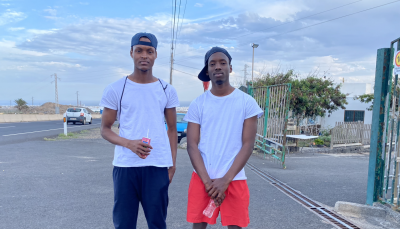
Jalou Algasir's, 19, journey to Europe began four years ago. Originally from Guinea (commonly known as Guinea-Conakri), the young man left his native country when he was only 15, in the midst of the coronavirus health crisis. That year, in 2020, more than half a million Guineans left the country, stricken by the crisis, corruption, inequality and the effects of the climate. To which must be added hundreds of thousands of internally displaced persons due to the floods that cyclically affect this West African country.
In 2021, a coup d'état against what had been the first democratically elected president in more than a decade culminated in a situation of political instability. The following year, Mohammed, also 19, decided to leave Guinea in search of a new life.
Neither of them set foot on European territory until last Sunday, November 3, 2024, when a Maritime Rescue boat rescued him and another fifty African people from the inflatable boat in which they were traveling and transferred them to Puerto Naos, in Lanzarote.
That same day, the body of a young Moroccan woman in her twenties was recovered who died trying to reach the Canary Islands. Luckily, the boat of Jalou Algasir and Mohammed did not have to mourn any deaths on the deadliest route in the world. Another boat also sank, leaving dozens of families with the uncertainty of not knowing where their loved ones were.
Both decided to leave their country fleeing the lack of opportunities and repression. "There we were children and our families did not have the means to pay for school supplies or take us to school," says Mohammed, "this pushed us to leave the country and come to look for an opportunity here." According to the Human Development Index, which is carried out annually by the United Nations and where the economic development of a country, health, education and income are measured, Guinea is one of the countries in the world with the worst quality of life, occupying the 182nd position among 190 countries.
Guinea, known as Guinea Conakri to differentiate it from Guinea Bissau and Equatorial Guinea, is surrounded by countries such as Sierra Leone, Ivory Coast, Mali, Guinea Bissau and Liberia.
Jalou Algasir left Guinea when he was only fifteen years old. On his trip to Europe, he first crossed to Mali accompanied by his uncle. After that, he continued his journey until he reached Algeria and finally crossed the border to Morocco. Two years later, Mohammed made the same journey. "We are like brothers, we know each other from the Guinea countryside, but we did not leave the country together," they clarify during an interview with La Voz.
On their journey to Europe, the two young Guineans came face to face with racism and the danger of the trip. After passing through Mali, they faced harsh living conditions in Algeria. "Life in Algeria is not easy at all, the people who are there are not well housed, they are not well fed," they continue, "we sleep in the desert or in houses that have no shelter or roof. We were always running away from the police."
The situation for black people who migrate to North African countries is dangerous and they often face racism. "There we suffer too much, in fact there is no freedom, we suffer too much racism," says Algasir. "They have a slightly lighter skin, that's why they treat us like that. There they tell us that we are animals, they can see you in the street and crush you like bugs and even throw stones at you," they emphasize.
This repression against black people who migrate extends throughout "all the countries of the Maghreb: Tunisia, Algeria, Morocco and especially Libya," they say.
Jalou Algasir and Mohammed met again on the coast of Tan Tan, in Morocco, when they were going to get on the inflatable boat with which they arrived in Lanzarote. "When we got close to the coast we ran out of fuel. Then we were able to get coverage and they told us to wait there."
"In the boat you have one foot in life and the other in death. You put one foot in the sea and you can die and you go back to the boat and you can live. It was not easy, you have nothing to eat, in fact you have nothing, so only God can help you survive," says Mohammed.
According to the Monitoring of the Right to Life of Caminando Fronteras, in 2023 a total of 6,007 people died in inflatable boats and canoes heading to the Canary Islands in 128 boats.
Despite the living conditions in the place, in 2023 Spain only accepted 50 applications for refuge and three for subsidiary protection from people born in Guinea. While it denied 237, according to figures from the Ministry of the Interior.
Algasir and Mohammed believe that their migratory path will not end in Spain and hope to reach France, specifically the city of Paris, to start a new life. "When I get to France, the first thing I want to do is study. In my country I didn't have the opportunity to do so, so when I manage to go there I want to continue my studies," says Mohammed.
Meanwhile, Algasir adds that "the first thing to do is to study because you can't do anything without studying. I want to be an entrepreneur and work in the real estate sector."


