
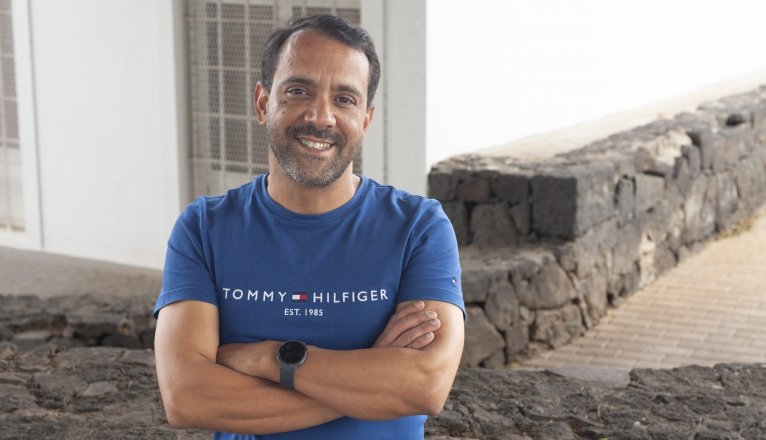
Being scared is not the same as having an uncontrollable urge to go to the bathroom due to feeling a lot of fear (chijarse) nor is looking out a window the same as alongarse, which is much more graphic and shows the idea of having half the body outside. "Language expresses a way of feeling and seeing the world," explains Zebensuí Rodríguez, member of the Canarian Academy of Language and a graduate in Hispanic Philology from the University of La Laguna, who delves with La Voz into the value of Spanish spoken in the Canary Islands.
The professor explains that "to give up using words like alongar is not only to give up a part of our linguistic identity, but it is also to give up a nuance of meaning, a semantic intuition that comes to enrich the language". In this way, although words can be used as synonyms, they do not necessarily mean the same thing.
In Lanzarote and La Graciosa, a small child is not simply a minor, but rather is a chinijo and being a chinijo is not simply being a child. A chinijo has grown up near the sea, with the smell of saltpeter, walks with skill over the callaos and when he reaches adolescence learns to play chinchón or ronda at the tables of the teleclub.
Fight to preserve the language or accept that it is lost?
Language is in constant change and is crossed by the history of each place. Currently, the irruption of technological language, marked by the strong use of Anglicisms, converges with the population flows of Lanzarote, where there are municipalities in which the inhabitants born in the Canary Islands are only around 30%, as is the case with Yaiza. This reality makes one wonder if part of the Canarian dialect will end up being lost.
This professor explains that two cases can occur, that in Lanzarote "linguistic accommodation occurs and the Canarian speaker abandons certain forms that he considers vernacular for more general ones to guarantee communication" or, on the contrary, as a reaction to the confluence of people from other territories, "enhance their way of speaking", as a sign of identity. "A friend told me, I'm going to keep saying chinijo and fonil and if I have to clarify it to the person listening to me, I clarify it", he exemplifies.
Making predictions about the future of the language, is "very difficult", but when analyzing the linguistic reality of the archipelago it is common to come across words that narrate the historical influence of other populations on the Canarian dialect. For example, gaveta, a Portuguese loanword that refers to a drawer, or encachazar, another Portuguese loanword that alludes to when an object, especially clothing, is very dirty. This philologist explains that constant relations with Portugal between the 15th and 17th centuries led to the entry of other terms such as casa terrera.
The Spanish spoken in the Canary Islands not only has influences from Portugal, but also shows terms originating from French, such as jable, or from the constant migratory movements between the islands and the American continent, such as the term pibe or guagua.
"In the Canary Islands, a long time ago we suffered from that belief —which unfortunately still persists— that our way of speaking was inferior to others. We came to think that our way of speaking was less legitimate, less correct, to even feel at some point a certain shame of our way of speaking," explains Rodríguez, who adds that currently "we have a greater knowledge of what linguistic reality is."
A sample of this cultural empowerment is the success, also outside the Canarian borders, of authors like the Lanzarotean Lana Corujo, who with her work They have sung bingo, where the use of Canarianisms and the description of people and landscapes of the island predominates, has sold thousands of copies; or the work of Donkey's belly, by the Tenerifean Andrea Abreu, who captured in black and white the orality of the Canarian dialect. Rodríguez states that before, writers like the Lanzaroteans Félix Hormiga, Ángel Guerra or Benito Pérez Armas vindicated their culture.
Each island has its peculiarity
Although Canarian Spanish is a common dialect for the entire archipelago, concepts like chinijo show that each island has its singularities. "It is evident, any speaker of Canarian Spanish will perceive it this way, that there are differences between islands," Rodríguez explains. In Lanzarote, for example, he indicates that it is common to aspirate the r, when it comes before an l: "For example, saying Juan Cal-los instead of Juan Carlos".
Perhaps, the clearest difference is the one registered by the accent of people from Gran Canaria, where the consonants that are in front of an s are pronounced as if they were two d and is registered in phrases like: "They are the two."
At the other end of the archipelago, on the island of El Hierro, this philologist describes its accent as "more conservative", compared to the innovative character with which he defines the pronunciation of Gran Canaria. "El Hierro maintains certain linguistic forms, for example, the full pronunciation of the s", he explains. In the western islands, the Gomeros also use "vosotros", despite the fact that in the rest of the archipelago "ustedes" is more widespread, which functions as a symbol of identity.
This professor and expert in Canarian speech points out that the geographical separation between islands makes them "small speech communities", but with their similarities.
Ajaches, gofio, guirre or tabaiba: the Guanchisms that remain to us
The language and its words tell the story of the island and that of those who have inhabited it. Among them, the guanchismos are those words, toponyms or expressions that come from the aboriginal languages spoken by the first inhabitants of the archipelago and that still resonate in the islands. For example, the word guirre (Neophron percnopterus), a subspecies of the common Egyptian vulture and the only scavenging raptor that lives on the islands, comes from the Tamazight or Canarian Berber languages. This bird is critically endangered and with its disappearance not only would a unique species in the Canary Islands be lost, but also an island term.
In the work Los Guanchismos. Dictionary of Toponymy of the Canary Islands, prepared by Maximiano Trapero and with the collaboration of Eladio Santana, 414 guanchismos are collected only in Lanzarote. The guanchismo dictionary includes words like Famara or Femés, but also gambuesa, which refers to a large stone corral where goats are normally kept.
Among the words that still endure today, chinijo is also found, which is the name given to the archipelago composed of La Graciosa, the islets of Alegranza and Montaña Clara, as well as the rocks of the East and the West, although this denomination seems to have been imported.
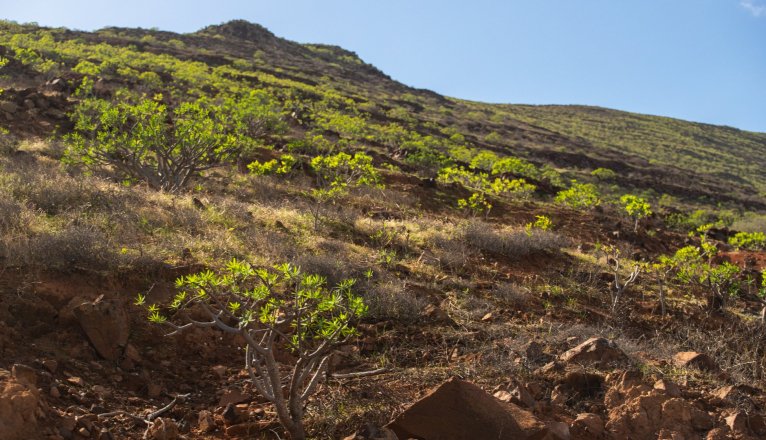
The list is long and some Guanchisms are found as soon as you open the window, concepts that refer to vegetation like the tabaiba, so characteristic of the landscape of Lanzarote or the best known in the Canary Islands, gofio.


Add La Voz de Lanzarote as a preferred Google source.
Stay informed with the latest current news.