The loss of containers loaded with bags of pellets (small plastics with a round shape) on the Portuguese coasts has triggered the presence of plastic on the coast of Galicia and in other communities in the north of the Iberian Peninsula. However, the existence of this type of material is not new to the Canary Islands.
These days, the regional government has decreed a pre-alert throughout the Archipelago due to the discovery of pellets in Tenerife. The Doctor of Oceanography Alicia Herrera Ulibarri is a researcher and is part of the Ecophysiology Group of Marine Organisms (EOMAR) of the IU-ECOAQUA of the University of Las Palmas de Gran Canaria. Among other branches, she is in charge of studying the effects of microplastic pollution on marine ecosystems in the Canary Islands.
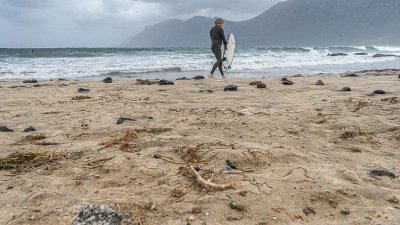
One of her lines of research was based on the analysis of microplastics and tar pollution on three beaches in the Archipelago, including Lambra and Famara beaches, in La Graciosa and Lanzarote, respectively. The choice of these beaches is due to the fact that, due to their orientation to the north or northeast of the islands, they are more exposed to the Canary Current, so they receive these microplastics and accumulate them.
Since 2015, when the aforementioned research took place, this team has been studying the effects of plastic on marine organisms. To do this, they experimented with fish in the laboratory. For 60 days, they mixed 10% of microplastics with the food to find out what their evolution was. "We realized that some of the chemical contaminants associated with plastics can pass into the liver," she explains to La Voz.
Alicia Herrera Ulibarri adds that the chemical contaminants associated with the microplastics that arrive in the Canary Islands "stick" to the walls of these pellets when they remain in the ocean by coming into contact with the chemical contaminants that are found in low concentrations in the water.
"The toxins it releases depend on the chemical contaminants they have associated with them, the concentrations of these contaminants, or the ambient temperature," she explains. Thus, plastic absorbs (attracts and retains) different contaminants on its walls.
In total, they have found more than 80 different types of contaminants. The most frequent contaminants are flame retardant pesticides and ultraviolet filter derivatives.
The investigations into the presence of plastic on the islands have not yet been able to conclude where these plastics come from. However, they have advanced that the Canary Cold Current carries the spills from the coast of the United States and Canada to the islands. In addition, there is an interactive map created by PlasticAdrift where you can see what happens when you release a rubber ducky anywhere in the Ocean.
"Also, even in the Peninsula there are losses in the plastic industry that end up reaching rivers and through them to the sea. So what reaches us, we don't know where it comes from, but what is a reality is that they are arriving continuously," adds the biologist.
"It is sad that this had to happen in Galicia for visibility to be given to a problem that has been happening for many years in the Canary Islands," laments the Doctor of Biology.
Regarding the decomposition of this plastic, Alicia Herrera Ulibarri narrates that residues of 20 or 30 years old can arrive, since the plastic can remain in the sea for many years. For example, in one study she was able to verify that the lobster trap labels that they have located in the samplings were more than 20 years old and remained in good condition.
In the Canary Islands, the plastics that are most commonly found are polyethylene and polypropylene, which are the most used in the industry. So, the only way to reduce the presence of these residues is to stop their production and consumption. "Above all, starting with single-use plastic. It makes no sense to use a material that resists so many years in the environment for just a few minutes," insists the researcher.
Cleaning the coasts
On the other hand, to deal with the plastic that is already in our seas and that returns to land during storms, cleaning the tide line is another point to take into account. "Large amounts of microplastics can reach the coasts, as we have seen many times, a significant amount were pellets," indicates the researcher. For example, in the field study carried out on Famara beach in October 2015, 40% of the material collected were pellets.
To collect these residues, it is recommended to use gloves, strainers or sieves to avoid directly touching the microplastics. As well as removing it "as quickly as possible" from the coast, because once they are in the ocean it is very difficult to collect them or if they stay on the beach they will begin to mix with sand and algae.
For this, experts use two methods: flotation or strainer. In the first case, it involves filling a bucket with sea water and putting the remains of pellets that are entangled between algae and other living animals inside, so that the microplastics will float and it will be easier to collect them. While the second option is to use a strainer to filter the sand and only extract the residue.
On the other hand, this researcher points out the importance of having "an alert system, a warning" so that the cleaning teams are prepared in case of microplastic spills and thus measures are taken as soon as possible.
Another problem to be solved by the institutions is the creation of a space where these products can be recycled, which come dirty with other chemical contaminants attached. "We have a few boxes of microplastics that we then use for laboratory experiments and for their study, but they are not really recycled," she indicates.
Microplastics on uninhabited islands
The islets of the Chinijo Archipelago, Alegranza and Montaña Clara, receive macro and microplastics. "Obviously, these microplastics are not removed because it is impossible due to the characteristics of the area and the difficulty of collecting them and the difficulty of getting there. Within the framework of the aforementioned project of the University of Las Palmas de Gran Canaria, Herrero travels to Alegranza once a year to carry out monitoring and cleaning of macroplastics together with the NGO WWF.


Add La Voz de Lanzarote as a preferred Google source.
Stay informed with the latest current news.