
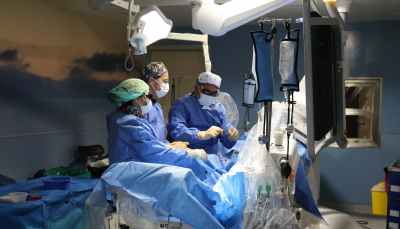
The Hemodynamic Cardiology and Vascular Surgery Unit of the Doctor José Molina Orosa University Hospital, attached to the Ministry of Health of the Government of the Canary Islands, has carried out around 800 interventions since its launch in September of last year, exceeding expectations and estimates made at its opening.
In this first year of operation, the Hemodynamics team has treated a total of 71 patients for Code Infarction, an emergency caused by myocardial infarction that until the opening of the new unit forced patients to be transferred by helicopter to the Doctor Negrín University Hospital of Gran Canaria, with the consequent delay in the care of this pathology.
Of the total interventions performed, 645 cardiac catheterizations, 340 diagnostic studies and 294 diagnostic and treatment interventions were performed.
Likewise, the Cardiology staff has implanted a total of 97 pacemakers, three insertable automatic cardioverter defibrillators and a cardiac resynchronizer during this first year, all interventions that required the transfer of patients to the reference hospital in Gran Canaria until just a year ago.
Diagnostic vascular surgery
As it is a multipurpose room, work has also been carried out in collaboration with the Vascular Surgery service for the diagnosis of peripheral vascular disease, and a total of eighteen arteriographies of the upper and lower limbs have been carried out. In this line of collaboration, the Hemodynamics Unit plans to incorporate endovascular treatment soon.
In addition, in a short period of time, and according to the service offer planning, it is planned to add care for the diagnosis and treatment of arrhythmias by means of electrocatheters.
A qualitative leap in care
The head of Hemodynamics, cardiologist Carlos Vasquez, expresses his satisfaction with the work done by the entire team and values "the development and operability of the unit to provide adequate health care to the population of the island and to the people who visit us." In addition, he emphasizes that "one year after its inauguration, we see that the data initially planned have been greatly exceeded."
For his part, the manager of the Lanzarote Health Services, Pablo Eguia, considers that the Hemodynamics Unit "has meant a qualitative leap in care and has benefited the users of Lanzarote."
On the other hand, he values the effort made by all the professionals who carry out their work in the Hemodynamics room, since "they have assumed the management of a unit equipped with cutting-edge technology and have paved the way to achieve comprehensive treatment of patients with coronary pathology and cardiovascular rhythm disorders."


