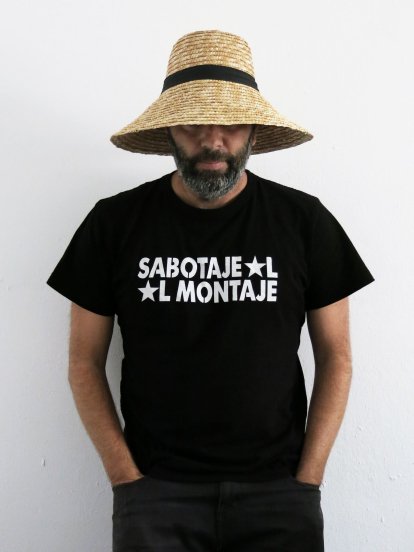
Graffiti artists were persecuted 20 years ago in the Canary Islands. Now, in more open islands, even institutions pay muralists to leave this plastic art on facades or inside buildings. However, at a time when it is more frequent in the capital islands, in Lanzarote graffiti intersects with the debate on landscape preservation.
Matías Matas (Lanzarote, 1973) is one of the renowned artists in Canarian and Spanish muralism, with international recognition. He was born in the town of Mácher, in the municipality of Tías, a town with just over 1,200 inhabitants. However, after several family moves, he passed through Fuerteventura and Gran Canaria, and at the age of 26 he moved to Tenerife to study Fine Arts.
His love for drawing arose from childhood, although it was not until the early 90s when he came across the art of graffiti. Matas was one of the skaters of the time and it was the board that led him to discover the paintings on the facades. "When I started seeing images of graffiti in skate films and documentaries and the drawings on the boards, that's when I started painting in the street and until now," he tells La Voz.
He doesn't forget his first graffiti. It was at three in the morning in the Escaleritas neighborhood, in Las Palmas de Gran Canaria. "I was with two friends and we got hooked on painting at night," he confesses. His first steps in this spray-based painting were not easy and on several occasions he clashed with the censorship of the time. Among them, with that of a public university in the Peninsula.
After 34 years as a graffiti artist, it has been the last ten when he has been able to live economically from it. "Right now it has become a labor structure in all the islands, many artists can enjoy it," he adds.
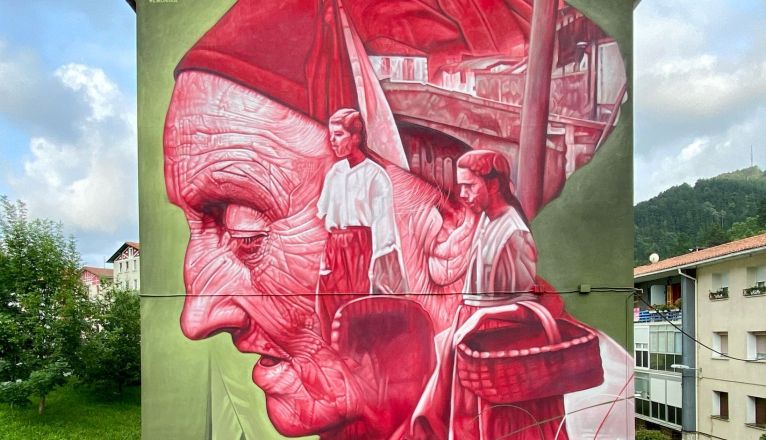
Much has happened since then, as the artist who hides behind Sabotaje al Montaje has just received the award for the best mural in the world in the social impact category for a work painted in Ondarroa (Vizcaya).
"This is the result of the work I have done in the Canary Islands, which has cost me a little more than other colleagues in other parts of the world," reveals the artist.
The reasons that led the graffiti artist with international projection to dedicate himself to the world of muralism stem from his love of painting in the street and sharing his art with everyone.
In addition, the most special reason is his eagerness for the "ephemeral" in a work that fades with the passage of time "to leave space on the walls for the generations that will come after him."
'Sabotaje al Montaje' and the neighborhoods
Matías Matas grew up in two neighborhoods of Gran Canaria, Escaleritas and La Paterna, which has made his love for the neighborhoods transversal to all his work. "I started painting the neighborhoods, the people of the neighborhoods and I still do," he confesses.
The Lanzarote native does not hide his love for the "peculiar characters" that become a symbol of each neighborhood and that are part of his figurative facet as an artist. . "It is important because we miss those characters when they disappear," he continues.
For him, painting in the neighborhoods is "a way of decentralizing culture", soaking the towns with art and "accessing their memory" while "giving importance to the place where we live."
When he turned ten years as a graffiti artist, the artist decided to present himself to the world as Sabotaje al Montaje, as a result of his first participatory projects, where "the population painted and the artist helped to develop their activity." After taking these initiatives from Gran Canaria to Tenerife and Barcelona, he decided to present himself to the world with a new name. Before that he signed as WIP and a worm.
"'Sabotaje al Montaje' was born from the manifesto that in this society in which everything is a set-up, I sabotaged it with art," says Matías Mata
To his figurative facet, which he has dragged from his beginnings to the present, he adds an abstract side, where he mixes color and brings the beginnings of graffiti to the present. "That heritage of graffiti is more recognized outside of here, that abstract facet more than the figurative one," he explains.
Art, landscape and the environment
In addition to the social component found in his murals, Matías Matas reveals the importance of the environment in his work. "Nature has been neglected in our society, but I have always felt a connection with respect for nature and I think that the next generations will not be able to enjoy it in the same way," says the artist.
Matas has worked on dozens of works in the Canary Islands. Far fewer have been done in Lanzarote, his native land. After 34 years as a graffiti artist, it has been the last ten when he has been able to live from it. "Right now it has become a labor structure in all the islands, many artists can enjoy it," he adds.
"I have painted in Lanzarote occasionally, but it has always been indoors and for private companies. The first one I did was in 2007 in El Almacén and there was criticism even from my family. It was 2007 and it was a mural. There were only some murals by César Manrique somewhere," exemplifies the painter.
About the debate between the preservation of the landscape and art. "I always say that since I'm there I can't comment because I've been away for many years. That protection seems good and necessary to me but there are some tourist areas that are very ugly," exemplifies the man behind Sabotaje al Montaje, who opens the possibility to graffiti in tourist spaces or in areas of Arrecife. "In no case will graffiti step on the legacy of César Manrique," he continues.
"The nature of Lanzarote is more artistic than a mural, you can't fight against that, but you have to dialogue, not censor," defends Matías Matas.
The visual creator denounces the situation of some urban artists on the island who must "repress or hide." At the same time, he raises the possibility of creating spaces where art and the preservation of the territory coexist, as César Manrique already showed throughout his work.
In this line, he reveals that the French tourist, of international renown, who painted the ruined Canarian houses "slipped" by making the drawing without having informed herself before of the place where she was going to paint. However, he points out the importance of the preservation of the territory and the debate that opened when the creator exposed how some abandoned houses in the Canary Islands were: full of garbage and in ruins.
"Being an artist with a worldwide impact that she published how we have the heritage, that also has to be worried about," he concluded.


Add La Voz de Lanzarote as a preferred Google source.
Stay informed with the latest current news.