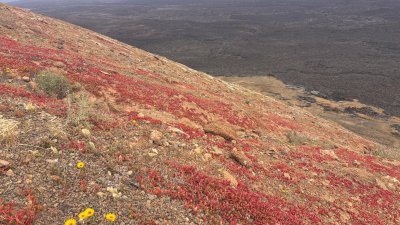
The abundant autumn and winter rains made Lanzarote dress in a great green mantle from north to south for months. However, now this green landscape has transformed into a reddish color due to a species of flora whose seeds were the sustenance of many families in times of famine: the cosco (Mesembryanthemum nodiflorum).
It is a species recognized as probable native species (NP) that is found on all the Canary Islands, according to the CanariWiki website of the Government of the Canary Islands. It is annual, meaning that it completes its life cycle in one year germinating, flowering, dispersing its seeds, and dying.
Its leaves are covered with a kind of shiny crystalline papillae that protect it from water loss. As for its length, its branches can reach fifty centimeters in length if conditions are optimal.
Despite its red color that we can appreciate in different areas of Lanzarote, in the first stage of life of this plant its leaves are green. The intense reddish color is reached when it reaches its full maturity, creating a very striking image.
During February and July, coinciding with the autumn and winter rains, the cosco presents small yellowish-white flowers, which give rise to capsules containing its seeds.
Its spectacularity is not only due to its color, but also to its use in the past as food during periods of famine, but also to its use to create soda ash, just as was done with barilla or patilla.
Likewise, throughout the 20th century during times of famine in World War I, the Spanish post-war period, and World War II, the cosco became one of the lifelines for the population that had nothing to eat due to conflicts and the complexity of importing cereals. The cosco seeds were toasted and ground to make a type of gofio, which calmed the hunger of generations.


Add La Voz de Lanzarote as a preferred Google source.
Stay informed with the latest current news.