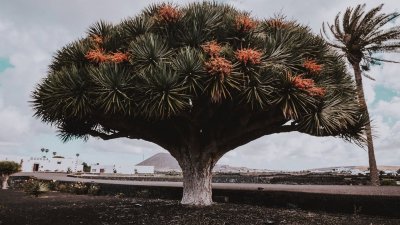
It is widely known that Lanzarote is not an island with forests, although it does have great biodiversity. However, in each municipality there are certain singular trees that were planted by the people of Lanzarote centuries ago and represent an incalculable historical, heritage, and natural legacy. For this reason, the Biosphere Reserve has carried out a preliminary study on the most significant specimens with the aim of creating an inventory that reflects their condition, location, and observations
This inventory also serves as a way to rescue stories and memories that link them to belonging to an island in different times, as many of these specimens are over a century old or have special characteristics, such as the dragon tree of La Florida or the fig tree of Tremesana, in Timanfaya.
According to Rafael Paredes, a biologist with the Cabinet of Environmental Studies (GEA) in charge of carrying out this inventory, the goal was "to locate trees in the environment that have a **value that transcends and affects us all**, that are part of our identity and heritage," all this regardless of whether these specimens were on private property or not.
Steps for Inventory Preparation
The first step of this project has been to analyze documentary information such as archives where trees already registered appear, like the Tremesana fig tree, "one of the one hundred important trees at a Macaronesian level".
"What we did is assess what documentary information exists, such as in Timanfaya National Park, where an analysis of the fruit trees in the park has been carried out and it is **believed that there were originally around 5,000**, but of those, **approximately 1,700 remain**, most of them centuries old, planted after the eruptions by different families and that have names and surnames," explains Paredes.On the other hand, the development process also focused on **territorial analysis**, meaning observing the different specimens found throughout the island. Finally, another point was **social prospecting**. "We realized that most of the specimens were wild, like **fig trees or lentisks**... there's one of the latter species in Tías that has a canopy of over 40 meters," he states.However, the biologist recounts that these trees did not germinate on their own, but rather someone planted them. "Most are fruit trees like **fig trees, almond trees, olive trees, or mulberry trees**, and most are related to people," he points out. It was then that Rafael Paredes proposed to his collaborators, geographer Famara Guadalupe and oceanographer Gara Goñi, to focus the work on finding people and **finding out what they said about these trees**. "We recognized that the importance lay in the connection with people," he continues.
Some of these unique trees are "institutional," meaning they were not planted by individuals but by administrations. Some examples are the ombú (Phytolacca dioica) located in front of the hermitage of Yaiza, the dragon tree (Dracaena draco) of La Florida, or the ficus trees in the plaza of Haría.
One of the trees that should have appeared in this inventory due to its uniqueness was the leaning palm tree of Masdache, which was cut down by vandals in October 2022. This tree became very popular on social media, which led to great fame and its tragic end.
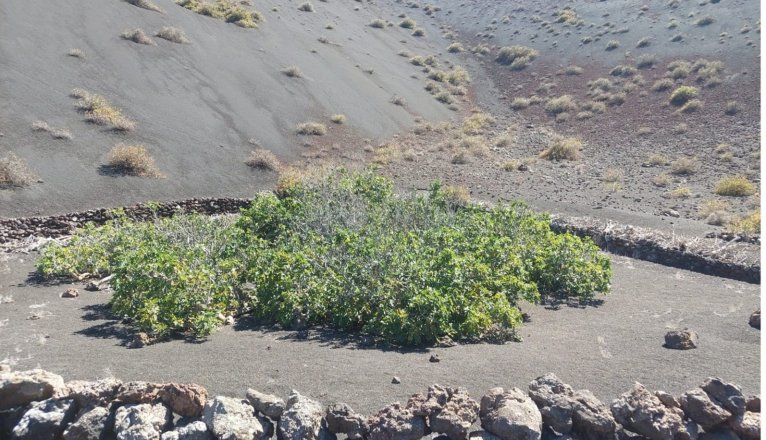
The Tremesana fig tree and the mulberry trees
The fig tree of Tremesana, located within Timanfaya National Park, belongs to the family of Inés Caraballo Medina. As she recounted in an interview for the park's fiftieth anniversary, the Medinas were originally from one of the villages buried by the eruptions of 1730-1736. After that, her family moved to Las Breñas.
From a very young age, she would go with her grandfather, riding a camel, to this fig tree where they "spent a couple of nights." She also recalled how the children were the ones who picked the fruits closest to the ground
"I don't know how to explain what it's like sleeping under a fig tree with that silence... when you're wrapped in blankets, a dry leaf falls and makes a racket, it means the surroundings are pure silence," she assured.
Another of the stories that arise from trees as popular as the **mulberry trees** (or mulberries) and that reflect their importance is the one by Agustín Jordán Romero, a riverside carpenter. In a text titled *The Mulberry Tree and I*, he details **the significance this tree had in his life since childhood**. "When I discovered it as a child, it became my favorite tree of my childhood and over the years it would become the tree of happiness," he begins.
"In summer, as soon as the blackberry season arrived, we would go. My grandparents lived in the town of Haría. Near their house, there were two mulberry trees, one on a farm about a hundred meters from my grandmother's house and another, our favorite, was right in front of my grandmother's house. It was on a fenced farm, the mulberry tree belonged to a man named Benito, and we were friends with his youngest son, Juan Salvador," he continues.
"When I left home to go to the mulberry tree, my heart was bursting with excitement, I was all emotion. My siblings Isidro, Alicia, and I would go. I remember my brother hanging from one branch, my sister from another, and me circling the lower branches, my face, hands, and everything that could be stained purple, almost red. We would go with a container to bring mulberries home, in the late afternoon, and we would pick them until it got dark... we would return home happy," she recalls.
"If I had to rename the mulberry tree, I would call it the tree of happiness," he affirms. "Time passed, I grew up, and by chance, I ran into the mulberry tree again. I became a ship carpenter, and mulberry wood is very good for making frames, ribs, and other boat parts. The remaining wood is used for curved and thick parts in carpentry, and the straight parts for making instruments like chácaras or timples," he says.
"The mulberry tree is not only the tree of happiness, but also of generosity. A few years ago, I planted a mulberry tree in my garden; it's already three years old and has grown a lot in this time. This summer it gave its first harvest, and every time I look at it, I go back to my childhood," he concludes.
Conservation and dissemination through schools
In Paredes' words, this provisional list should **become a definitive one and its dissemination should go through the educational centers** of all municipalities. "We should go to each municipality to talk with the elders and to the schools so that the children talk with their parents or grandparents and try to recover that identity that is established between the tree and the people and, even, **reconstruct those identities** that have been lost," he argues.
"The singular trees of Lanzarote on this island have the enormous faculty of being very linked to the people. As many of them have been abandoned, they die because they complete their biological cycle... fruit trees can be eternal if you give them the right treatment, but if not, they disappear. With the new society, through schools or associations, the Lanzarote that César Manrique dreamed of can be recovered," he concludes.


Add La Voz de Lanzarote as a preferred Google source.
Stay informed with the latest current news.