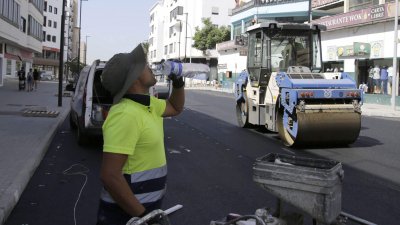
The Canary Islands has suffered the hottest November in its history this 2023. This is revealed by the data from the Climatological Advance prepared by the State Meteorological Agency (Aemet).
"The temperature has remained above the average reference value for practically the entire month, with the exception of days six and seven, when values were taken slightly below," the document stated.
In particular, this increase in temperatures has been more pronounced in the province of Santa Cruz de Tenerife, reaching a climatic anomaly of three degrees more than usual in maximum temperatures. In the case of the province of Las Palmas, the disruption has been 1.6 degrees more in the minimums, 2.3 more in the maximums and 1.9 more in the averages.
Proof of this mismatch is that the island of La Graciosa recorded eleven nights above 20 degrees during the month of November. After the eighth island, in Yaiza there were a dozen tropical nights and at the Aemet station at the César Manrique Airport (San Bartolomé) there were up to six.
The only municipality in Conejero where temperatures remained below 20 degrees during the nights of November was Haría. Specifically, the year 2023 has recorded more tropical nights than the last nine years.
San Bartolomé records the maximum temperature
The César Manrique Airport station recorded the highest temperature last November 13, reaching 31.9 degrees. This record was the sixth highest in the Canary Islands, only above La Palma (30.7) and Fuerteventura (31.6).
Regarding the highest minimum temperatures, 23 degrees Celsius were reported in the Las Vegas area in Tías, last November 14.
It was not until November 21 that a decrease in temperatures was recorded due to the formation of a DANA in the vicinity of the Archipelago. In particular, Aemet has highlighted the minimum temperatures, which remain at "relatively high" values during most of this period.
This month of November is already the 15th driest in the province of Las Palmas, with a precipitation percentage of 38%. In the particular case of Lanzarote, the trough with an associated front that affected the island between November 3 and 7, left 2.4 millimeters of precipitation in 24 hours and in La Graciosa a total of 0.4 liters per square meter. Both islands received the least rain in the Archipelago.
Add La Voz de Lanzarote as a preferred Google source.
Stay informed with the latest current news.