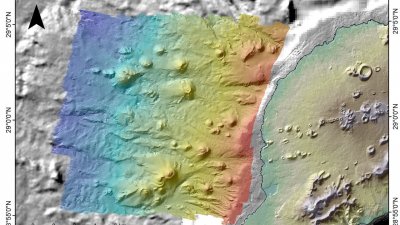
More than twenty submarine volcanoes grew under the skirts of the Timanfaya National Park and reflect that Lanzarote is the island of volcanoes also under the water. For the first time in the history of the island, a group of scientists from the Spanish Institute of Oceanography (IEO) has mapped in high quality the eruptions that occurred west of Lanzarote.
Specifically, the Submarine Canary Volcanology (Vulcana) project of the Spanish Institute of Oceanography has been in charge of making a 3D reproduction in Lanzarote, at the end of December last year, more than 100 kilometers of the coast of Timanfaya with the aim of offering the population unknown information about the other side of the Canary volcanoes: those that were created under the sea.
This initiative has two objectives: to scientifically know the state of the submarine volcanoes and to advise the institutions on the possible risks or how to act in the crises.
After 12 uninterrupted years of work, not even in the years of the pandemic did they stop, they have already mapped the entire coast of El Hierro, La Palma, part of Tenerife and the Enmedio volcano, located between Tenerife and Gran Canaria. Now, Lanzarote is the first eastern island that they have mapped in very high resolution.
"Canarias is a volcanic archipelago that if we look at the surface we can see a lot of volcanoes, but there are the same under the sea", has started the scientist and participant in the expedition that left aboard the oceanographic vessel Ramón Margalef west of Timanfaya last December.
Campaign in the Timanfaya National Park
Although it is not the first time that the seabed of Lanzarote has been studied, it is the first time that its volcanoes have been analyzed. "We dedicate a large part of the loop time of our campaign to carry out a high-resolution bathymetry", Fraile explained.
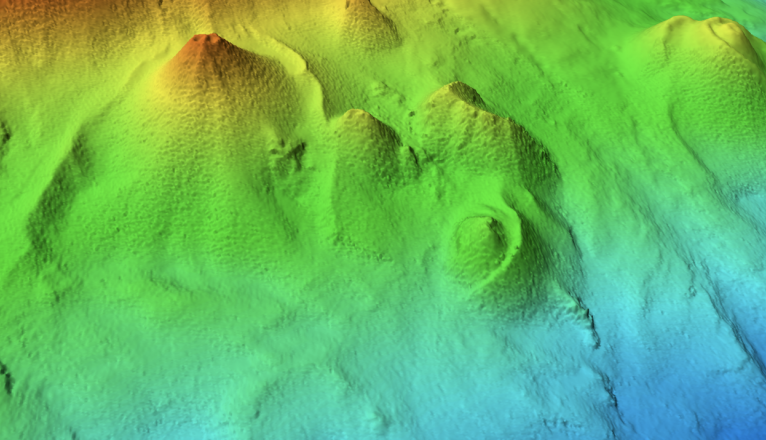
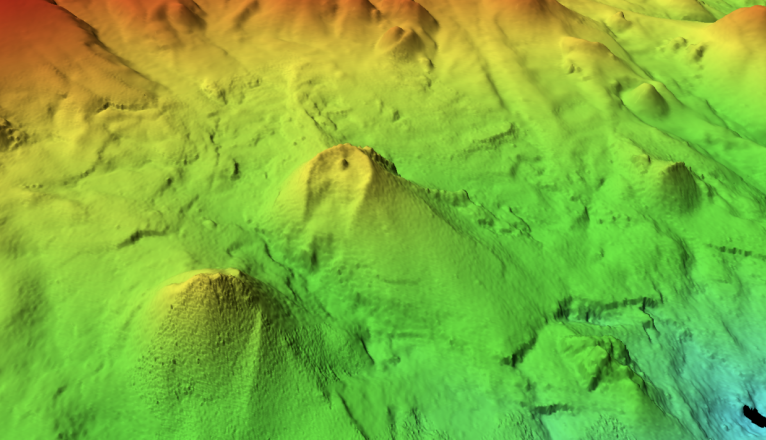
In this sense, they departed from the coast of the Timanfaya National Park to the open sea, covering 100 square kilometers of new cartography. "We have taken some quite spectacular images with a lot of resolution of the volcanic cones of the submarine volcanoes", the researcher has reported.
The technological resources that existed before allowed experts to see mere points, while now they have been able to reflect the volcanic buildings, with their fractures and landslides, which allows them to perform a thorough morphological analysis of these volcanoes, so far unknown.
Specifically, during the week in which they monitored the west of the island, they were able to analyze "with physicochemical instrumentation" a volcano with a double crater. "We put some machines in the water and took them to the interior of each of these craters to see if it had any kind of outlet of gas anomaly, of hydrothermal fluids", Fraile indicated.
After that, they took water samples "very close to the bottom of those craters and well, the first analyzes confirm, no, that that is the portal in particular that we could show, because it did not present any type of anomaly", explained the volcanic physicist.
In the aforementioned investigation, they extracted sediments from the seabed, between 150 and 2,500 meters deep. For this they made use of a box core, which makes a bite in the terrestrial sediments. After that, a part of those samples are studied in the same ship, others are frozen for later analysis, while a small part is destined to another research project of microplastics in the seabed.
The Vulcana project
The Vulcana Project arose in 2011, with the eruption of the Tagoro submarine volcano on the island of El Hierro, as explained by the researcher of the Spanish Institute of Oceanography of the Higher Council for Scientific Research (CSIC) Eugenio Fraile to La Voz. Since then the team has already carried out 38 campaigns to study the hydrothermal sources, the physical, chemical, biological and geological components that occur in the submarine eruptive phenomena of the Archipelago.
Within the framework of this initiative, the aim is to create a puzzle that reflects the oceanic reality of the Archipelago. The Vulcana team tries to clarify in what states the different Canary submarine volcanoes are since "many of them are active in different phases". Thus, the research already has "one of the longest time series in submarine multi-technologies" that exist in the world.
In addition, it is part of the Special Plan for Civil Protection and Emergency Care for volcanic risk in the Autonomous Community of the Canary Islands (PEVOLCA) that is working on the creation of volcanic risk maps for all the islands, in conjunction with the Canary universities and the Higher Council for Scientific Research.
Add La Voz de Lanzarote as a preferred Google source.
Stay informed with the latest current news.