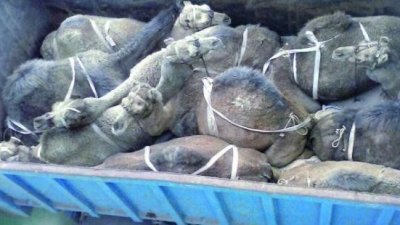
The Timanfaya Camel Breeders Association issued a statement this Monday in its defense. The document comes after the Police opened a sanctioning file this Saturday to the owners of 2 vehicles transporting 15 camels. The animals had just been transferred from Lanzarote to Tenerife, to participate in the Cavalcade of Kings of Santa Cruz. For this, they traveled 18 hours in what has already been described as conditions of "overcrowding" and with their legs tied to remain crouched.
Faced with these accusations, the Timanfaya Camel Breeders Association has issued the following statement:
The Timanfaya Camel Breeders Association strongly rejects the public complaint about alleged animal abuse related to the transport of camels from the island of Lanzarote to Tenerife for their participation in the Cavalcade of Kings. The Association recalls that the camel, due to its behavior, nature and physiology, has a unique treatment, so it wishes to point out the following:
1. The animals left Lanzarote in good health, traveled without suffering alterations and arrived in perfect condition at their destination.
2. In the transport of camels, for the safety of the animals themselves, it is not advisable to make them travel standing up, but lying down, and it is done by grouping them because they are animals that group together to rest and that is how they feel more comfortable. The closer they are, the more stability and comfort they will enjoy inside the cargo bed. Camels even withstand stabling well for a few days, so much so that getting in and out of a means of transport can cause them more alterations than staying inside. It is also an animal that can remain crouched and without drinking water for a long period of time.
3. The fastening straps used in their transport do not affect blood circulation or cause wounds to the animals in any part of the body.
4. For the movement of animals, it is necessary to submit a request and obtain permission from the competent directorate of the Government of the Canary Islands. The camel herders affected by the complaint complied with this procedure. Both the carrier and the means of transport are duly registered and the camels traveled with the veterinary card that identifies each animal and certifies the absence of symptoms of disease.
5. The camel herders have always offered excellent treatment to the animals, complying with all veterinary controls, working to exercise the profession in a dignified manner and ensuring the maintenance of the species. Uga has the most important camel herd in Europe.
6. Our activity, with tourist rides, since the fifties, and occasional collaborations in pilgrimages and Cavalcade of Kings in several municipalities of the Canary Islands, has been transparent and without a history of animal abuse, as it is not in the situation at hand.
7. We regret that the lack of information about the behavior of the species and the activity of the camel herders leads to a complaint that we are convinced will end up being clarified.
8. We respect and care for the breed not only because it provides sustenance to many families on the Island, but also for its significant historical value in our culture. The camel was used many years ago in farming tasks and since the sixties it has an indisputable tourist interest accentuated with the passage of the years.
Add La Voz de Lanzarote as a preferred Google source.
Stay informed with the latest current news.