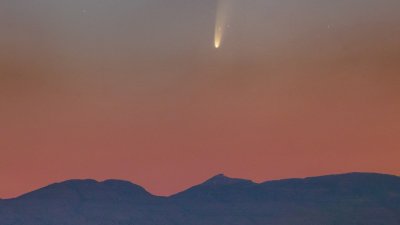
This weekend you can see "with the naked eye" the brightest comet of the last decade. Astronomy enthusiasts have been waiting for this moment for almost a decade, after the fragmentation suffered in May by the ATLAS comet, whose increasing brightness could have reached that of Venus (the morning star), had it not fragmented during its approach to the sun.
The NEOWISE space telescope (which has among its objectives the search for objects near the earth), discovered on March 27 a new object orbiting around the sun with the characteristics of a comet, showing a condensed central nucleus and a tail that comes out of it in the opposite direction to the sun. It was called comet C/2020 F3 Neowise.
Since then, observations of this comet have made it possible to determine its orbit with precision, which is very elongated, periodic and retrograde (it moves in the opposite direction to that of the planets), completing a revolution around the sun every 3,000 years.
This new comet reached its closest approach to the sun on July 3, at only 0.29 Astronomical Units from it (an astronomical unit is the distance between the earth and the sun, approximately 150 million kilometers), reaching temperatures close to 600 degrees Celsius, which caused an intense sublimation of the volatile materials present in the nucleus and the formation of an extensive "tail" of gas and dust particles that extends over millions of kilometers.
The great activity of the nucleus has also produced a great increase in the brightness of the comet, which although it will decrease as it moves away from the sun will allow us to see it with the naked eye from the earth in the coming days from our latitudes.
How to observe it
The best days to observe the NEOWISE comet with the naked eye from Lanzarote (weather permitting) will be next Friday, July 10 and Saturday, July 11, when it can be seen before dawn, from 5.45 local time. At that time the comet will be in the northeast over the horizon at a very low altitude, almost glued to the ground, at only 3º altitude, but it will increase in altitude in the following minutes until it reaches about 12º above 6.30 hours, when despite continuing to gain altitude it will begin to "fade" due to the effect of sunlight at dawn.
From July 14, the comet can be seen at dusk, but with less brightness than it will present these days, so its observation with the naked eye will become more difficult but it will become an easy target within reach of small amateur telescopes.
Those responsible for the two astronomical observatories accredited by the International Astronomical Union in Lanzarote, Gustavo Muller (Observatorio J47) and Agustín Domingo Acosta (Observatorio Z39), advise that the observation site be as favorable as possible, with a clear northeast horizon, with a certain height and away from cities or lights that make it difficult to see because even a bright comet, like this one, can "disappear" due to the thin clouds on the horizon, the haze, the humid air, the smoke, the twilight glow, the city lights or the moonlight. They also recommend the use of binoculars, as they facilitate the location of the comet and allow to better capture the less bright part of the comet's tail.
Muller and Acosta recently participated in the monitoring of the ATLAS comet whose nucleus fragmented as it approached the sun, frustrating the forecasts that, according to the evolution of its brightness since its discovery in December 2019, made it a firm candidate to be one of the brightest comets of the last decades, with a luminosity equivalent to that of the planet Venus, popularly known as "the morning star" (the brightest object in the night sky after the moon). The observations of both have been published in the Astronomy magazine of last June for having accurately captured the key moments of the fragmentation of the nucleus.


Add La Voz de Lanzarote as a preferred Google source.
Stay informed with the latest current news.