
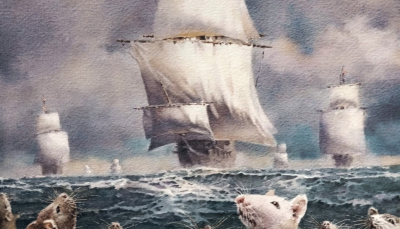
The author Alberto Vázquez Figueroa has published this September 27th his new book 1622. The Ship of Rats which will be presented on October 24th in the Sala el Fondeadero, in Puerto del Carmen, at 7:30 p.m. It is the first time that Vázquez-Figueroa has made a book for a Canarian publisher (Editorial Herques) and it is also the first time that Vázquez Figueroa has made a publication with two well-differentiated parts: the first, the novel itself, and the second part corresponds to the historical-scientific, based on real events.
Several Canarian researchers collaborate in this historical part: Daniel García Pulido, Manuel Lorenzo Arrocha and Juan Francisco Delgado. The book also has a prologue written by the writer Cirilo Leal Mújica and by the professor of Archeology and Canary Islands Prize, Antonio Tejera Gaspar.
Likewise, it is necessary to mention the collaboration with two phrases on the band that borders the book, by the prestigious professors and researchers Carlos Martínez Shaw, Emeritus Professor of Modern History at the UNED of Madrid and Germán Santana Pérez, Professor of Modern History at the University of Las Palmas de Gran Canaria. For his part, the cover and back cover of the book were made by the painter Miguel González Rodríguez, and had the collaboration of María González Correa and Lucía González Correa.
In addition, numerous institutions of the Canary Islands collaborate in this publication, including the Government of the Canary Islands (General Directorate of Cultural Heritage), Ports of Tenerife, several Island councils, including the Cabildo de Lanzarote and numerous municipalities of all the Islands, including Tías.
1622. The Ship of Rats is a book in which a series of real events are recounted, which have been the subject of analysis and historical research, as it appears in the second part of the work. This well-documented information has provided a set of data of great interest, the foundation on which Alberto Vázquez-Figueroa has written the novel of this title, displaying the great narrative mastery to which this creator has accustomed us in his long career as the author of more than one hundred books, considered one of the most widely read contemporary novelists in Spain and in the world.
The work is divided into two parts, well differentiated by the color and type of paper in each of them. It is also complemented by numerous illustrations. To learn about the ins and outs of the 1622 expedition of the Fleet of the Indies, the valuable references of the Carmelite chronicler Antonio Vázquez de Espinosa have been consulted, who tells us in his text a series of high-impact scenes, full of crudeness and danger, produced by the devastation suffered by the boats, due to the onslaught of several storms, but, above all, by the invasion of a terrifying plague of rats that appeared in the ships. Hungry rats that attacked the sailors, birds and other animals they carried on board, and even the cats themselves. More than three thousand would be killed.
The armada left the Andalusian ports in 1621, made up of 33 boats. It made a stopover in the Canary Islands, as usual, while only seven boats would return to the Peninsula at the end of 1622. Bad luck haunted the survivors, since when they were near the port of Cádiz they were assaulted by Dutch pirates who roamed those waters.
From the aforementioned expedition to the Indies there are still many enigmas to be solved, among them, the reasons that would induce General Fernando de Sosa, who was in command of the fleet, to have ventured to set sail from Havana to Spain on a date that coincided with the season of great storms, common at that time of year. The losses of the cargo of gold, silver and other raw materials with which the ships were loaded remain to be assessed. Many other enigmas of that cursed fleet of the Indies will continue to be buried for a long time in the waters of the Atlantic.


